
A 32-year-old with C5 spinal cord injury has weak inspiratory and expiratory muscles, peak cough flow 155 L/min, retained secretions, and SpO2 90% on room air. The patient is alert, can follow commands, has no bulbar dysfunction or contraindication to manual assistance, and needs a bedside cough strategy before suctioning. Which assisted cough and hyperinflation technique should the therapist apply to improve cough effectiveness?
Select an answer to reveal the explanation.
Short Explanation
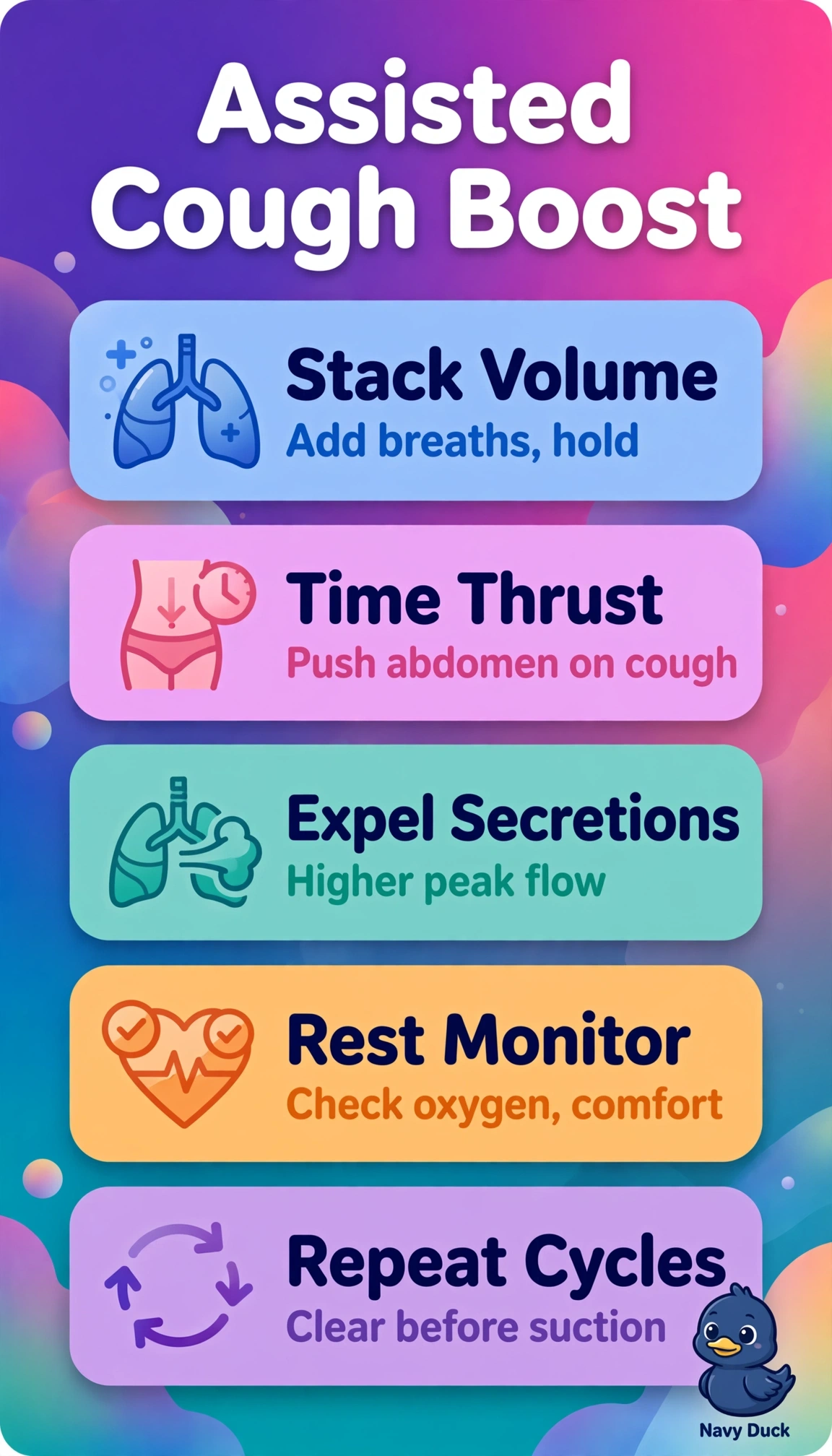
You can give weak muscles a helping hand right when it counts. Stack breaths to build lung volume, then time an abdominal push with the cough—like winding up before a throw. This air-stacking plus assisted thrust boosts cough strength.
Full Explanation
In C5 tetraplegia with inspiratory and expiratory weakness, low operating lung volume reduces elastic recoil, vital capacity and pre-cough inspiration, contributing to retained secretions and SpO2 of 90% on room air. Peak cough flow of 155 L/min confirms ineffective cough, below the 160 L/min threshold, so bedside clearance needs both inspiratory augmentation and expiratory assistance. Lung volume recruitment with air stacking delivers breaths to maximal insufflation capacity, improving lung volume, compliance and oxygenation; a synchronized abdominal thrust during glottic opening then augments expiratory flow and shear to mobilize secretions. This is appropriate before suctioning when the patient is alert, cooperative, has no bulbar dysfunction and has no contraindication to manual assistance. An abdominal thrust without prior air stacking starts expiration from low volume with poor recoil and does not address the inspiratory deficit. Air stacking without expiratory assistance may improve volume and oxygenation but does not provide enough peak expiratory flow when expiratory muscles are weak. Mechanical insufflation-exsufflation is a valid neuromuscular technique, but bypasses simpler, available manual methods that are appropriate when cooperation and safety criteria are met. Exam caveat: supplemental oxygen alone does not correct low cough flow or replace hyperinflation plus assisted expiration. Practical check: reassess peak cough flow, SpO2, sputum yield, dyspnea and thrust timing with glottic opening, while screening for pain, rib injury, hemodynamic instability and aspiration risk.