
A 59-year-old intubated patient in the ICU has coarse rhonchi, visible secretions in the endotracheal tube, and a transient desaturation after coughing, with a sterile suction kit and closed-system catheter available at bedside. Which suctioning technique should the therapist use to clear an artificial airway while preserving oxygenation and sterility?
Select an answer to reveal the explanation.
Short Explanation
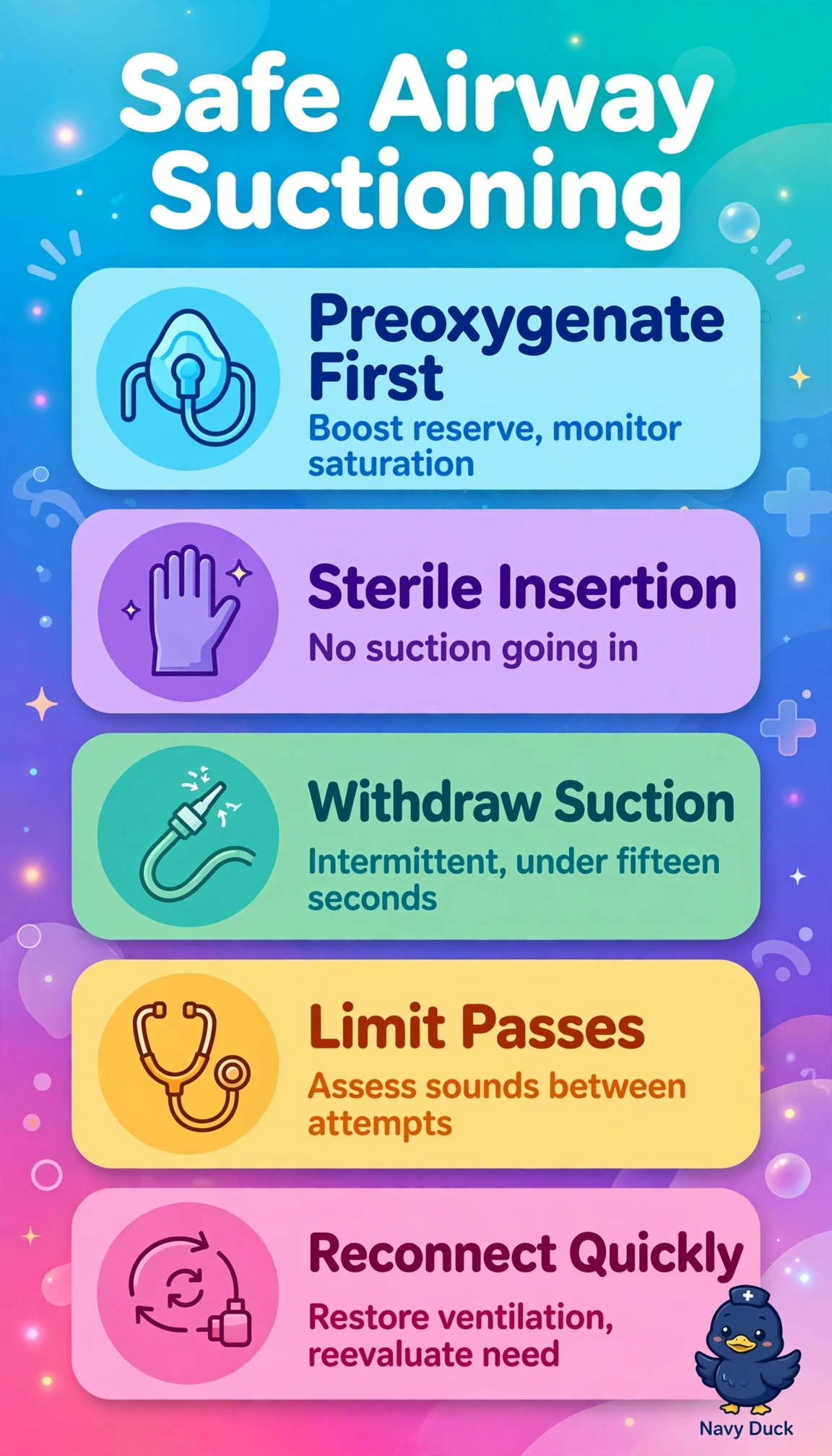
You’re protecting oxygenation and the airway with a careful, sterile pass. Insert the catheter without suction, then use brief intermittent suction as you withdraw to clear visible secretions. Preoxygenation helps limit hypoxia, while suctioning only on withdrawal reduces mucosal trauma.
Full Explanation
Preoxygenate, insert a sterile catheter without suction, and apply brief intermittent suction only while withdrawing. Preoxygenation restores oxygen reserve after the transient desaturation; sterile insertion protects the lower airway, which bypasses upper-airway defenses; and suction on withdrawal clears visible secretions while limiting mucosal trauma, atelectasis, hypoxia, and vagal stimulation. Inserting a sterile catheter without preoxygenation and suctioning briefly on withdrawal otherwise follows the right technique, but misses the oxygenation step: with low reserve, even a brief pass can cause profound hypoxemia and dysrhythmia. Applying suction during insertion as well as withdrawal fails the atraumatic principle: negative pressure on entry can strip mucosa, provoke edema, bleeding, and bronchospasm, remove oxygen, and prolong hypoxia without improving clearance. Using a clean rather than sterile catheter, despite preoxygenation and brief suction on withdrawal, fails the sterility principle: an artificial airway lacks filtration and cough protection, so nonsterile introduction can seed the tracheobronchial tree and increase ventilator-associated pneumonia risk; clean technique may be accepted for oropharyngeal suction, not this airway. Exam caveat: connect a desaturation history to preoxygenation, and reject routine lavage, prolonged passes, and suction on insertion even when other steps are appropriate. Practical check: use the sterile closed-system catheter available, choose a catheter less than half the tube lumen, limit each pass to 10–15 seconds, monitor saturation and rhythm, and reoxygenate between passes.