
In the ICU a volume-controlled ventilated patient suddenly has a high-pressure alarm, decreased exhaled volume, tachycardia, and asymmetric breath sounds after repositioning with intact power and oxygen supply. Which ventilator, alarm, and circuit troubleshooting action best restores safe ventilation?
Select an answer to reveal the explanation.
Short Explanation
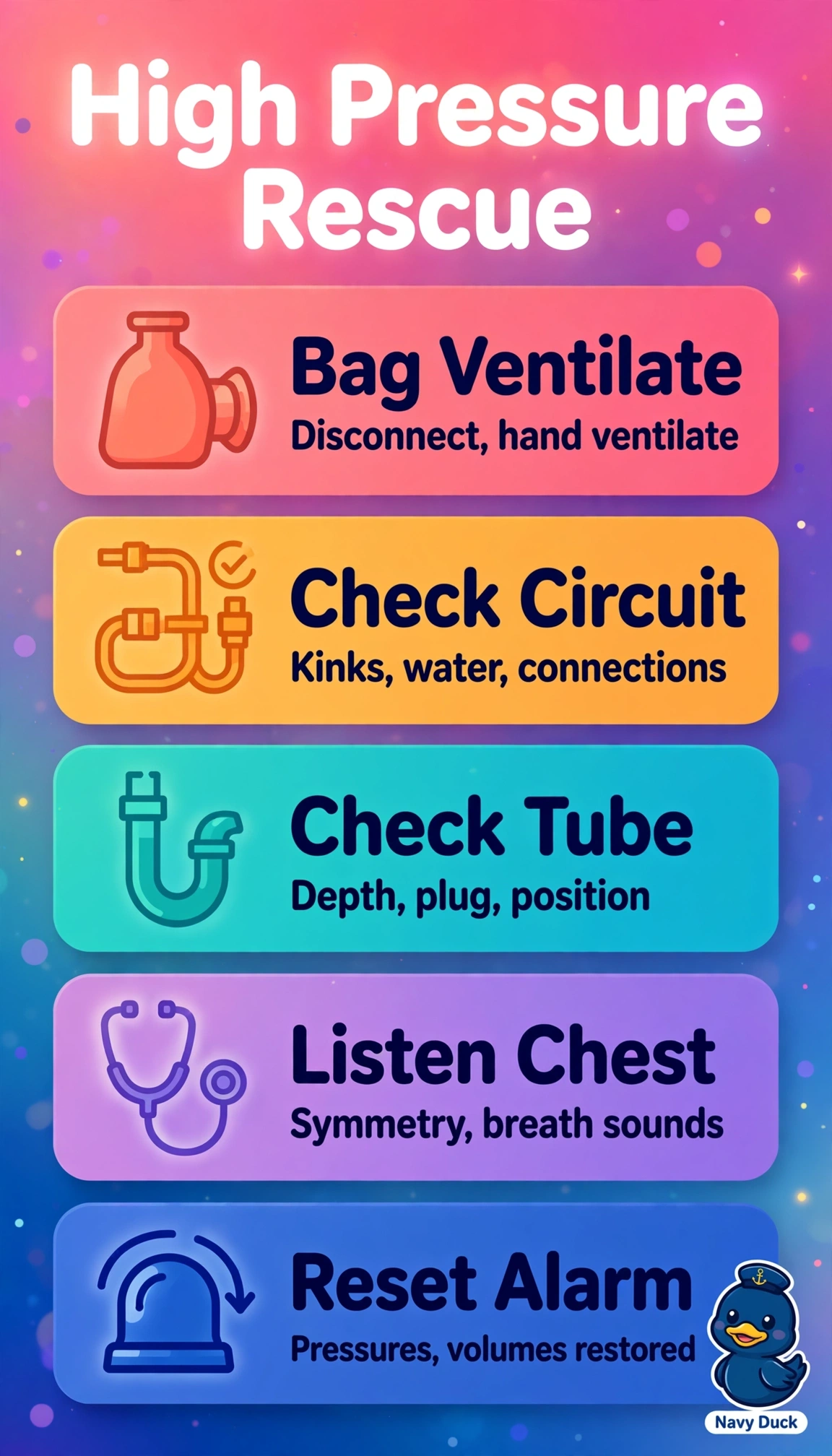
High pressure plus one-sided air means something is blocking or misplaced. Stepping in by hand buys safety — disconnection lets you ventilate and find the kink fast.
Full Explanation
The correct action works because high-pressure alarm plus decreased exhaled volume during volume control means set volume cannot be delivered due to obstruction or tube malposition, and asymmetric sounds plus tachycardia after repositioning with intact power and oxygen points to kink, mucus plug, or mainstem intubation, so brief disconnection for bag ventilation sustains oxygenation while allowing direct inspection, suctioning, unkinking, tube-depth verification, and repositioning. Sedation with continued volume ventilation and pressure trending helps dyssynchrony but fails by treating patient effort rather than mechanical patency, so obstruction or endobronchial migration persists with ongoing hypoventilation. Switching to pressure control to limit peak pressure protects against barotrauma but fails by controlling the alarm number without restoring lost volume or correcting displacement, permitting occult hypoventilation. Evaluating for tension pneumothorax with preparation for decompression recognizes asymmetry and tachycardia appropriately but fails as the first rescue because it pursues an invasive diagnosis before the required universal step of ensuring a patent airway and circuit through manual ventilation and inspection. Exam caveat: after movement, prioritize displacement, kinking, and plugging over settings changes, mode switches, or escalation of support. Practical check: compare set to exhaled volume, note peak versus plateau pressure, verify ETT mark, assess symmetry, suction, unkink, monitor SpO2 and capnography while bagging, then re-secure and confirm bilateral ventilation.