
In the emergency department an adult with pneumonia wears a Venturi mask prescribed at 28% with the manufacturer-matched flowmeter setting, but SpO2 is 84%, the jet nozzle is cracked, the diluter window is misaligned, and room air hisses loudly around loose connections. The prescription must stay at 28%. Which troubleshooting action should the therapist take first to restore accurate gas delivery?
Select an answer to reveal the explanation.
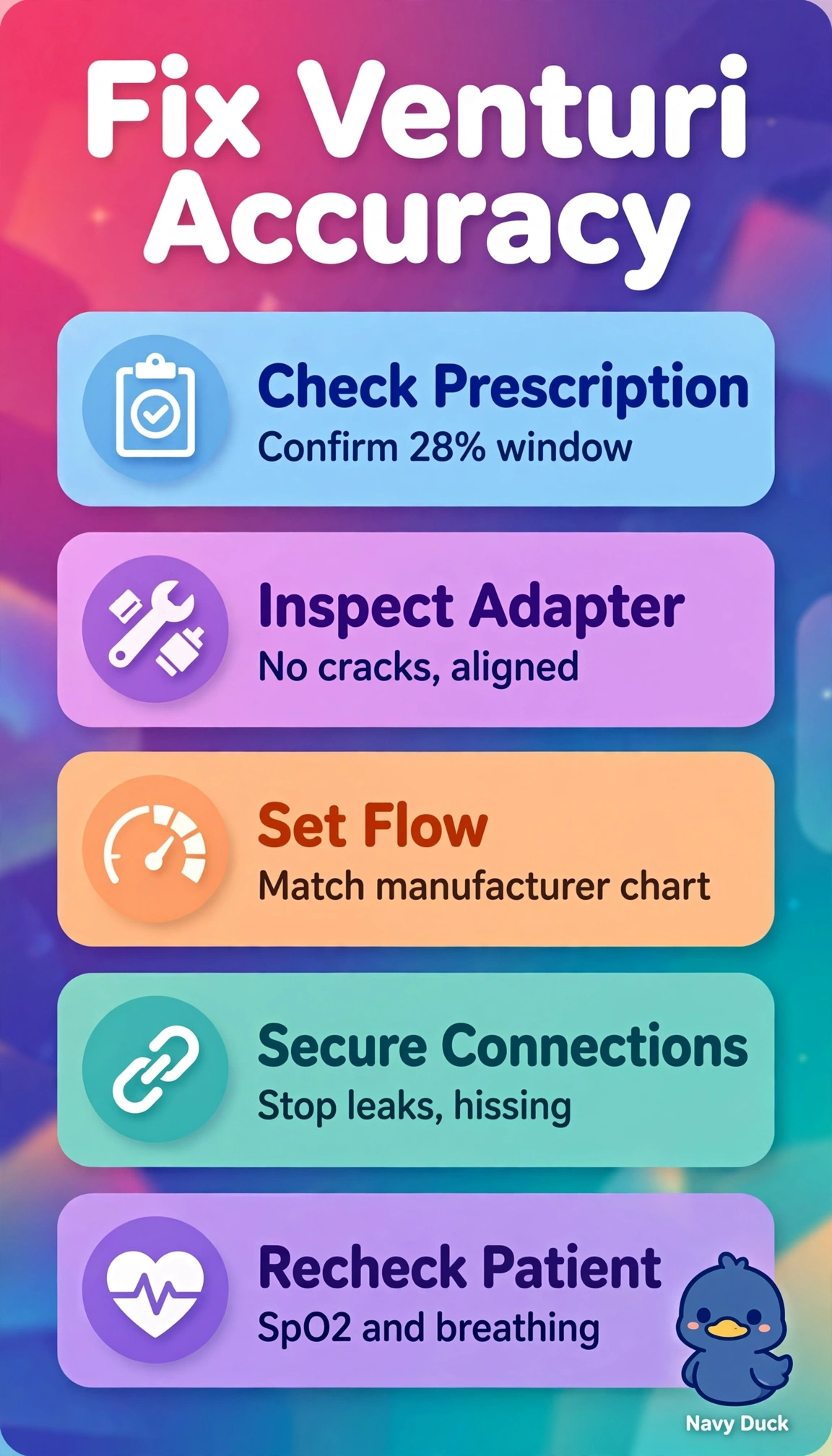
Short Explanation
You spotted precision matters more than just turning it up. A Venturi is a recipe where air and oxygen must mix exactly, so fixing the adapter restores the prescribed blend.
Full Explanation
The correct action restores Venturi accuracy by addressing all the mechanical faults together: replacing the cracked jet re-establishes the precise high-velocity orifice that drives fixed-ratio room-air entrainment for 28%, aligning the manufacturer-matched diluter window selects the correct entrainment port size, securing the loose connections stops oxygen escaping before it reaches the jet, and resetting flow to the specified rate ensures total output flow meets or exceeds the patient inspiratory demand to prevent dilutional fluctuation. Tightening connections, aligning the window and resetting flow while retaining the cracked adapter fails by fluid dynamics because a fissured jet cannot generate the intended Bernoulli pressure drop, so the air-to-oxygen ratio remains unpredictable despite a leak-free circuit. Replacing with an intact 28% adapter, securing leaks but titrating flow upward for hypoxemia fails by prescription adherence because total flow beyond the specified rate increases velocity without correcting hypoxemia from pneumonia and violates the must-stay-at-28% calibrated delivery principle, risking CO2 retention in susceptible patients. Replacing the adapter, tightening connections and resetting flow without correcting window alignment fails by entrainment geometry because a misaligned window partially occludes or enlarges the air-entrainment ports, delivering an FiO2 higher or lower than labeled. An exam caveat is to treat low SpO2 as a signal to notify the prescriber rather than unilaterally raising FiO2 or flow when the stem mandates a fixed concentration. A practical bedside check is to seat the mask, confirm the window clicks into the 28% detent, verify the flowmeter bobbin at the specified mark, listen and feel for hissing leaks, and reassess SpO2, work of breathing and ABGs.