
On a surgical ward a 70-year-old post-lobectomy patient on 2 L nasal cannula now has SpO2 97%, clear breath sounds, normal ABGs, and walks hallways without dyspnea for two days. The nurse asks if oxygen should continue indefinitely. Which therapy decision best applies add, modify, continue, or discontinue logic for this stable patient?
Select an answer to reveal the explanation.
Short Explanation
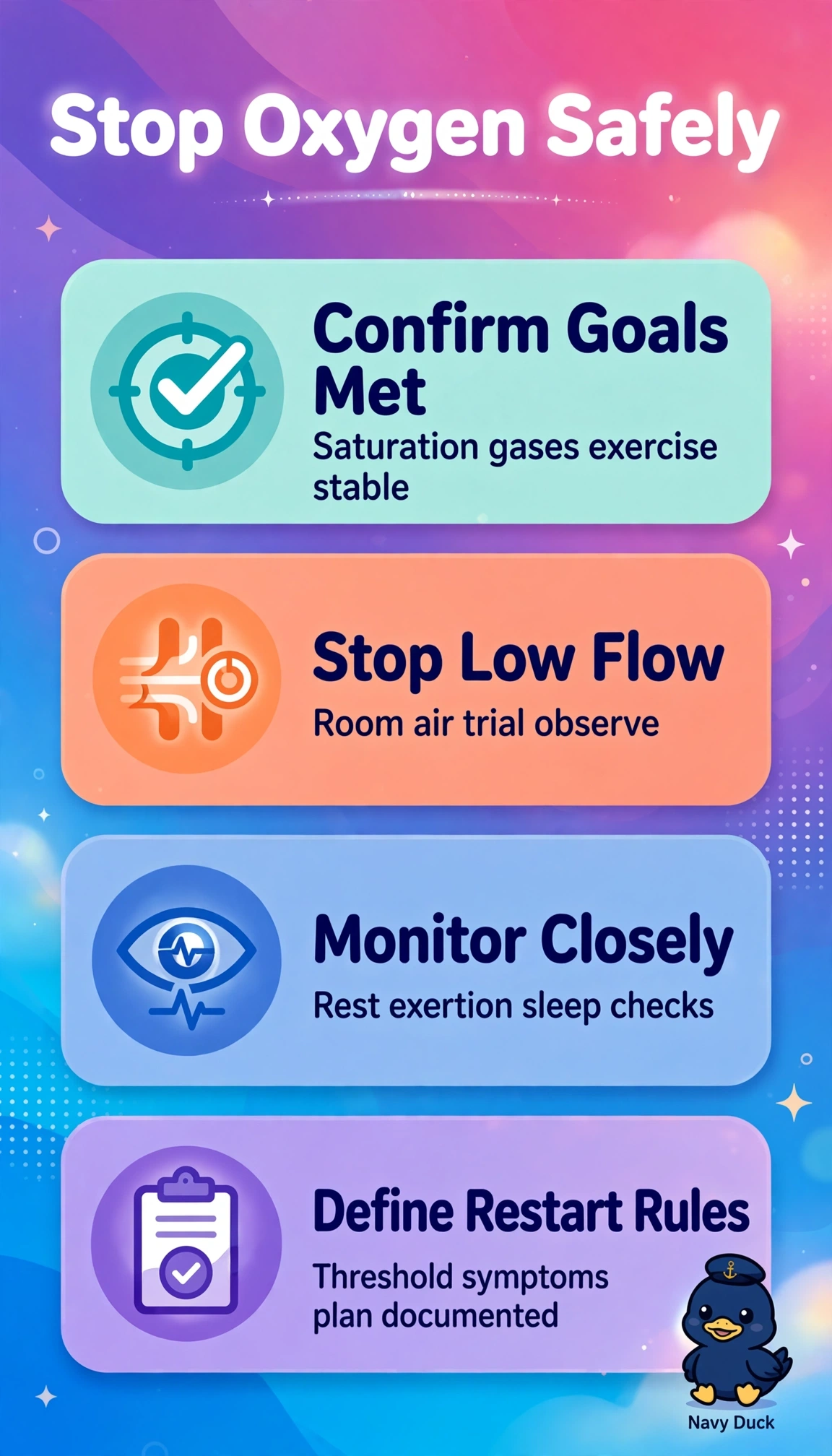
You've hit your goals here, so you don't need to ride with oxygen forever — it's like taking the training wheels off once you're steady. You can discontinue it safely now with close monitoring and clear restart cues if things slip.
Full Explanation
The correct decision reflects discontinuation logic because sustained SpO2 97% on 2 L, normal arterial blood gases, clear breath sounds, and hallway ambulation without dyspnea for two days demonstrate resolution of hypoxemia and adequate reserve, so stopping therapy with monitoring and explicit restart criteria is safe and avoids unnecessary oxygen. Continuing 2 L with daily oximetry and reassessment is familiar postoperative management that maintains stability, yet it fails by continuation concept because continuation requires ongoing indication and current findings already meet stopping criteria rather than need for maintenance. Tapering to 1 L with ambulation oximetry for gradual weaning is common cautious practice, yet it fails by modification concept because titration is indicated for partial response or intolerance, whereas a stable normal assessment supports cessation rather than stepwise reduction. Adding overnight oximetry while maintaining oxygen to screen for sleep-related desaturation is routine after thoracic surgery, yet it fails by addition concept because escalation requires new desaturation, increased work of breathing, or abnormal gases, none of which are present. An exam caveat is to apply stated saturation, gas exchange, and functional tolerance thresholds over the specified time frame rather than assuming age or recent lobectomy alone mandates oxygen. A practical check is to stop oxygen, monitor SpO2, respiratory rate, dyspnea, and ambulation tolerance closely, provide written restart thresholds, and resume only if desaturation, distress, or gas deterioration recur.