
A pulmonary function lab reports inconsistent FVC results on a portable spirometer, with failed daily calibration checks using a 3-L syringe, variable room temperatures, and recent transport between clinics. Patients show good effort and coaching. Which troubleshooting step should the therapist perform to restore accurate spirometry?
Select an answer to reveal the explanation.
Short Explanation
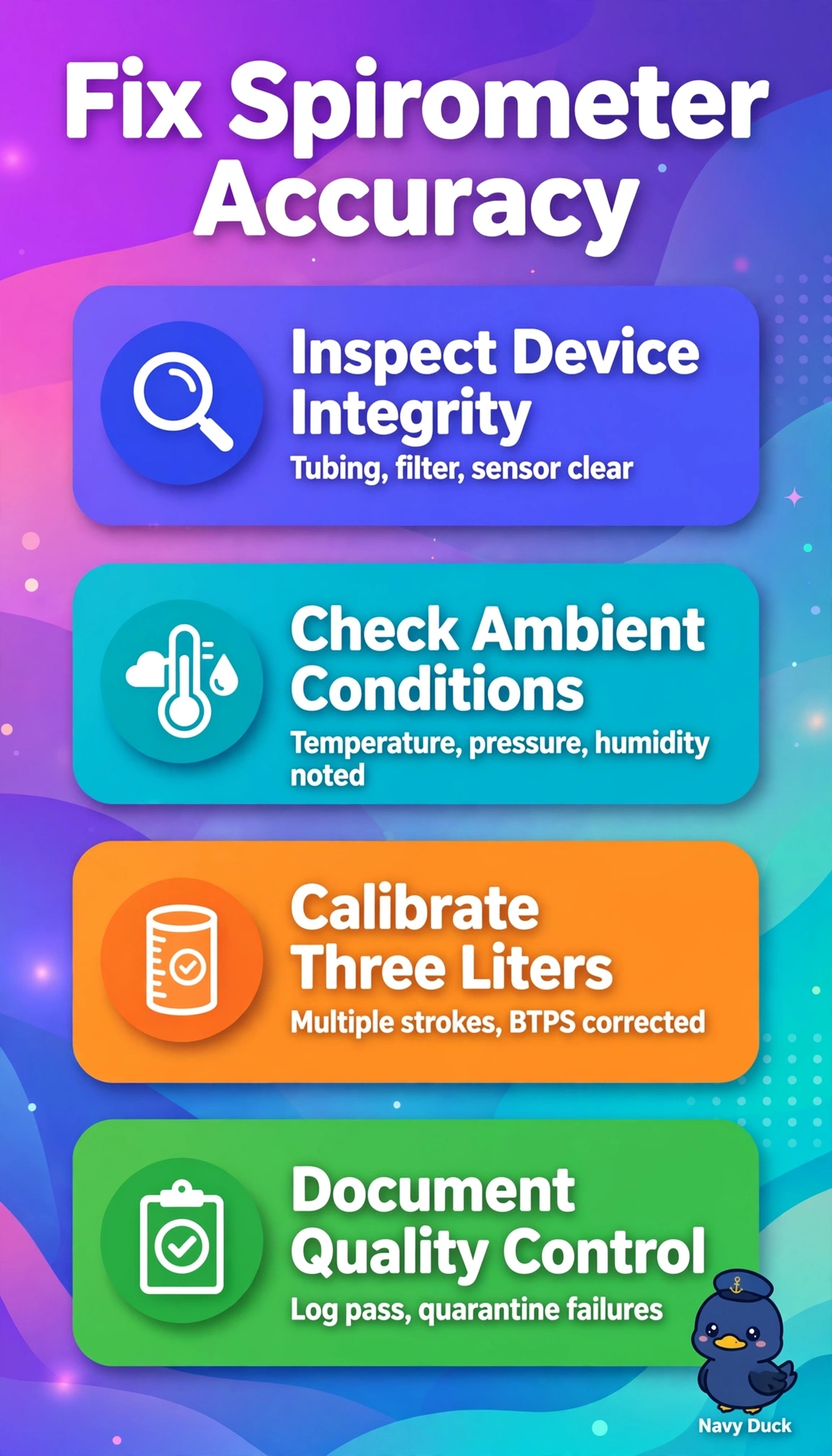
You’ve got good patient effort, so you don’t need to keep pushing more blows when the spirometer may have a leak or blockage. You can restore accurate results by inspecting for leaks and sensor obstruction, then recalibrating with the 3-L syringe using BTPS correction and documented controls.
Full Explanation
Failed daily checks mean the spirometer is not valid for clinical use until accuracy is restored; transport and variable room temperatures can contribute to mechanical problems and thermal volume effects. Inspecting for leaks and sensor obstruction, then recalibrating with the 3-L syringe using BTPS correction and documenting controls, addresses both equipment integrity and temperature-related volume changes. Recalibrating with BTPS correction but not inspecting for leaks or obstruction leaves mechanical faults unresolved, so results may remain variable despite correct calculations. Inspecting the equipment but verifying at ambient conditions without BTPS correction does not account for temperature-related changes in gas volume, which can undermine accuracy when room conditions vary. Relocating testing to a stable-temperature area and using a healthy biological control without syringe recalibration cannot quantitatively verify accuracy after a failed check; a biological control assesses reproducibility, not calibration. An exam caveat is that good patient effort and coaching do not compensate for failed device checks, so repeating maneuvers alone is not a fix. As a practical check, equilibrate the syringe and spirometer, enter the actual environmental conditions, deliver smooth full strokes, confirm the results meet tolerance, and document the controls before testing.