
A 58-year-old post-abdominal surgery patient develops fever, increased work of breathing, and diminished bases on auscultation, with new opacities on portable film and borderline hypotension. Multiple therapies are possible and the team needs focus. Which information-gathering priority should the therapist choose to interpret the acute change?
Select an answer to reveal the explanation.
Short Explanation
You sorted signal from noise when many tests compete. Focused bedside assessment plus trend review clarifies atelectasis versus pneumonia, and prioritization prevents delayed rescue.
Full Explanation
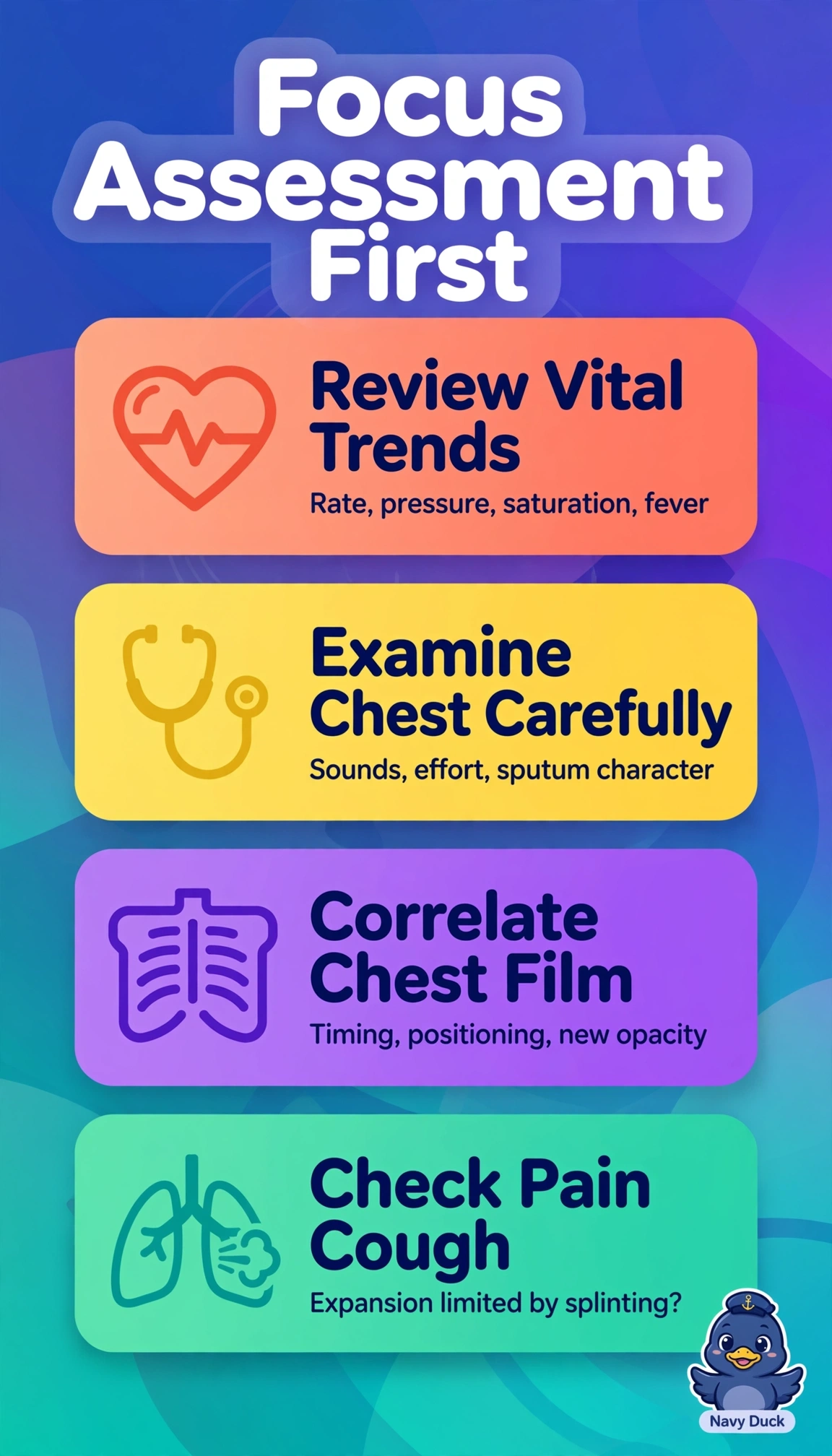
The correct priority synthesizes expansion, sputum, vitals, oximetry, pain control and film timing because post-abdominal fever, increased work of breathing, diminished bases, new portable opacities and borderline hypotension could mean atelectasis, pneumonia, effusion or early sepsis, each demanding different therapy. Basal expansion and auscultation distinguish volume loss amenable to recruitment from consolidation, sputum character plus fever pattern separates infection from simple atelectasis, trend review quantifies instability and urgency, oximetry tracks mismatch, pain assessment determines capacity for deep breathing and cough, and timing and positioning of the portable film prevents overcalling supine-dependent opacities as new disease. The splinting-focused assessment with sputum, vitals, oximetry and film timing reflects standard postoperative care but fails ventilation assessment by omitting basal expansion, leaving inability to interpret whether diminished bases explain imaging and dyspnea. The wound-focused assessment with expansion, vitals, oximetry and film timing reflects sound surgical surveillance but fails infection discrimination by omitting sputum, leaving pneumonia versus atelectasis unresolved when fever is central. The mobilization-focused assessment with expansion, sputum, vitals and oximetry reflects good rehabilitation care but fails imaging correlation by omitting film timing, risking misattribution of chronic or positional changes to acute deterioration. Exam caveat is to choose data that discriminates among competing diagnoses rather than data that merely supports one familiar therapy. Practical check is to align fever curve, blood pressure trend, SpO2 and breathing effort, pain scores with cough volumes, sputum description, and film acquisition time and patient position before recommending therapy.