
During a concurrent quality review, a clinical documentation specialist notices that a hospitalized patient's laboratory results and nursing notes suggest acute respiratory failure, but the attending physician's progress note only lists chronic lung disease. How should the specialist address this discrepancy?
Select an answer to reveal the explanation.
Short Explanation
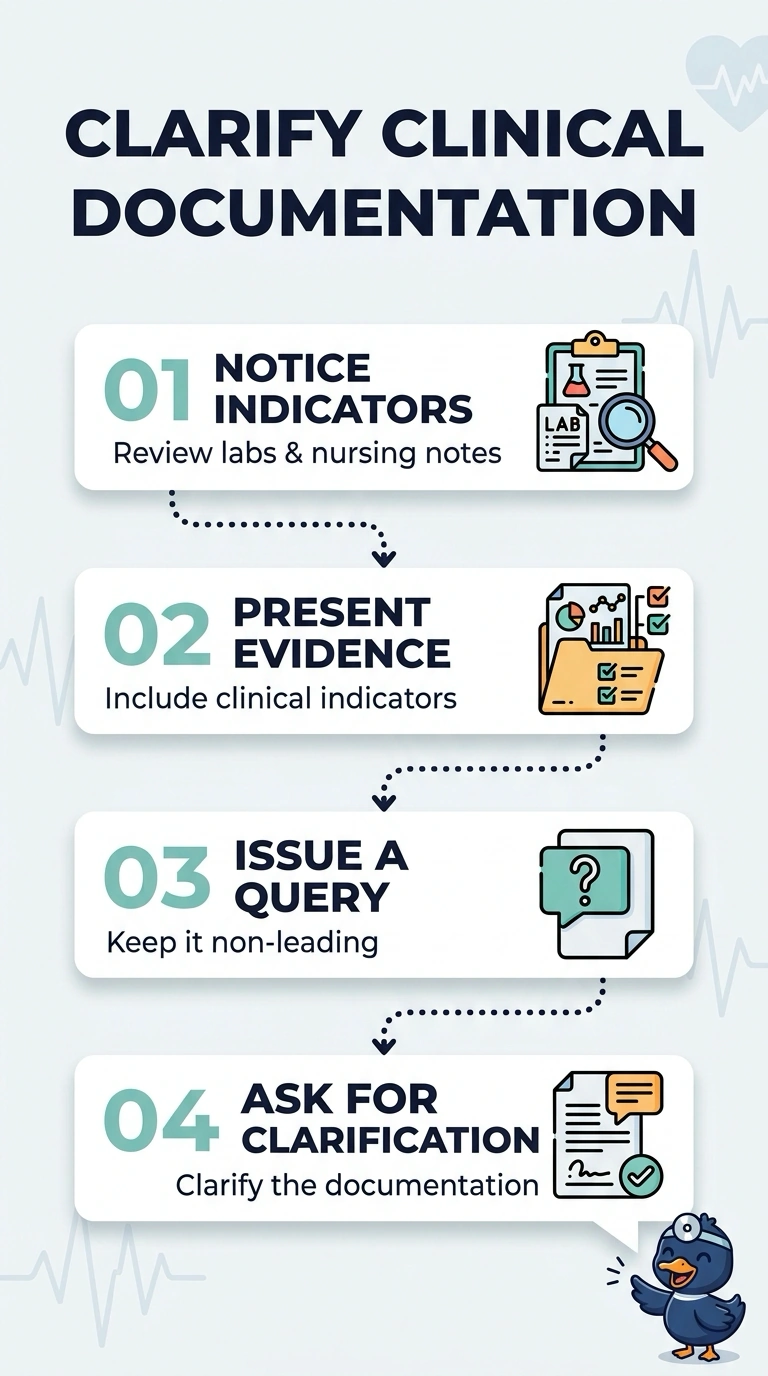
When chart notes and lab values tell two different stories, you should ask a neutral question rather than write the diagnosis yourself. A non-leading query gives the physician the objective clinical facts and lets them make the medical call. Avoid instructing the physician to document a diagnosis just to boost severity scores.
Full Explanation
Issue a non-leading clinical query presenting the clinical indicators and asking for clarification preserves clinical autonomy while helping ensure the medical record accurately reflects patient acuity for quality measurement and risk adjustment. Present objective findings—such as blood gas values, oxygen requirements, and nursing assessments—with neutral response options so the attending physician can confirm, rule out, or further specify the condition. Adding acute respiratory failure directly to the discharge summary problem list for coding violates scope-of-practice and documentation integrity rules, because only the treating practitioner can establish a diagnosis. Sending a message instructing the physician to document acute respiratory failure for higher severity is an improper leading query that introduces compliance risk by steering clinical judgment toward reimbursement. Waiting until after billing submission for a retrospective peer review committee to resolve the discrepancy misses the opportunity for timely accuracy and leaves risk-adjusted quality scores distorted. As a caveat, offer only clinically supported choices plus an 'other' response so the physician can confirm, rule out, or specify the condition; 'not clinically significant' is optional, not mandatory. For an operational check, audit a monthly sample of documentation queries to verify neutral wording and timely physician response rates.
Prefer to study offline? Printable PDF study book + test engine ($7.50, unofficial). These questions stay free here.