
During annual capital planning, a health system's finance committee ranks equipment requests solely by projected revenue growth, repeatedly deferring bedside ceiling lifts and smart medication cabinets. How should the quality leader integrate quality and safety into resource decisions?
Select an answer to reveal the explanation.
Short Explanation
If your capital committee only scores dollar return, safety equipment will always lose to shiny revenue-makers. The trap is pleading for leftover funds afterward instead of putting safety risk right onto the scoring rubric.
Full Explanation
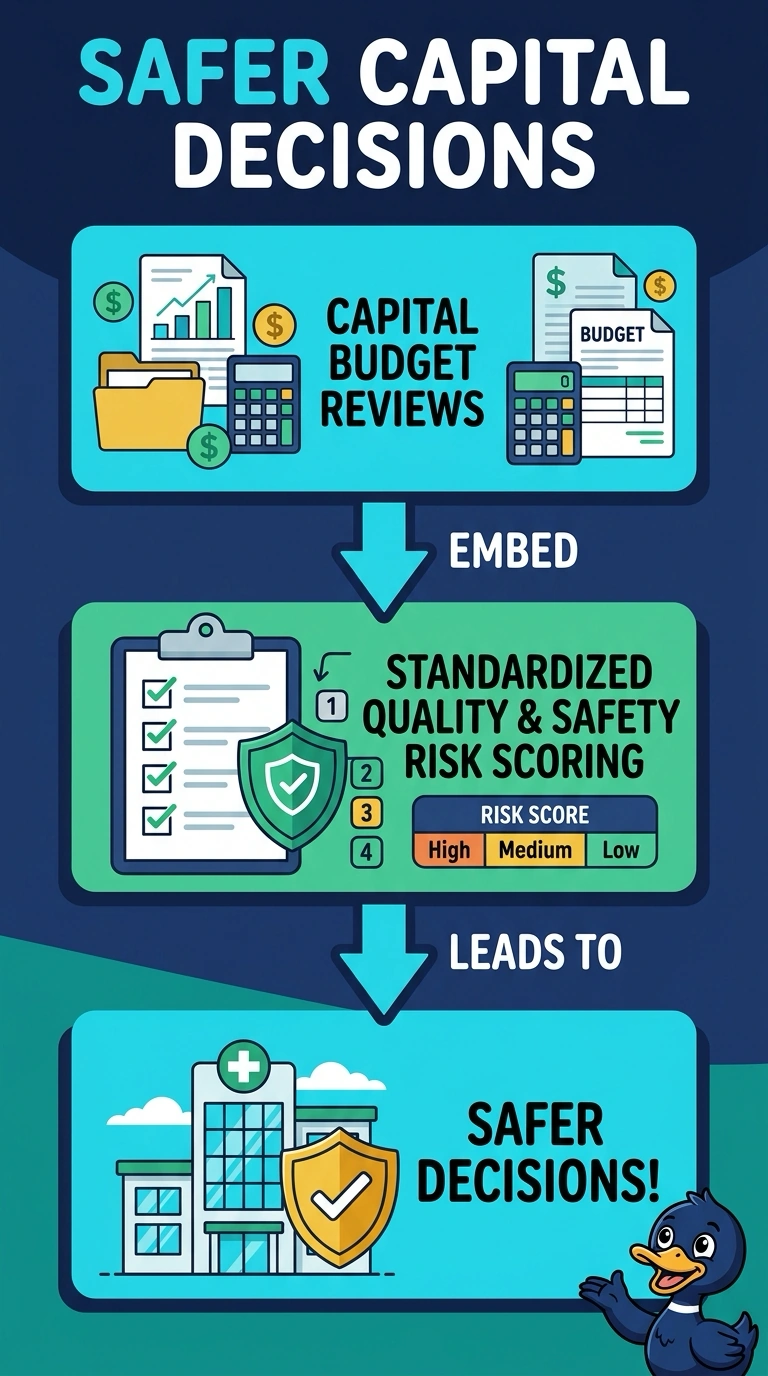
Embedding standardized quality and safety risk scoring into capital budget reviews ensures that patient harm reduction, regulatory compliance, and reliability gains carry explicit weight alongside financial return before funds are allocated. Placing safety on the same formal decision matrix aligns capital stewardship with the organization's quality strategy. Relying on separate safety grant proposals to support bedside equipment fails because residual funds are rarely sufficient for infrastructure needs and treats safety as an afterthought. Allowing each clinical department to fund safety upgrades out of supply savings creates inequitable gaps between high-margin and safety-critical support units. Tying bedside safety equipment funding to annual volume performance fails because it conditions essential harm prevention on productivity and leaves low-volume but high-risk areas unprotected. As a caveat, risk-scoring criteria must be defined objectively with clinical, safety, and finance leaders so scoring does not become subjective lobbying. Operationally, review the approved capital list each cycle to verify what share of funded projects directly mitigated top organizational safety risks.
Prefer to study offline? Printable PDF study book + test engine ($7.50, unofficial). These questions stay free here.