
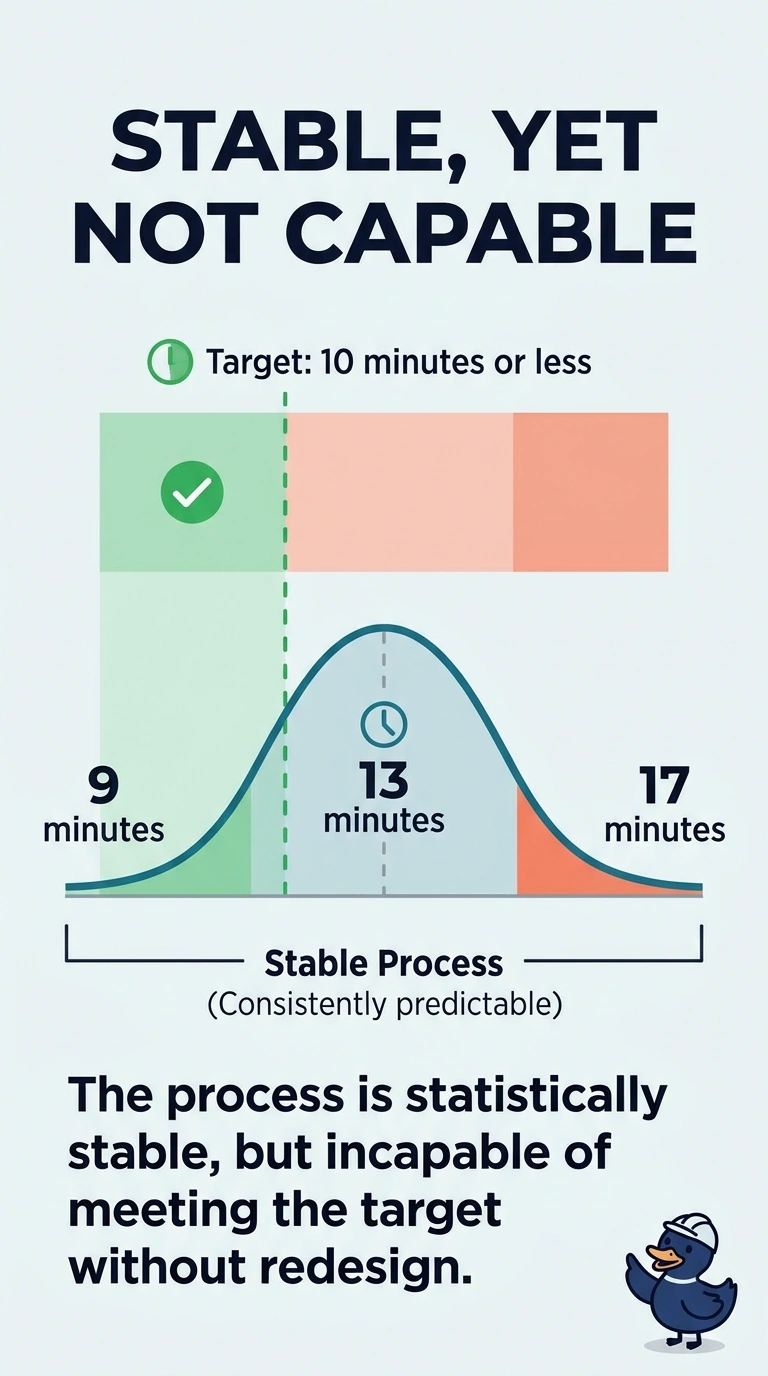
An emergency department tracks monthly door-to-ECG times for chest pain patients on a statistical process control chart. All points over the past year fall within the lower control limit of 9 minutes and the upper control limit of 17 minutes, with a centerline of 13 minutes, yet clinical guidelines target 10 minutes or less. What does this indicate about the process?
Select an answer to reveal the explanation.
Short Explanation
Control limits represent the voice of your process, while targets represent the voice of the patient or guideline—and those two voices do not automatically agree. The trap is assuming a stable chart means good performance, or trying to force control limits to match the goal. When a stable process consistently misses the target, you need fundamental workflow redesign.
Full Explanation
The process is statistically stable but incapable of meeting the target without redesign because all observations fall within the natural control limits of 9 to 17 minutes around a 13-minute average, showing predictable common-cause variation, so the process sometimes meets the 10-minute goal but is not capable of meeting it consistently without redesign. The upper control limit should be lowered to 10 minutes so staff receive alerts sooner confuses statistical control limits, which are calculated from actual process data, with clinical specification targets. Special-cause variation is driving frequent delays that require individual case discipline misdiagnoses the chart, since no points fall outside the limits or show non-random patterns, making individual blame counterproductive. The process has achieved Six Sigma capability because all points stay inside control limits is false because stability alone does not equal capability when the process distribution routinely exceeds the specification limit. One caveat is that teams should never tighten targets without first mapping where minutes are lost between arrival, triage, and ECG acquisition. As an operational check, perform a gemba observation of chest pain intake to identify structural steps—such as moving ECG machines to triage—that can shift the centerline below 10 minutes.
Prefer to study offline? Printable PDF study book + test engine ($7.50, unofficial). These questions stay free here.