
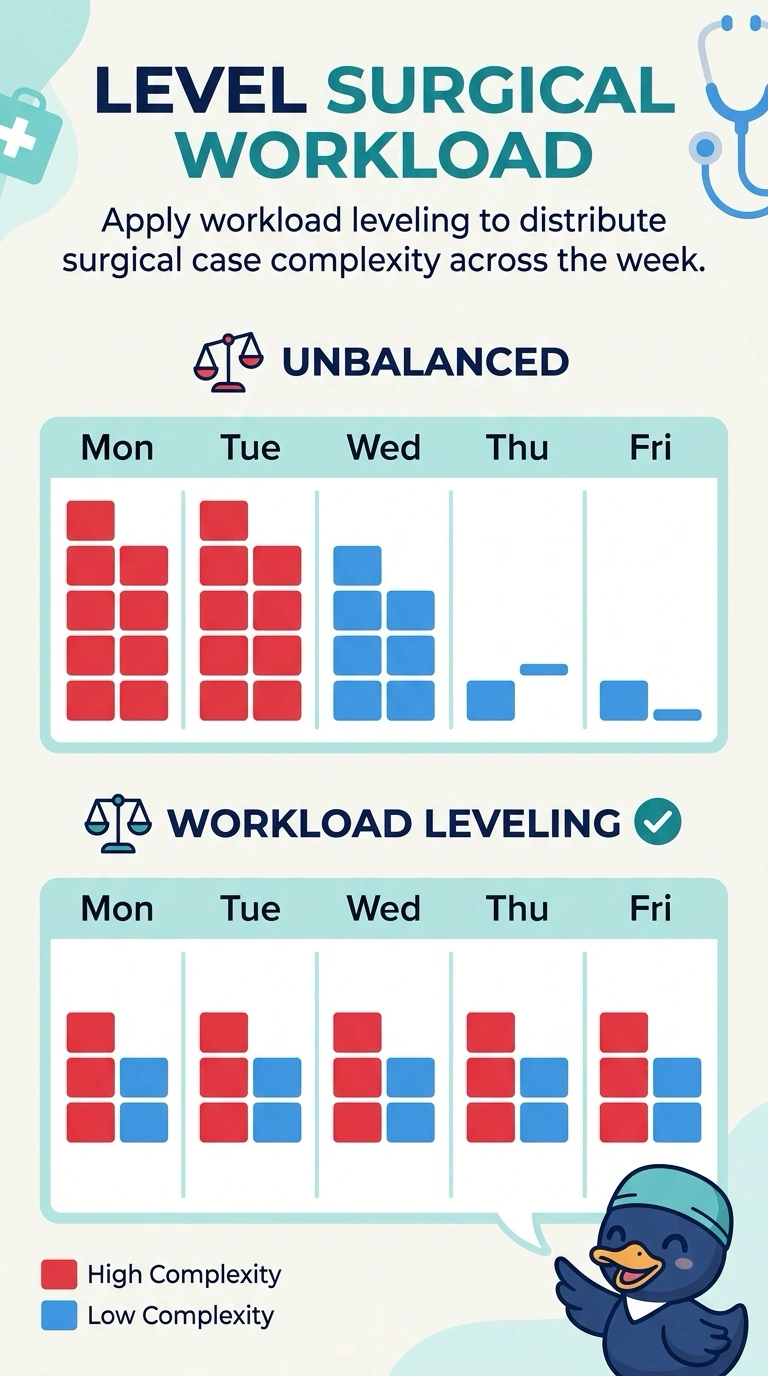
A hospital's surgical suite schedules nearly all complex orthopedic procedures on Mondays and Tuesdays, causing post-anesthesia care unit bottlenecks and delayed inpatient bed placement early in the week while operating rooms sit underused on Thursdays and Fridays. Which Lean approach best resolves this imbalance?
Select an answer to reveal the explanation.
Short Explanation
When every heavy case lands on Monday, your recovery unit drowns while Thursday sits quiet—that is uneven flow, not a bed shortage. The trap is buying extra capacity for artificial peaks instead of leveling the schedule.
Full Explanation
Applying workload leveling to distribute surgical case complexity across the week—known in Lean as heijunka—smooths demand across Monday through Friday so downstream post-anesthesia, sterile processing, and inpatient bed teams operate at a steady, predictable pace. Balancing case types and expected length of stay prevents early-week gridlock without expensive capital expansion. Adding extra post-anesthesia recovery bays to absorb Monday and Tuesday surgical surges fails because it builds costly capacity that sits idle later in the week while leaving inpatient bed bottlenecks intact. Batching preoperative lab draws into a Monday morning clinic block worsens unevenness by creating another artificial queue at the start of the week. Extending evening shift hours in sterile processing on the busiest surgical days treats a downstream symptom of uneven block scheduling and drives overtime fatigue. As a caveat, schedule leveling requires collaborative negotiation with surgical block owners rather than unilateral administrative mandates. Operationally, monitor daily case-hour variance and post-anesthesia hold minutes across all five weekdays to confirm smoother flow.
Prefer to study offline? Printable PDF study book + test engine ($7.50, unofficial). These questions stay free here.