
A health system analyst wants to determine whether discharge to a skilled nursing facility independently predicts 30-day unplanned readmission (yes or no) while simultaneously controlling for patient age, illness severity, and comorbidities. Which statistical method is most appropriate?
Select an answer to reveal the explanation.
Short Explanation
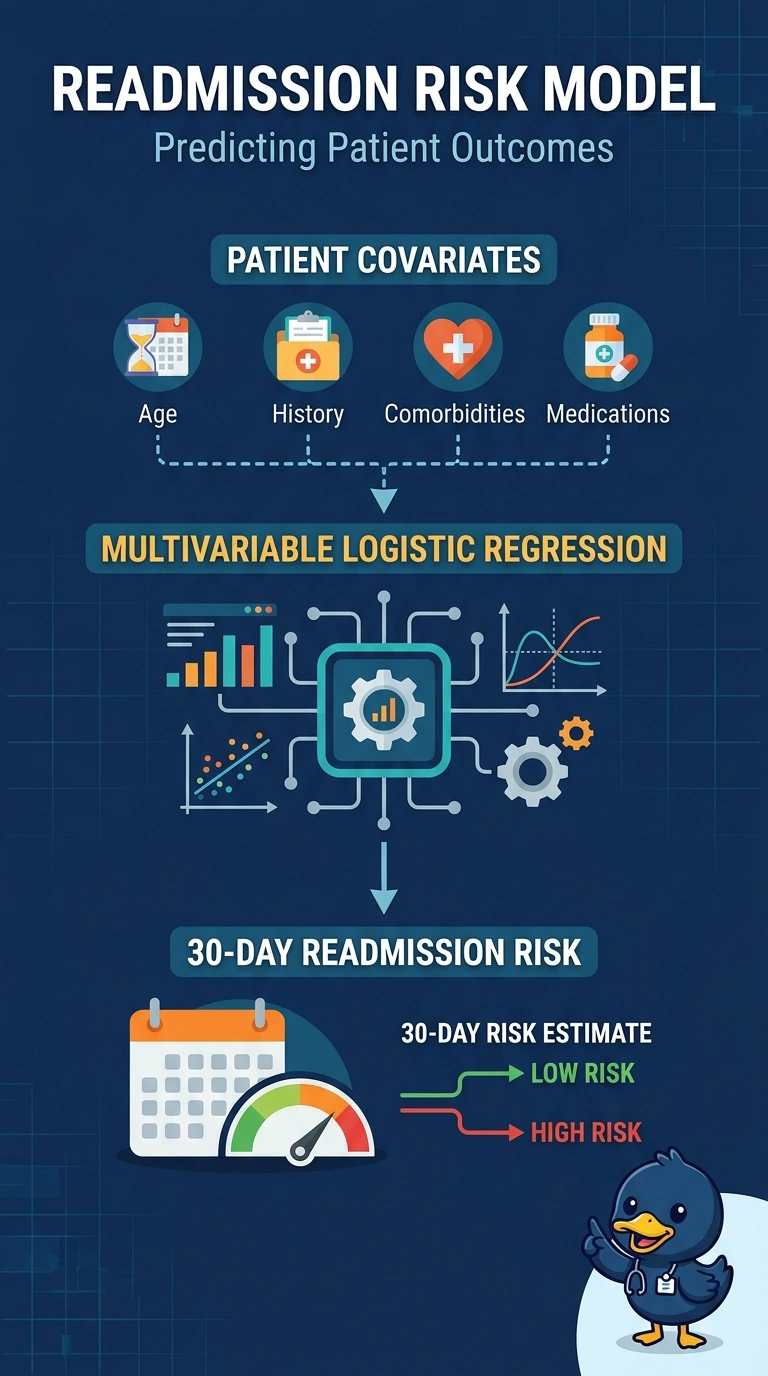
When your outcome is a yes-or-no event like a 30-day readmission and multiple patient risks are tangled together, a basic two-variable test cannot separate them. The trap is picking linear regression for a binary outcome or an unadjusted chi-square test that ignores case mix. Use multivariable logistic regression to isolate the predictor while controlling for covariates.
Full Explanation
Evaluating whether a care setting independently predicts a dichotomous clinical outcome requires statistical modeling that handles binary responses and simultaneous confounding variables. Selecting Multivariable logistic regression adjusting for multiple patient covariates models the log-odds of 30-day readmission (yes or no) while holding age, illness severity, and comorbidities constant. Using Simple linear regression predicting continuous length of stay addresses a continuous outcome with a single predictor rather than a binary readmission event adjusted for multiple confounders. Running A chi-square test comparing unadjusted readmission proportions tests only whether two categorical variables are associated without controlling for sicker, older patients being discharged to skilled nursing facilities more often. Plotting A run chart tracking monthly readmission percentages over time displays longitudinal process stability, but it cannot estimate the independent effect of discharge disposition across patient-level covariates. As a caveat, logistic regression assumes independent observations and sufficient outcome events per covariate to avoid overfitting unstable risk estimates. For an operational check, inspect model calibration and discrimination metrics and confirm that coded comorbidities reflect true baseline risk rather than post-discharge artifacts.
Prefer to study offline? Printable PDF study book + test engine ($7.50, unofficial). These questions stay free here.