
A primary care clinic measures hemoglobin A1c values in the same 45 patients at baseline and again six months after enrolling them in a pharmacist-led titration program. Assuming the within-patient differences are normally distributed, which analytical approach is most appropriate?
Select an answer to reveal the explanation.
Short Explanation
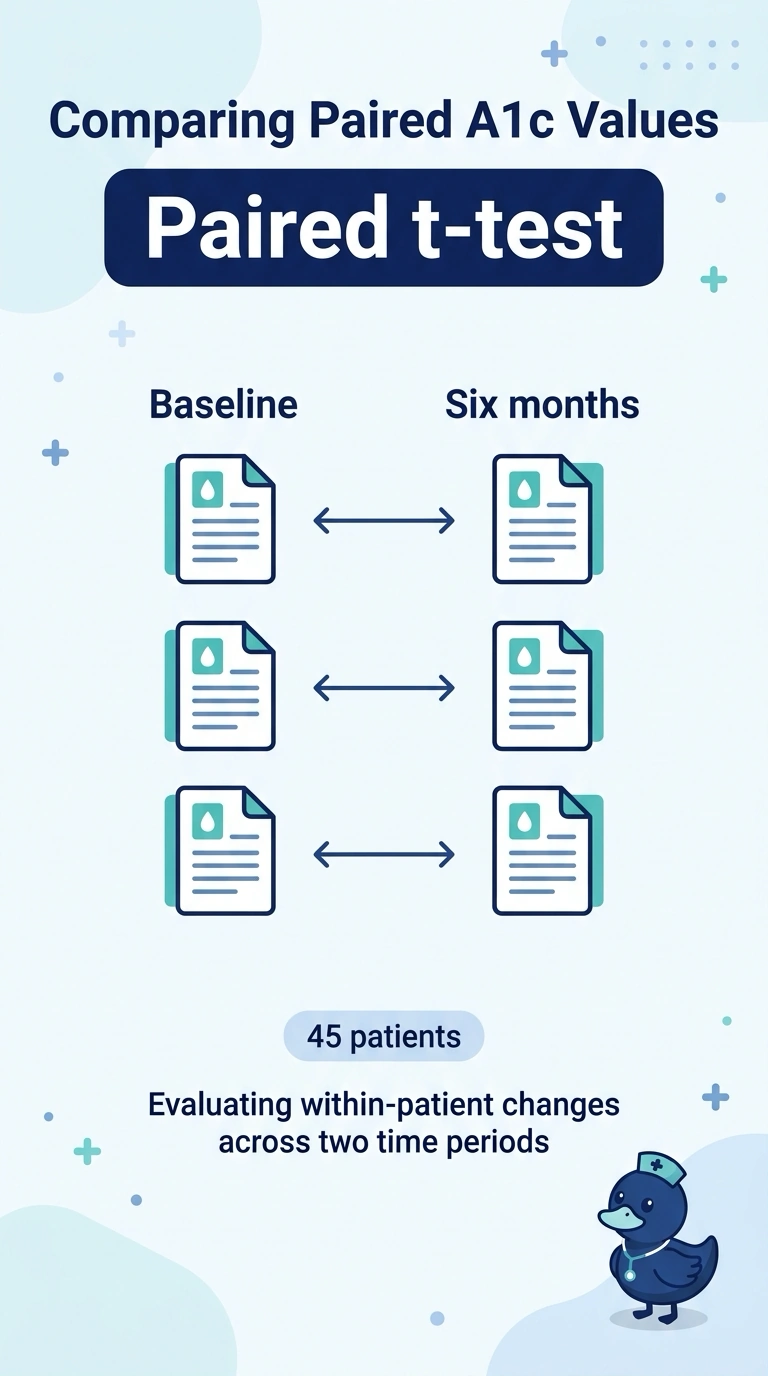
When you measure the same patients before and after a program, their results are linked, like before-and-after photos of the same house. A paired t-test focuses on each person’s change instead of treating the two time points as unrelated groups.
Full Explanation
Applying a paired t-test to evaluate within-patient changes across the two time periods is appropriate because each patient serves as their own control, and the test evaluates whether the mean of the paired differences differs significantly from zero. Accounting for within-patient correlation reduces random between-patient noise and increases statistical power. Running an independent two-sample t-test on the combined visit logs is unsuitable because it assumes independent measurements, but baseline and six-month results come from the same 45 patients. Using a chi-square test of independence on the raw monthly averages is unsuitable because chi-square evaluates categorical frequency counts, not continuous laboratory values. Plotting a control chart with only two data points per patient cannot establish baseline stability or distinguish common-cause from special-cause variation over time. As an exam caveat, if paired differences are heavily skewed or contain extreme outliers, a non-parametric Wilcoxon signed-rank test should replace the paired t-test. As a practical check, inspect a histogram or normality plot of the calculated difference scores and verify complete paired records for all 45 patients before reporting significance.
Prefer to study offline? Printable PDF study book + test engine ($7.50, unofficial). These questions stay free here.