
After analyzing 90,000 primary care visits, an analyst reports that average check-in wait time fell from 18.4 minutes to 18.0 minutes with a p-value below 0.001, and urges leadership to declare a major operational breakthrough. How should the quality director respond?
Select an answer to reveal the explanation.
Short Explanation
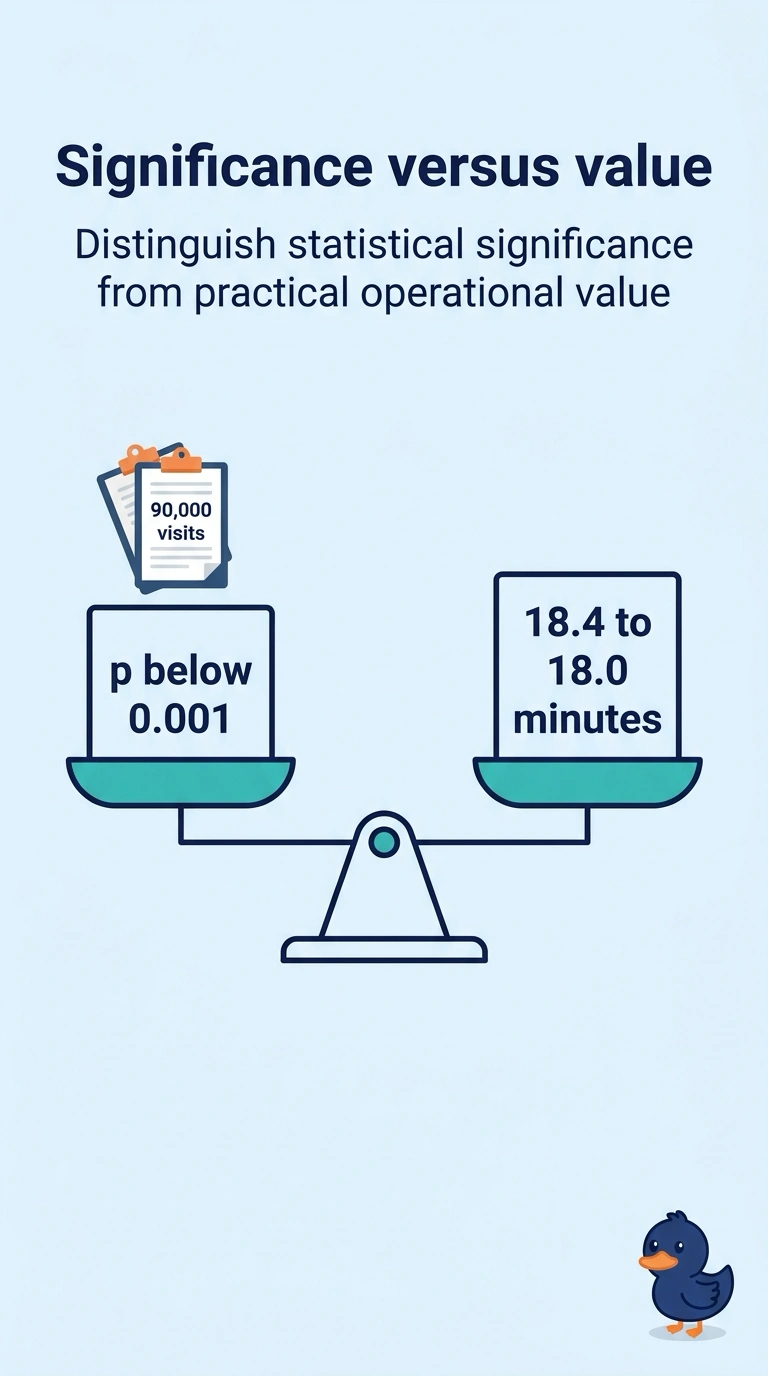
With 90,000 visits, even a 24-second blip looks mathematically dramatic under a p-value microscope. The trap is mistaking a tiny p-value for a big real-world win, so you should ask whether patients or staff would ever notice the difference.
Full Explanation
Hypothesis testing in large healthcare datasets frequently produces tiny p-values for differences that are operationally trivial. Choosing to Distinguish statistical significance from practical operational value prevents leadership from celebrating or investing resources in a 24-second wait-time shift that neither improves patient satisfaction nor frees clinic capacity. Relying on Accept the finding because a low p-value proves meaningful clinical impact confuses sample-size power with effect size; as sample size grows into the tens of thousands, negligible differences routinely cross statistical thresholds. Choosing to Switch to a one-tailed hypothesis test to confirm the size of the gain is flawed because p-values measure compatibility with a null hypothesis, not the magnitude or usefulness of an operational change. Likewise, choosing to Aggregate the data into annual averages to eliminate daily noise obscures time-ordered variation and can hide clinic-level bottlenecks rather than clarifying whether the change matters. As a caveat, even a small average shift could be practically important if it reflects dramatic gains in one high-risk clinic offset by no change elsewhere, so always inspect effect size and subgroup distributions. Operationally, pair any hypothesis test with confidence intervals and pre-defined clinical or operational improvement thresholds before declaring success.
Prefer to study offline? Printable PDF study book + test engine ($7.50, unofficial). These questions stay free here.