
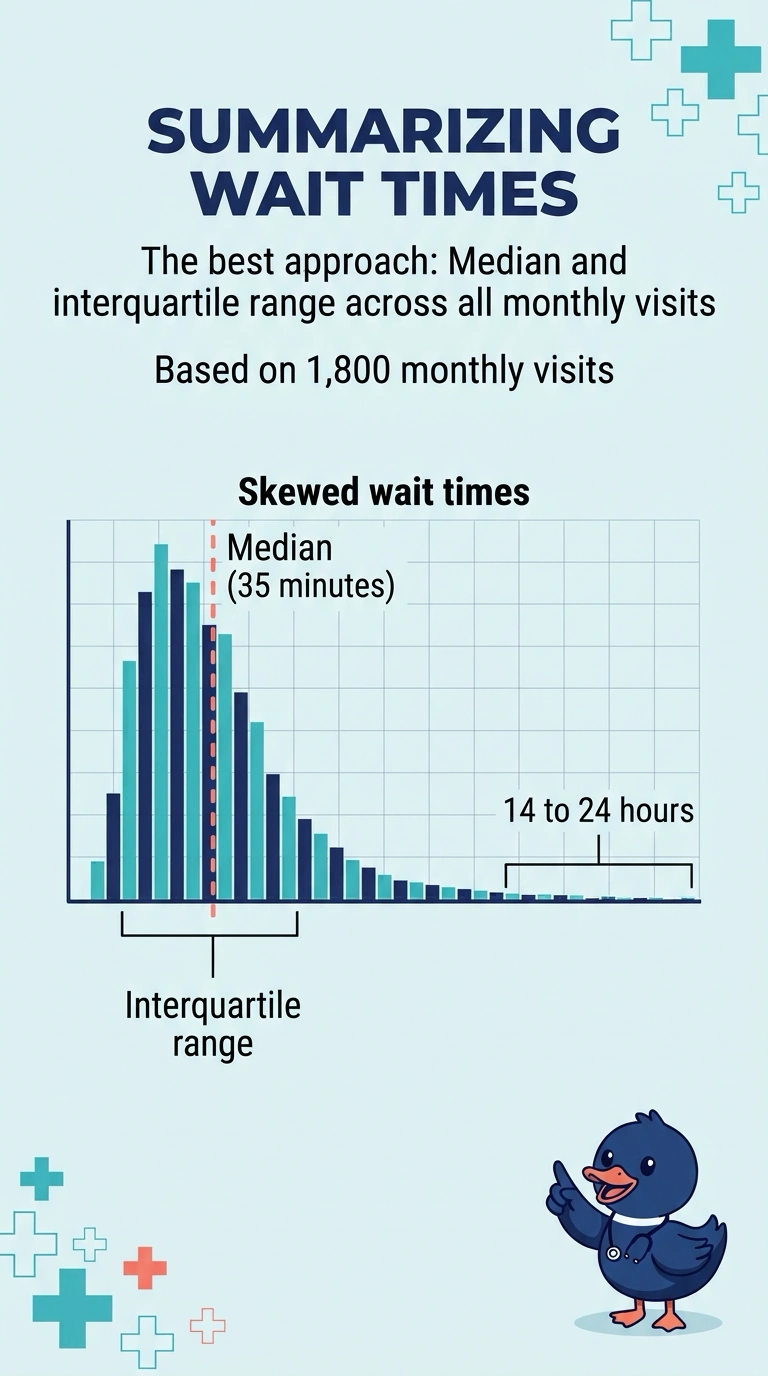
An emergency department quality analyst summarizes monthly patient wait times for 1,800 visits, where most patients are seen within 35 minutes but a small group of complex behavioral health boarders wait 14 to 24 hours. Which summary statistics best represent typical wait time and spread for this skewed distribution?
Select an answer to reveal the explanation.
Short Explanation
When a handful of extreme outliers stretch your wait-time data like a rubber band, the average gets pulled far away from what most patients actually experience. The trap is reaching for standard parametric statistics simply because they are familiar. You need non-parametric summaries that stay anchored to the middle of a skewed distribution.
Full Explanation
Emergency department wait times with a small cluster of prolonged behavioral health boarders form a right-skewed distribution rather than a symmetric bell curve. Reporting the Median and interquartile range across all monthly visits accurately reflects the typical patient's wait time at the 50th percentile while measuring spread across the middle 50% of visits without distortion from extreme tails. Using the Arithmetic mean and standard deviation across all monthly visits pulls the center upward and inflates dispersion because squared deviations magnify those 14-to-24-hour stays. Choosing a Weighted average and full range from shortest to longest visit still lets a single extreme boarding stay dictate the entire spread. Relying on the Mode and variance across all monthly visits fails because mode and variance ignore the shape of the long tail and are not robust summaries of a skewed distribution. One caveat is that quality teams should still track prolonged boarding stays separately as a safety and capacity indicator even when summarizing typical waits with non-parametric statistics. As an operational check, plot a monthly histogram or box plot alongside the median and interquartile range to confirm whether skewness is widening over time.
Prefer to study offline? Printable PDF study book + test engine ($7.50, unofficial). These questions stay free here.