
A tertiary academic medical center's crude inpatient mortality rate is higher than a nearby community hospital's rate, even though both facilities follow similar evidence-based protocols. Which analytical step should the quality analyst perform before comparing performance between the two hospitals?
Select an answer to reveal the explanation.
Short Explanation
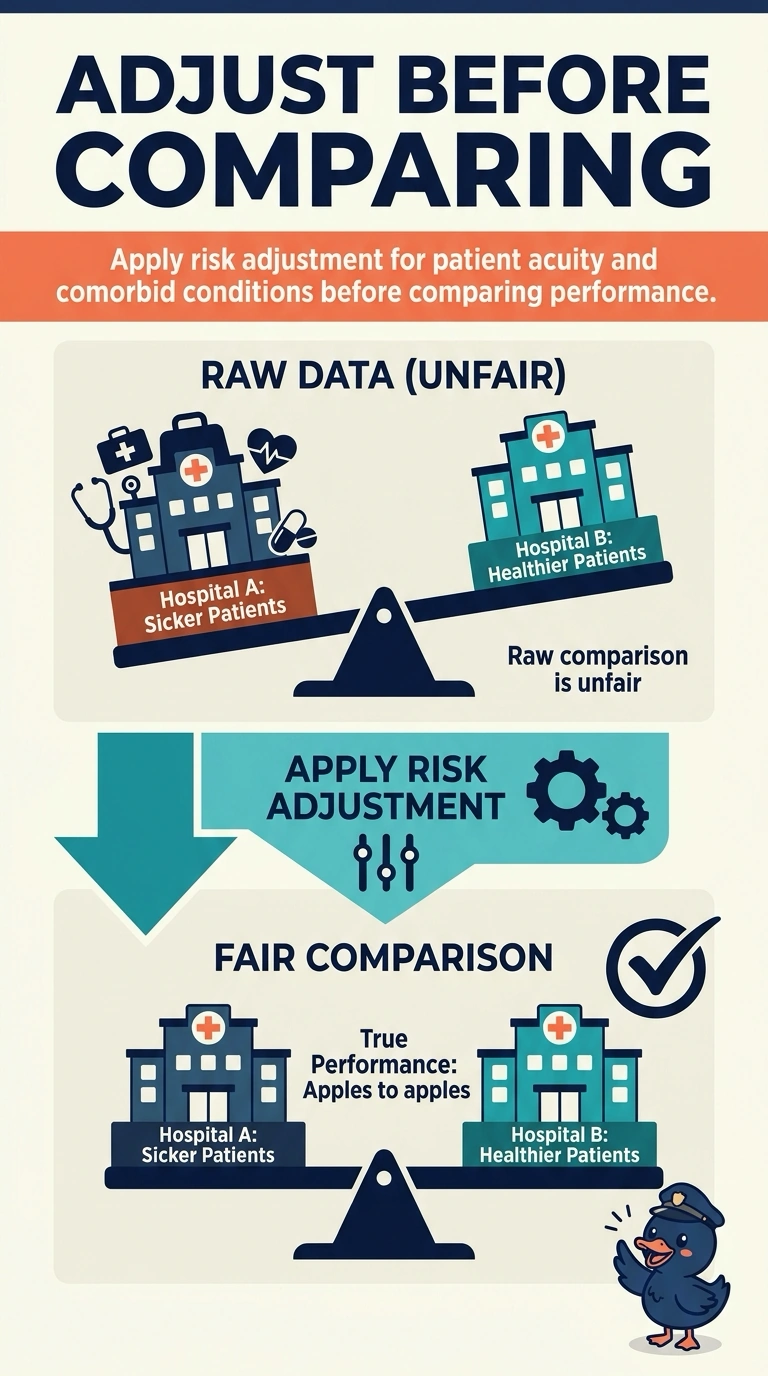
You’re comparing a tertiary referral center with a community hospital, so raw mortality rates can reflect who each facility treats as much as how well it provides care. Use risk adjustment for patient acuity and comorbid conditions before judging performance; otherwise, you’re not making an apples-to-apples comparison.
Full Explanation
Tertiary medical centers routinely treat higher-acuity transfers and complex surgical patients, which can raise crude mortality compared with lower-acuity community hospitals even when both follow similar evidence-based protocols. Applying risk adjustment for patient acuity and comorbid conditions uses statistical models to account for baseline illness severity, age, and diagnoses, allowing the hospitals to be compared on expected versus observed outcomes. Excluding intensive care unit admissions from the tertiary hospital’s data only would introduce selection bias and remove the highest-risk care processes that quality teams need to monitor. Converting both crude rates into simple three-month moving averages may smooth short-term variation over time, but it does not correct for underlying differences in case mix. Replacing the mortality rate with the average length of stay for each hospital would substitute a length-of-stay efficiency measure for a clinical outcome measure. A caveat is that risk adjustment depends on accurate clinical documentation and coding of present-on-admission comorbidities; otherwise, sicker patients may appear healthier on paper. As a practical check, review observed-to-expected mortality ratios alongside comorbidity-capture audits before presenting facility comparisons to leadership.
Prefer to study offline? Printable PDF study book + test engine ($7.50, unofficial). These questions stay free here.