
A designer reviews two datasheets for a string calculation on a cold-climate home: Module A lists 41 V open-circuit voltage and 11 A short-circuit current at STC, plus temperature coefficients. Which reading correctly uses STC, open-circuit voltage, and short-circuit current for this design?
Select an answer to reveal the explanation.
Short Explanation
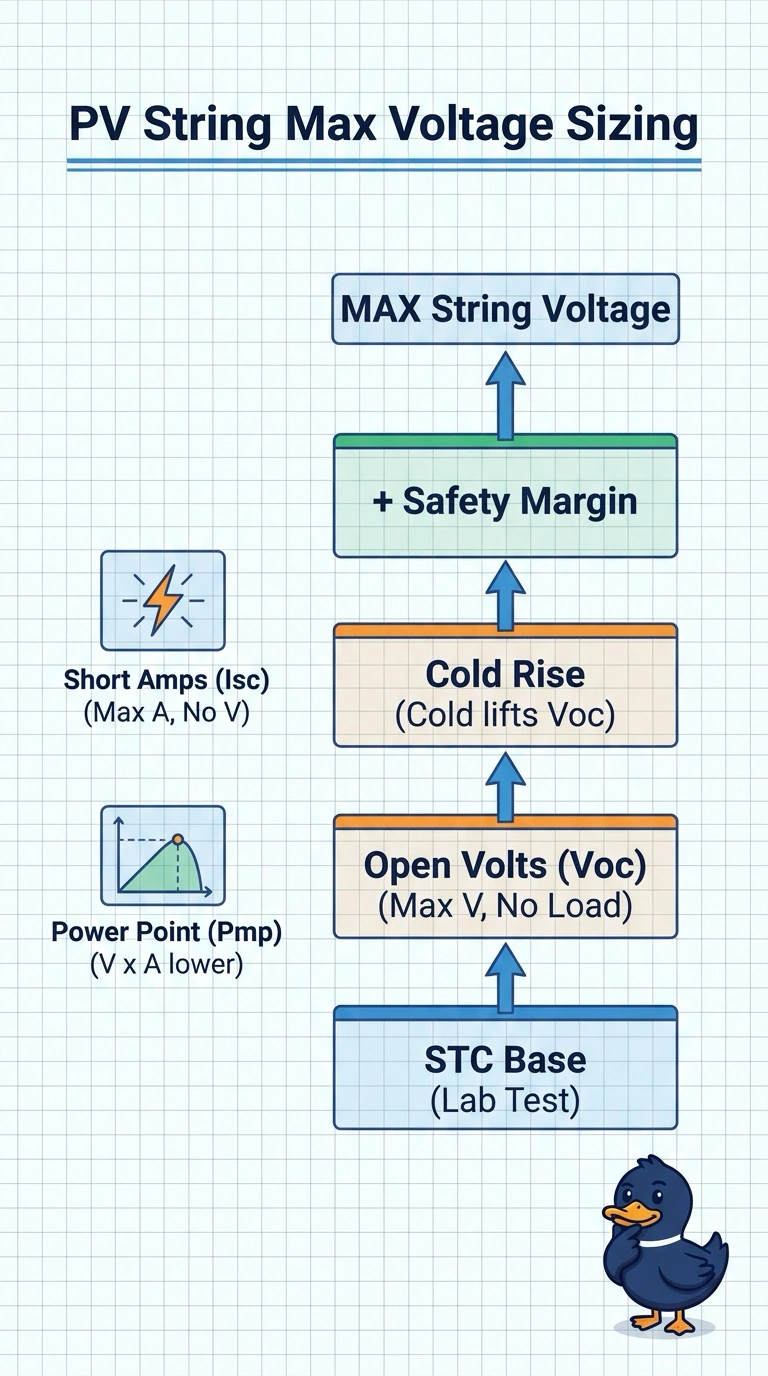
Cold mornings push voltage higher than the label, so plan for that spike. Open-circuit voltage sets your maximum string limit, like the highest water mark a pipe must hold.
Full Explanation
The correct approach uses the module’s open-circuit voltage (Voc), because string maximum voltage is assessed with the modules at open circuit, not at their normal maximum-power operating point. The listed 41 V is a standard test condition (STC) reference value; in a cold-climate design, Voc must be adjusted using its temperature coefficient to estimate the higher voltage at the design minimum temperature, then the required safety margin is applied. The 11 A short-circuit current (Isc) is a current rating, not a voltage value, and does not determine the string’s maximum voltage. Using cold-corrected Voc but omitting the prescribed margin leaves out a separate design allowance, so the result does not meet the stated requirement. Using cold-corrected maximum-power voltage (Vmp) substitutes an operating-point voltage for Voc; even with a margin, it can underestimate the maximum open-circuit string voltage. Applying a margin to STC Voc while correcting temperature only for current fails to account for the cold-driven increase in voltage. Exam caveat: the applicable electrical code and equipment limits determine the required margin and design temperature; do not assume one universal factor. Practical check: compare the resulting cold-corrected string Voc, including the required margin, with the inverter’s maximum DC input voltage.