
During a service call a tech must shorten a length of steel strut that is only propped against the equipment rack. The truck has a 4-1/2 inch cordless angle grinder with a grinding disc installed, its guard rotated out of the way, plus a box of same-size cut-off wheels. How should the tech set up the angle grinder and the strut before cutting?
Select an answer to reveal the explanation.
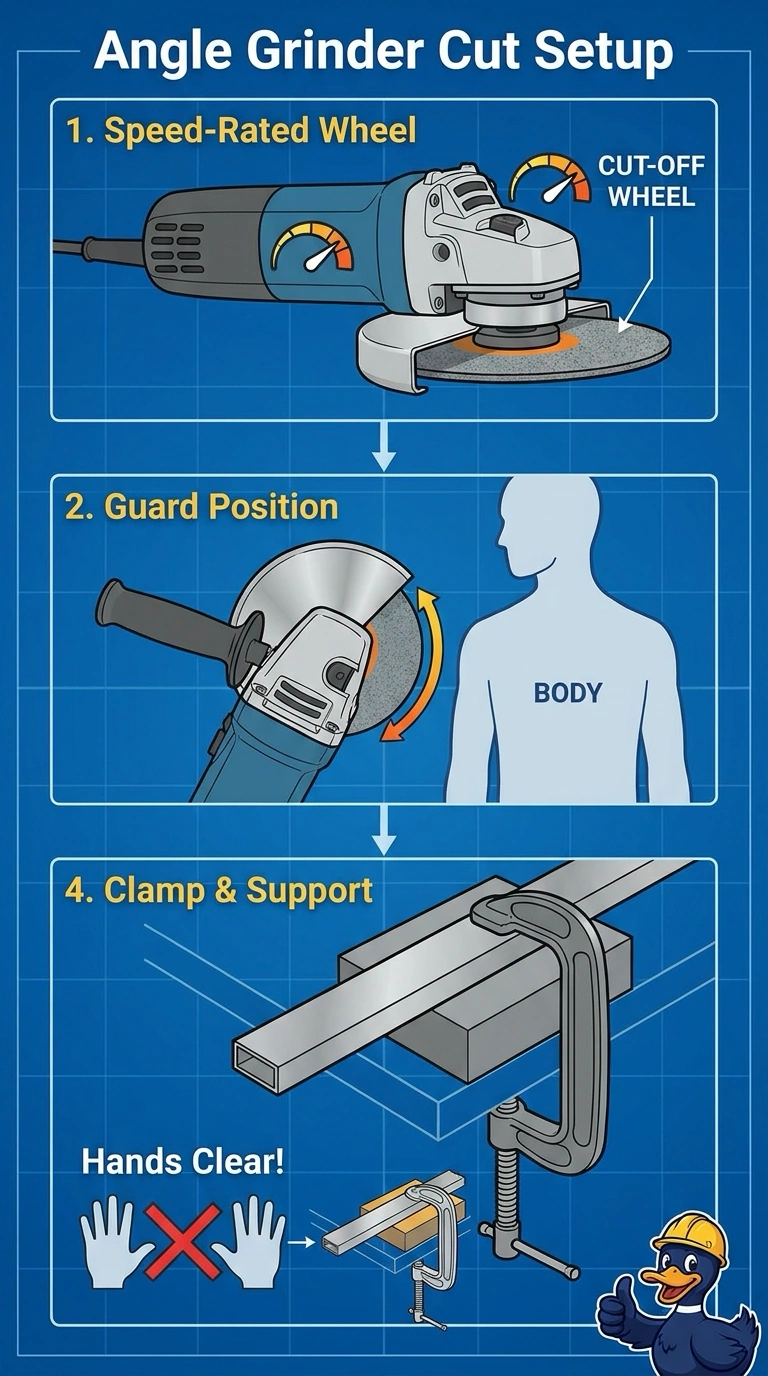
Short Explanation
You’ll make the cut safer by fitting a speed-rated cut-off wheel, placing the guard between you and the wheel, and clamping the strut firmly. A cut-off wheel is designed for cutting; the installed grinding disc is not, and a fixed stop alone does not secure the strut against movement.
Full Explanation
The safe setup uses a cut-off wheel rated for the grinder’s operating speed, places the guard between the wheel and you, and clamps the strut so it cannot shift or pinch the wheel. A matching cut-off wheel and a clamp are not enough if the guard is oriented to deflect sparks away from the rack rather than to shield you; guard position should account for the operator’s exposure. The installed grinding disc is intended for grinding, not this cut. Its thicker profile and side-loading characteristics make it a poor substitute for a cut-off wheel. A speed-rated cut-off wheel and correctly positioned guard are also insufficient when the strut is only supported against a fixed stop: support does not positively restrain it, so it can move as the cut finishes. Exam caveat: a wheel that fits the grinder is not necessarily rated for its no-load speed, so check its marked maximum RPM as well as its diameter and arbor. Before cutting, verify that the guard is secure and between you and the wheel, the strut is firmly clamped, and the cut will not cause the offcut to drop or bind the wheel.