
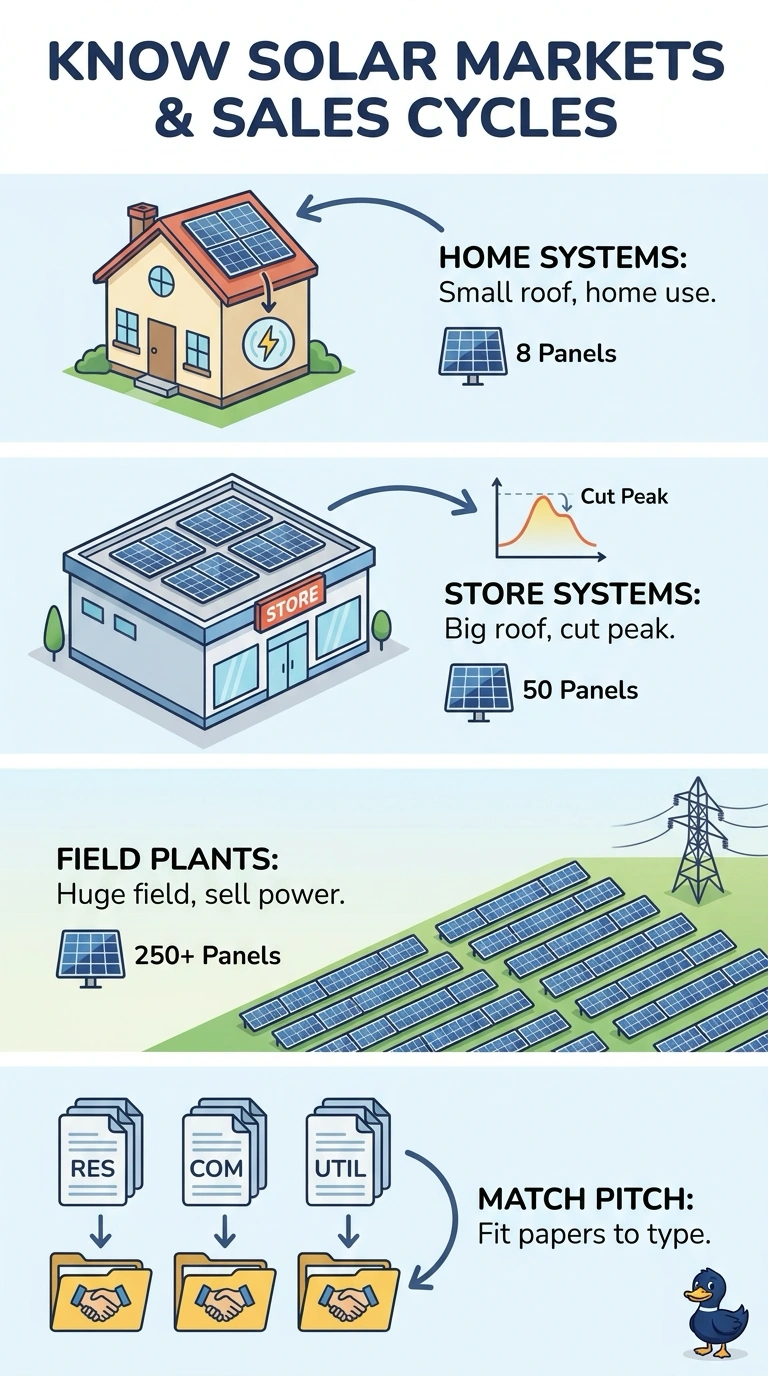
A sales trainee has three leads: a 8 kW home roof, a 250 kW retail store roof with demand charges, and a 50 MW fenced field selling to a utility, each with different buyers, permits, and interconnection paths. Which distinction among PV market segments best guides the sales approach for these leads?
Select an answer to reveal the explanation.
Short Explanation
You’ve got the right pitch when you match each buyer and project to its own scale and sales cycle. Solar sales aren’t one-size-fits-all—your approach should fit the home, business, or utility project.
Full Explanation
The best approach matches each lead to the market segment that typically shapes its buyer, sales cycle, permitting, and interconnection: the 8 kW home system is residential, the 250 kW business rooftop is commercial, and the 50 MW project selling power to a utility is utility-scale. The commercial store also calls for attention to demand charges, while the utility project involves utility procurement and large-project interconnection processes; neither is simply a larger version of a household sale. Classifying all three correctly but using one standard sales cycle overlooks distinct decision-makers and timelines: homeowners often decide individually, businesses may require financial and facilities review, and utility projects can involve lengthy procurement. Calling the utility-connected field commercial overlooks that the buyer and project scale make utility-scale the relevant segment. Treating the demand-charge retail roof as a residential net-metering sale misses its business customer and tariff economics. Exam caveat: project size is a strong clue, but ownership and offtake structure also matter when segment boundaries are less clear. Practical check: confirm the customer, who buys the energy, applicable tariff, permitting authority, and interconnection process before choosing a sales path.