
A home has a battery-based inverter tied to the grid with backup loads. During a storm the lights flicker, the inverter disconnects from the grid and powers backup loads, then it shuts down overnight even though solar is idle. Morning checks show grid sag with unstable frequency and very low battery voltage. Which operating relationship among utility voltage and frequency and battery voltage and state of charge explains the shutdown?
Select an answer to reveal the explanation.
Short Explanation
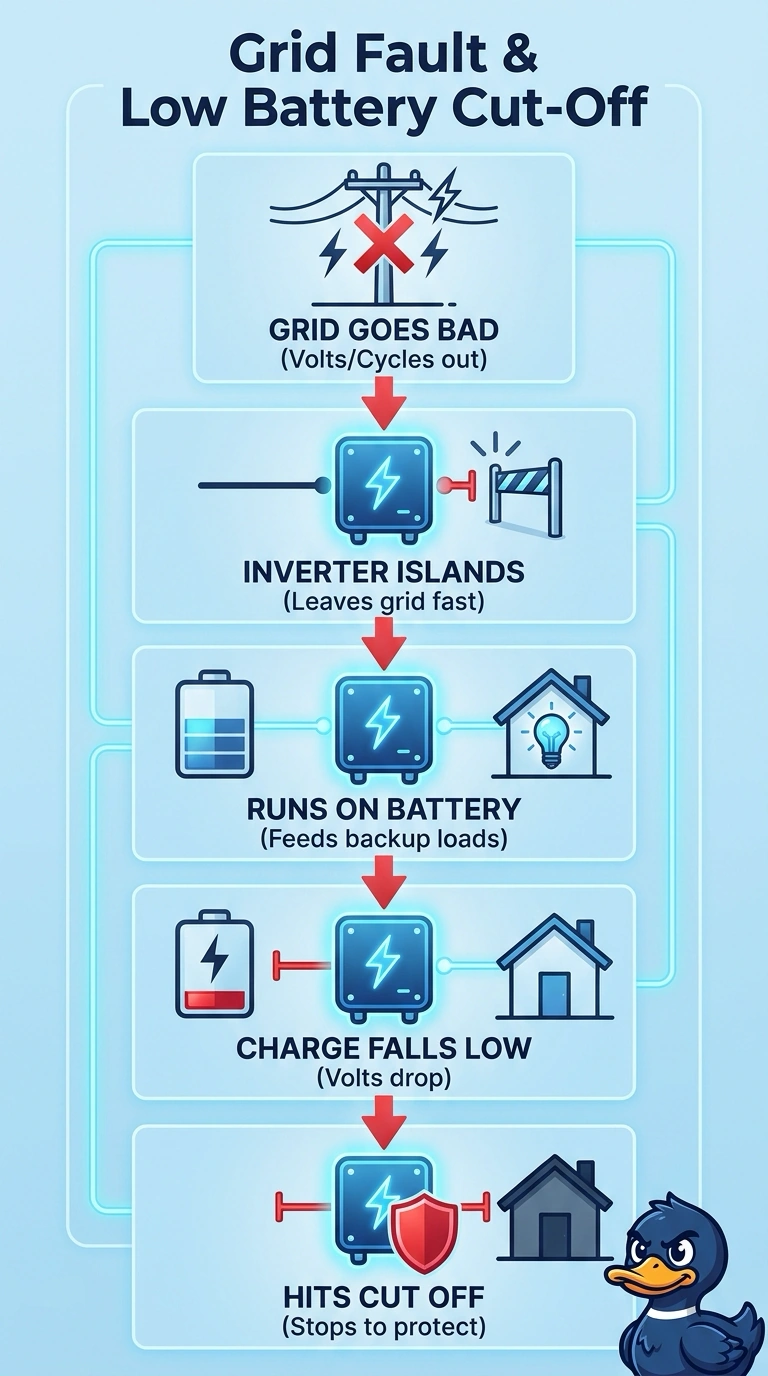
You nailed a two-step chain there. The grid event forced islanding, then low charge forced shutdown, and cut-off is your safety floor like a fuel light.
Full Explanation
The correct relationship is that utility voltage and frequency moved outside the inverter’s acceptable grid limits, so it disconnected and formed an island to supply the backup loads. With solar idle, the battery continued to discharge; its voltage eventually fell to the inverter’s low-voltage cutoff, causing shutdown. A reserve-SOC limit is a legitimate way to end battery discharge, but it does not explain this case if battery voltage has reached the cutoff; it substitutes a programmed capacity threshold for the observed voltage condition. A scheduled discharge limit can also be used to manage battery reserves, but no schedule is given, and it does not account for the reported low battery voltage as the shutdown trigger. An overload trip is another standard protection, yet attributing shutdown to a load surge while battery voltage remains above cutoff conflicts with the morning finding of very low battery voltage and lacks evidence of an overload. Exam caveat: low voltage and low state of charge often occur together, but they are not interchangeable; the actual trip criterion depends on inverter settings and battery-management protections. Practical check: review the inverter’s event log and configuration for grid-limit and low-battery trip records, and compare battery voltage and state-of-charge readings at shutdown with the specified thresholds.