
A maintenance tech must verify a suspected soiling loss on a 50-kW roof array at solar noon on a clear day, comparing meter readings to expected output and the monitoring portal. Which irradiance meter practice yields a trustworthy check?
Select an answer to reveal the explanation.
Short Explanation
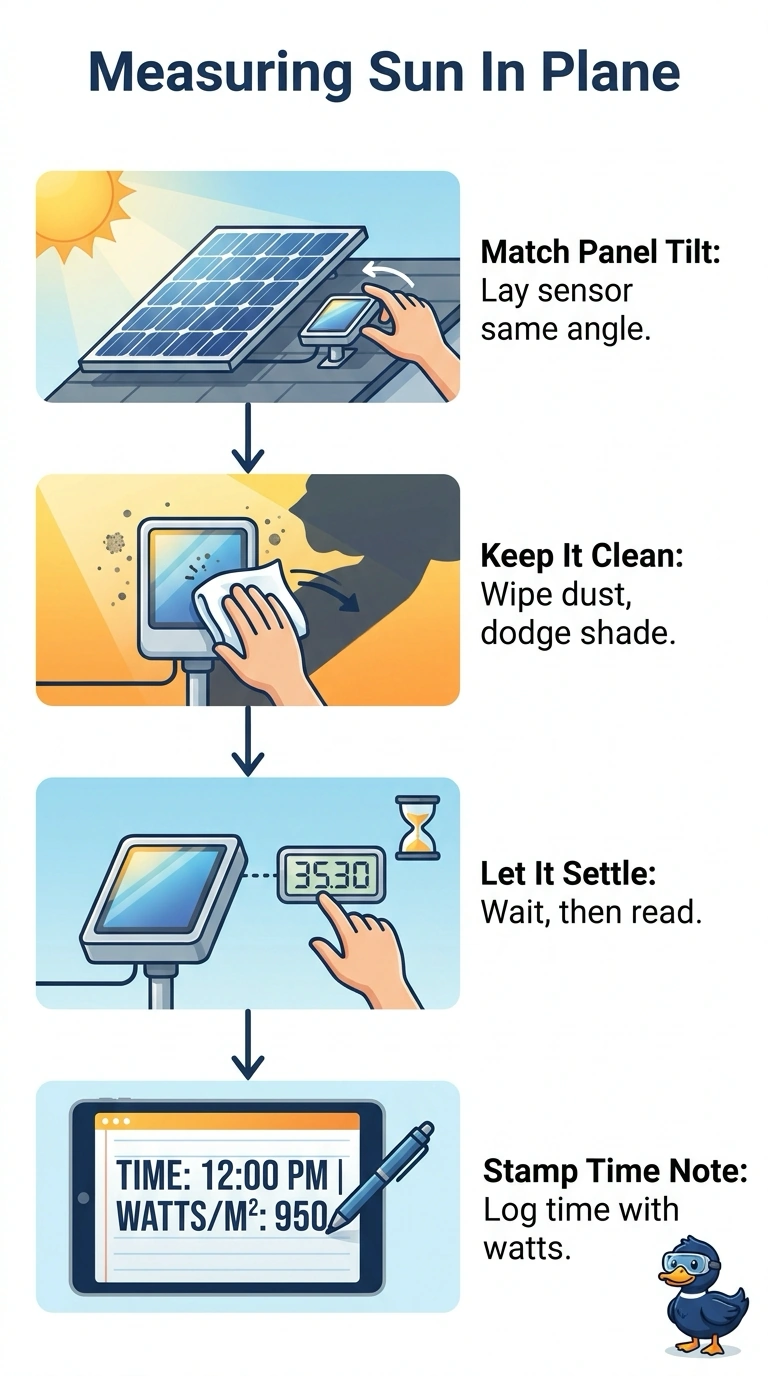
Your meter must see what your panels see. Matching tilt and sky nails plane-of-array accuracy, like pointing your camera at the same view to compare photos.
Full Explanation
The correct practice measures irradiance in the array’s plane, with the sensor clean and unobstructed, and preserves the reading time. Plane-of-array irradiance is the relevant sunlight input for comparing the roof array’s output with expected performance; a horizontal reading can differ substantially when the modules are tilted. Cleanliness and freedom from shade prevent the meter itself from introducing a false low reading, while time stamps let the technician align measurements with inverter or portal data and the expected-output reference. A clean, shade-free horizontal measurement at solar noon is a legitimate way to measure global horizontal irradiance, but it does not represent the tilted array’s incident irradiance. A plane-of-array reading taken without a time stamp still measures the right quantity, yet cannot be reliably matched to time-dependent production or portal records. A properly logged plane-of-array reading in midafternoon is also a standard field measurement, but it does not meet the stated solar-noon condition; changing solar angle and operating conditions can make that comparison unrepresentative. Exam caveat: “solar noon” means the sun’s local culmination, not necessarily 12:00 on the clock. Practical check: confirm the sensor is coplanar with the modules, unobstructed, clean, and synchronized to the same clock basis as the monitoring data.