
A new hire asks why a 400-W glass-backsheet module on rails needs clamps at set zones and a small gap to the roof. Which description should the trainer give to describe PV modules and mounting structures?
Select an answer to reveal the explanation.
Short Explanation
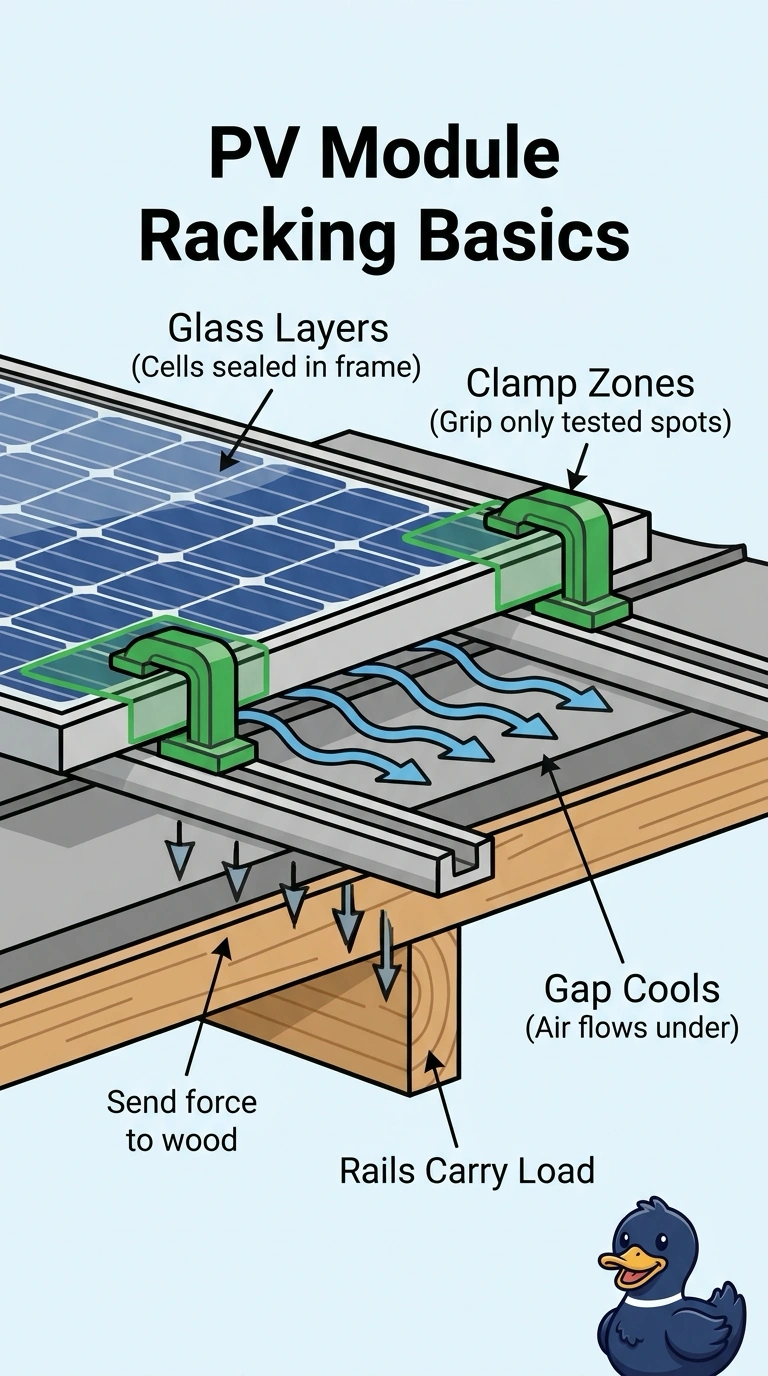
You’re supporting a framed laminate on rails, so keep the clamps within its listed zones and leave a little space beneath it. That careful clearance helps the installation match the module’s requirements and allows airflow.
Full Explanation
The suitable description is a framed laminate on rails, clamped within its listed zones to provide the intended load path and held above the roof with a small airflow gap. The listed clamp zones matter because the module must be supported where its manufacturer allows; the gap preserves clearance beneath the module. A description using framed backsheet modules on rails with standard mid- and end-clamps positioned by rail spacing changes the clamp criterion: rail spacing alone does not establish safe clamping locations. A description using framed glass-glass laminates on rails changes the module construction; the stated module is glass-backsheet, even though the listed zones and raised airflow gap are relevant installation details. A description using roof-anchored standoff mounts changes the support system from rails, even though it retains the framed backsheet module, listed clamp zones, and raised clearance. Exam caveat: similar-looking modules and mounting hardware are not interchangeable by assumption; permitted clamp regions and mounting configurations depend on the specific product’s listing and installation instructions. Practical check: verify the module label and datasheet, then compare the rail layout, clamp positions, and installed roof clearance with the manufacturer’s instructions and the project’s approved design.