
During commissioning of a 10-kW hybrid system with backup, the grid sags on a hot afternoon, frequency wavers, and the battery bank reads low after overnight loads. Which relationship among utility voltage and frequency and battery voltage and state of charge should the technician use to explain operation?
Select an answer to reveal the explanation.
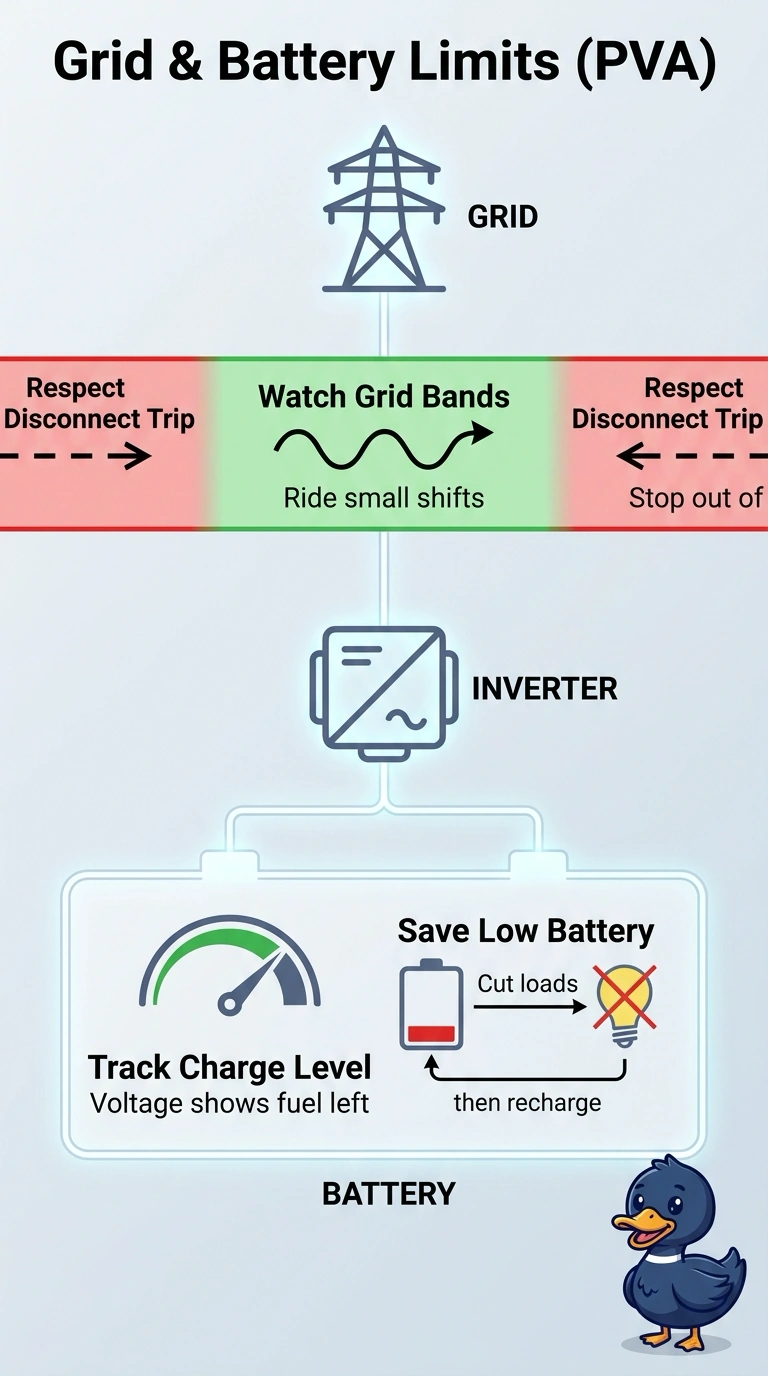
Short Explanation
You are reading two dashboards at once, grid health and fuel gauge together. Trust limits: the inverter guards both, pausing grid tie when off-spec and saving the battery when low.
Full Explanation
The correct relationship separates grid conditions from battery condition. Utility voltage and frequency can vary within the inverter’s permitted operating window; small shifts need not interrupt service, but excursions beyond configured or required limits can cause disconnection. Battery voltage and state of charge indicate stored energy and available backup, not the utility’s voltage or frequency. When charge is low, the system may reduce or shed loads to preserve remaining energy. Shutting backup off immediately at low charge is a credible protection strategy, but it fails the stated behavior: curtailment is not the same as ending backup. Tripping whenever voltage or frequency departs nominal values is also a real protective response, but it misses ride-through of small shifts that remain within the operating window. Voltage-based load control is used in some systems, yet terminal voltage varies with load, temperature, and battery chemistry; relying on it alone does not represent estimated state of charge as specified. A key exam caveat is that ride-through thresholds and low-charge actions depend on inverter settings, applicable grid rules, and battery-management limits. In practice, check the commissioning settings and event logs for grid voltage/frequency trip thresholds, battery SOC and voltage readings, and the configured low-charge load-shedding response.