
A foreman plans a two-story shingle-roof install requiring ladder access, fall protection, and work inside a live main panel to land a backfed breaker for a 10-kW system. Which identification of applicable safety regulations best guides this safety plan?
Select an answer to reveal the explanation.
Short Explanation
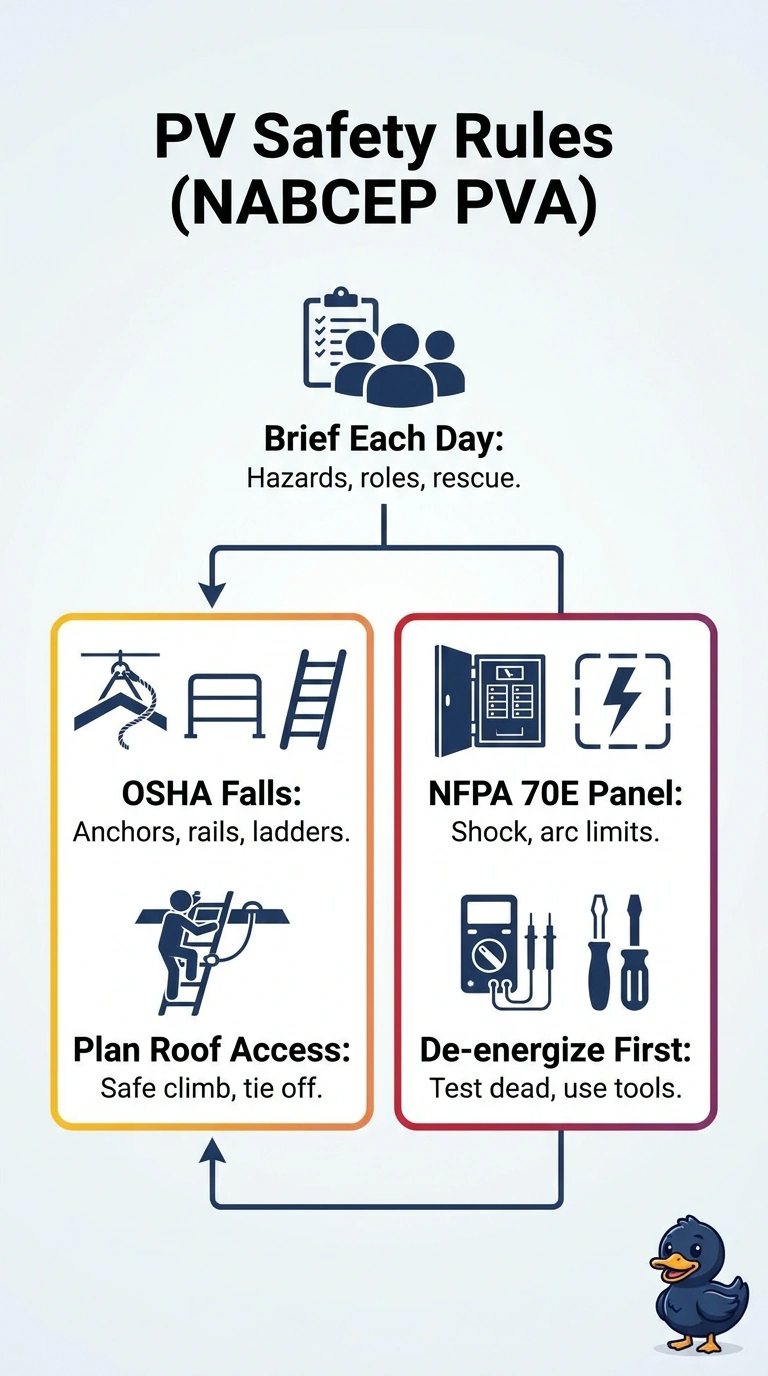
You’re matching each hazard to the safety rules that address it. OSHA and NFPA 70E work together here: OSHA covers falls and ladders, while NFPA 70E addresses arc-flash risk at the live panel.
Full Explanation
The plan citing OSHA fall and ladder rules plus NFPA 70E arc-flash practices addresses both distinct hazards: OSHA construction requirements guide ladder use and fall protection during roof work, while NFPA 70E provides electrical safe-work practices relevant to the specified live-panel task, including arc-flash risk. Citing OSHA rules and NEC interconnection requirements is plausible because both matter to a rooftop solar installation and backfed breaker, but installation-code requirements do not replace NFPA 70E’s worker-protection practices for work inside energized equipment. Citing OSHA and NFPA 70E shock protection covers roof access and shock hazards, but shock protection alone does not address the required arc-flash assessment and controls for the live panel. Citing fall-protection rules and arc-flash practices addresses those hazards but omits ladder-safety requirements, even though ladder access is explicitly part of the job. Exam caveat: distinguish installation rules, such as the NEC, from workplace safety standards; one does not automatically substitute for the other. Practical check: before work begins, verify that the written plan identifies applicable OSHA fall and ladder requirements and addresses energized-work justification, boundaries, PPE, and arc-flash risk under the site’s electrical safety procedures.