
Your crew must set ballasted racks on a dusty flat roof in summer heat where就不 saw-cutting concrete generates silica dust and workers face falls near the edge. Which control choice best applies the hierarchy of controls to this solar job-site hazard?
Select an answer to reveal the explanation.
Short Explanation
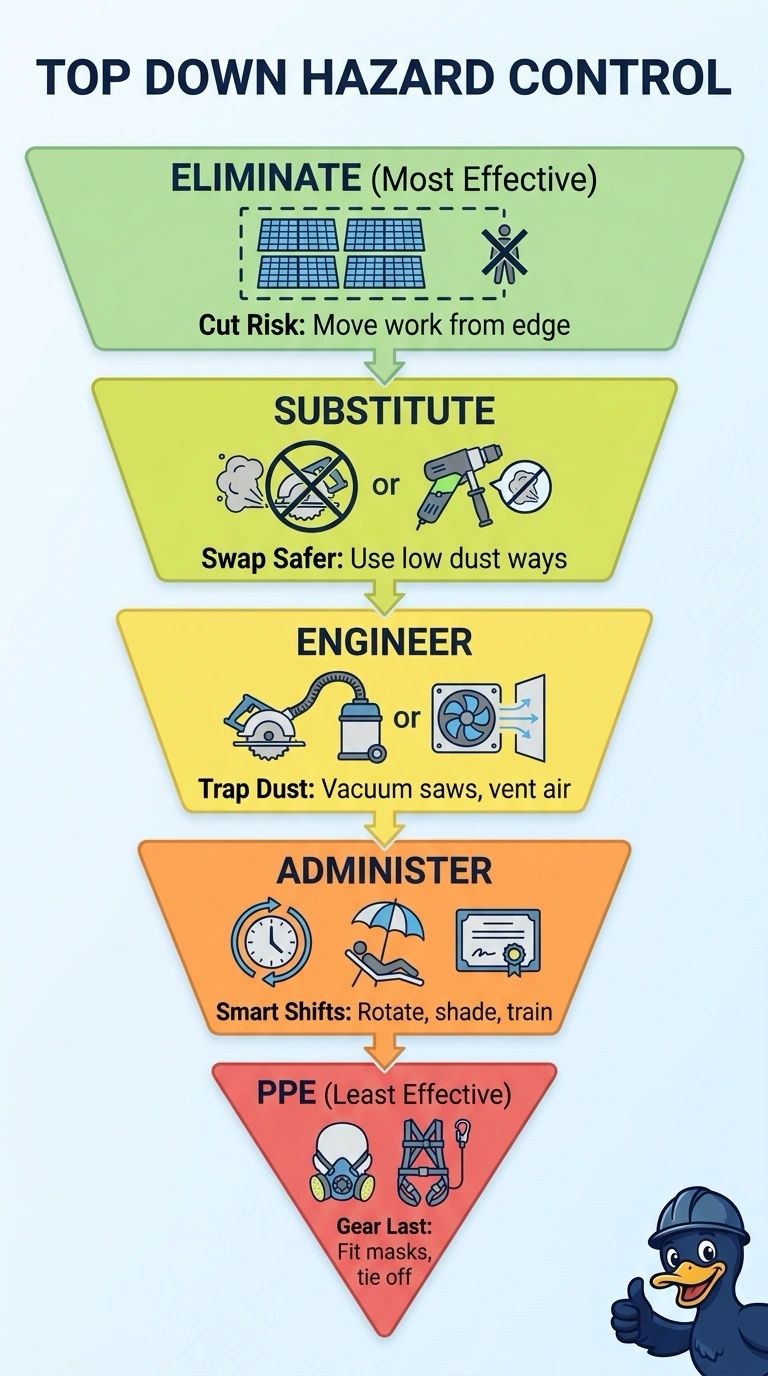
You’re stacking controls from strongest to weakest, not starting with gear. The hierarchy means removing the edge exposure first, then controlling what remains and adding protective measures for residual risks.
Full Explanation
The setback layout is the strongest starting point because it eliminates routine edge work; dust capture at the saw controls silica at its source, while shift rotation, shade, and respirators add protection for residual heat and exposure risks. Rated guardrails, dust capture, shift rotation, shade, and respirators provide several sound controls, but guardrails protect workers from a fall rather than eliminating edge work through a setback. A setback with dry-cutting and HEPA extraction, shift rotation, and shade uses a strong source-control measure, but omits respirators from the specified supplementary protection package. A setback with source capture, respirators, and cool-hour rotation includes important controls, but omits shade, leaving out a stated heat-control measure. Exam caveat: hierarchy questions ask for the best package for the scenario, not whether another control could be acceptable after a site-specific assessment. Practical check: verify the setback keeps workers away from the edge during installation and cutting, and confirm the saw’s dust-capture system is operating effectively before work starts.