
During commissioning of a 6-kW string inverter you measure 240 volts AC at the point of connection while the system exports 24 amps to a resistive test load. The lead wants power and circuit resistance confirmed from these readings. Which Ohm's law and power calculation gives the correct values?
Select an answer to reveal the explanation.
Short Explanation
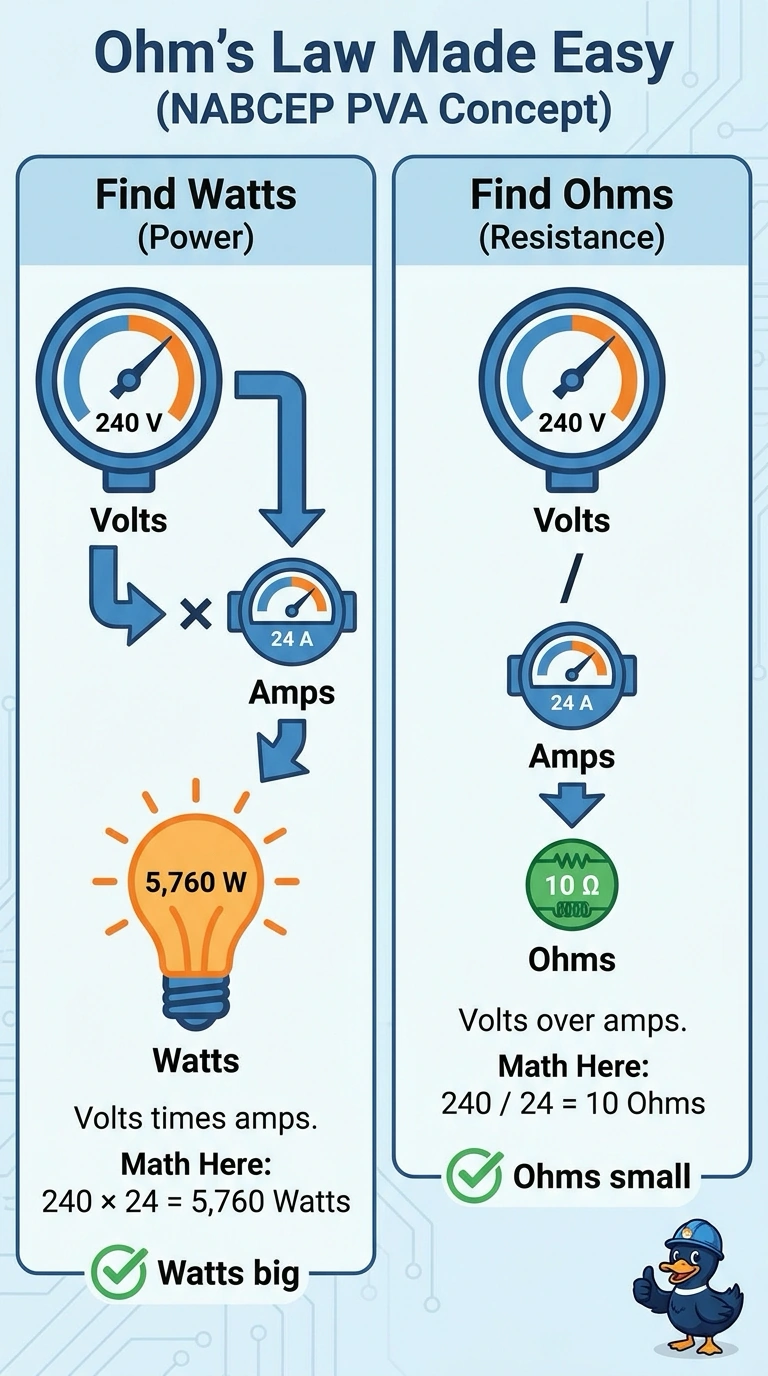
You turned meter numbers into answers—nice math. Volts times amps gives watts fast, just as length times width gives floor space.
Full Explanation
Use the measured voltage and current at the load: 240 V × 24 A = 5,760 W, and 240 V ÷ 24 A = 10 Ω. Because the test load is resistive, its power factor is effectively 1, so real power equals voltage multiplied by current. The calculation using a 0.95 power factor applies a reduction suited to loads that are not purely resistive; it understates power here, although its resistance calculation is correct. The calculation using the inverter’s 6,000-watt rating substitutes nameplate capacity for the power confirmed by the operating readings. The calculation using 120 volts per leg may apply when analyzing one leg of a split-phase system, but the stated point-of-connection voltage for this load is 240 volts; using 120 volts gives 2,880 watts and 5 ohms, rather than the values supported by the measurements. Exam caveat: for AC loads that are not resistive, real power generally requires a power-factor term, and voltage and current must be compatible RMS measurements. Practical check: verify that the meter readings are taken simultaneously at the same connection and that the test load is actually resistive.