
You service a 9-kW home system in Charlotte with a string inverter listed 200-500 Vdc MPPT range and 600 Vdc max, plus 240 Vac output. On a cold morning it shows 545 Vdc at low power and frequent restarts. Which interpretation of inverter AC/DC voltage and MPPT range best explains the fault?
Select an answer to reveal the explanation.
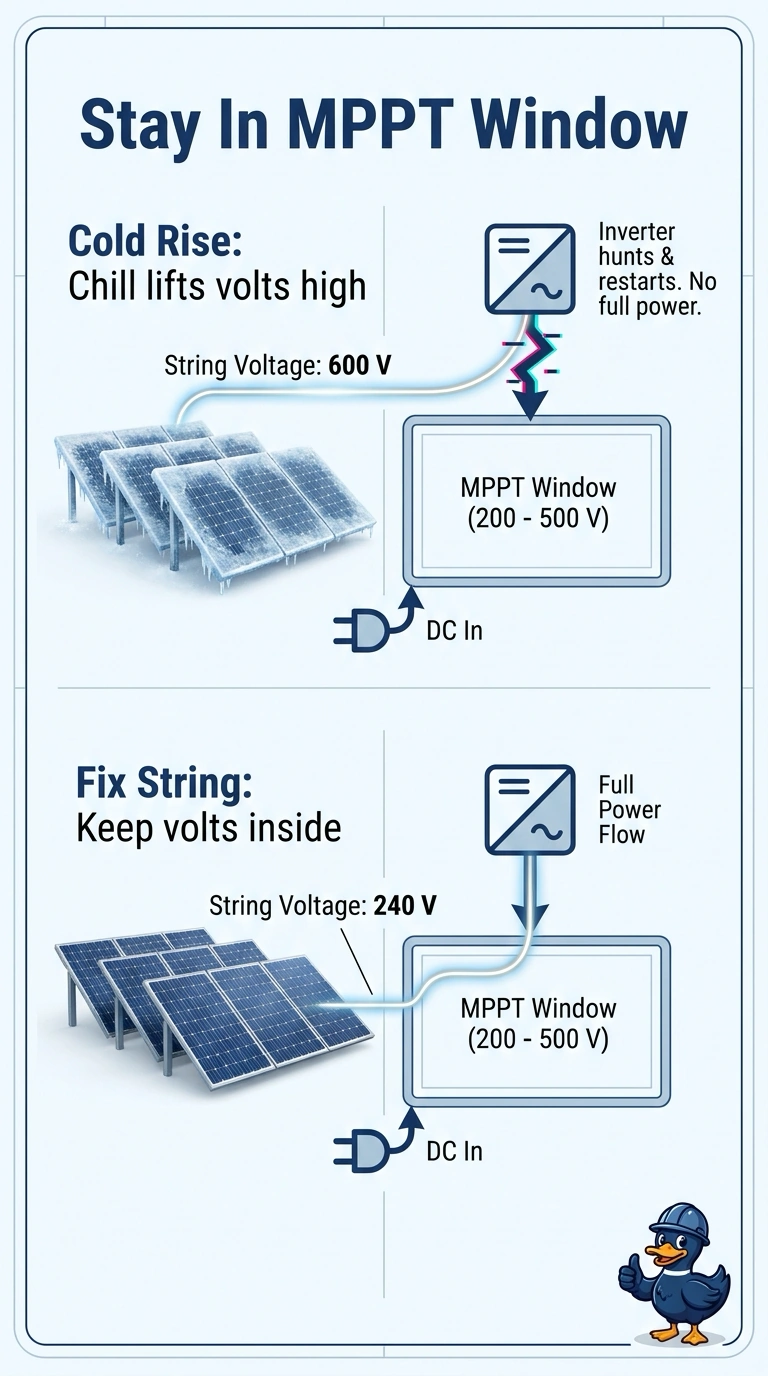
Short Explanation
Cold mornings push string volts high, and your window has a ceiling. Running above that MPPT range leaves the tracker lost and cycling. Bringing volts back inside lets it lock on and stay.
Full Explanation
The 545 Vdc reading is above the inverter’s 200–500 Vdc MPPT operating window, even though it remains below the separate 600 Vdc absolute maximum. The inverter may therefore be unable to track the array’s operating point reliably, explaining the low power and repeated restarts; reducing the string’s series module count or otherwise bringing its operating voltage into range is the relevant remedy. Using the 600 V maximum as the operating target confuses a safety limit with the narrower range in which the inverter can perform MPPT. Checking utility voltage is a reasonable troubleshooting step for restarts, but the stated 240 Vac output rating is not evidence of an AC-side fault, and it does not explain why the reported DC voltage exceeds the MPPT range. Distinguishing cold open-circuit voltage from loaded operating voltage is also good practice, but the reading is given as the voltage present during low-power operation; assuming it is an unloaded Voc reading does not establish that loaded tracking is within range. Exam caveat: maximum DC voltage and MPPT range are different specifications, and passing the maximum-voltage check does not guarantee proper operation. In the field, verify the voltage measurement’s operating state, compare cold-weather string Voc with the absolute limit, and compare loaded Vmp with the MPPT window using the module data and actual series count.