
A school board weighs a 100-kW rooftop to stabilize a tight operating budget and meet climate goals, asking what solar delivers beyond kilowatt-hours. Which explanation best captures predictable electricity cost and environmental benefit for this school?
Select an answer to reveal the explanation.
Short Explanation
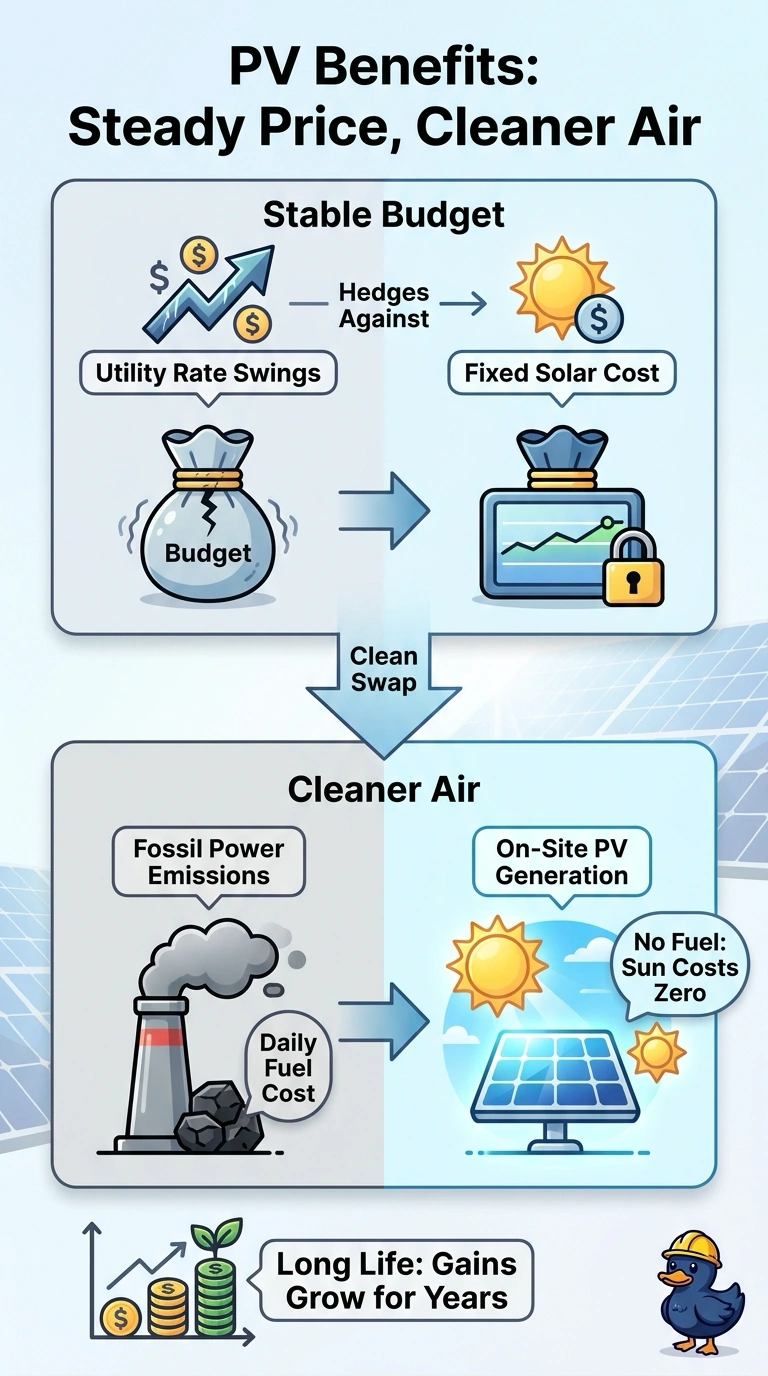
You’re looking for steadier costs and cleaner power, not a promise that every bill will stay fixed. A hedge against rate swings plus on-site generation that displaces fossil emissions gives you both benefits over the system’s life.
Full Explanation
The fixed-cost explanation connects the two benefits the board seeks: a fixed solar cost can reduce exposure to changing utility rates, while on-site generation can avoid some grid generation and its associated fossil-fuel emissions over the system’s operating life. Net-metered rooftop solar can lower bills and displace grid emissions, but export-credit rules and utility rates can change, so those savings alone do not establish a predictable cost hedge. A fixed-price solar lease can hedge rate swings and cut emissions, but an exported midday kilowatt-hour does not always displace fossil generation equally; avoided emissions depend on when and where the electricity enters the grid and what generation it replaces. Tax credits and lower utility purchases can improve the budget, and rooftop generation can displace fossil emissions, but neither fixes the price of the school’s future electricity. Exam caveat: a fixed solar payment does not guarantee a fixed total bill, since demand charges, utility tariffs, production variation, and contract terms still matter. Practical check: compare the contract’s payment and escalation schedule, export-credit assumptions, and modeled emissions with the school’s interval load and local grid data.