
A two-person crew services inverters on a low-slope warehouse roof, working about fifteen feet in from every edge. Six unprotected skylights sit inside the work area, the parapet is forty-two inches high, and the nearest engineered anchor is forty feet away along the north edge. Which fall protection system addresses the real exposure in this fifteen-foot work zone?
Select an answer to reveal the explanation.
Short Explanation
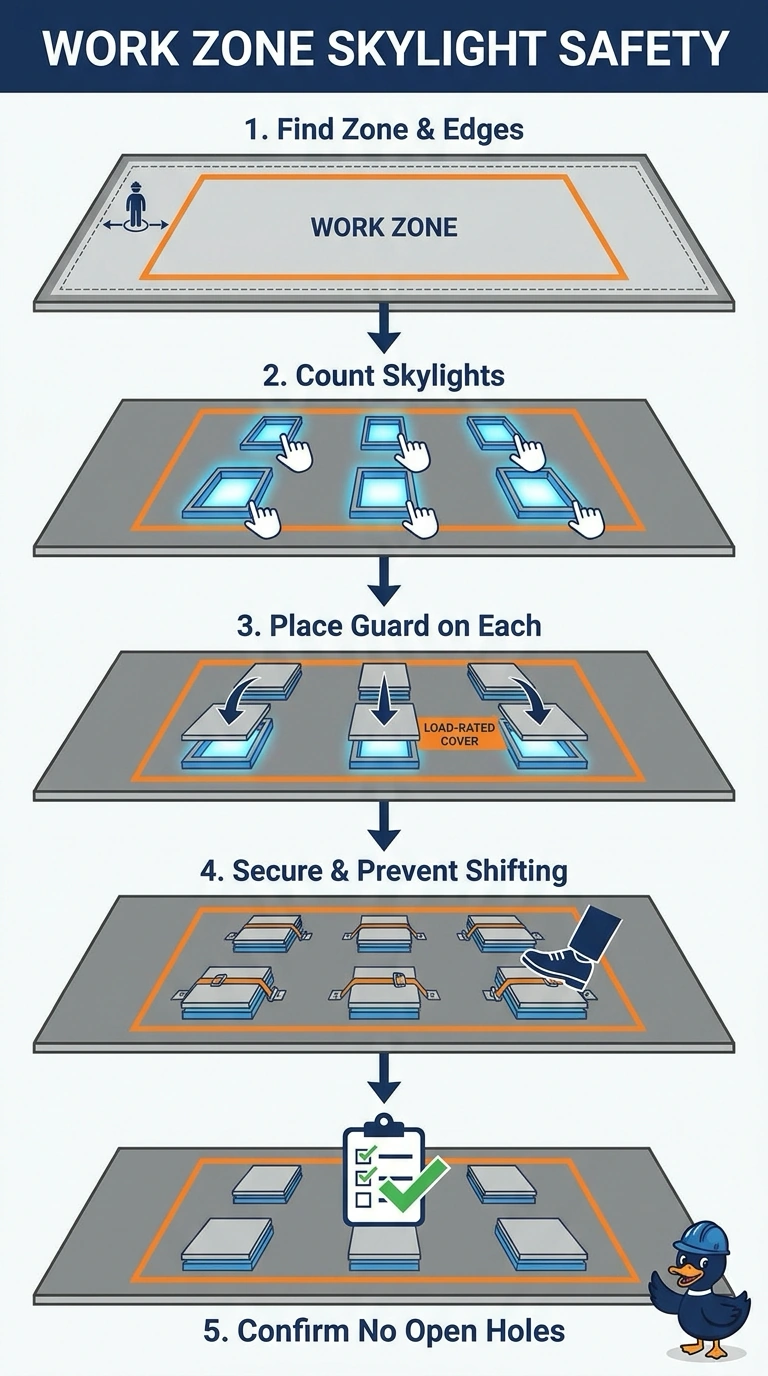
You’re working well inside the roof edges, so the six skylights are the fall exposure to address. A secured, load-rated cover over each skylight both supports the expected load and stays in place. That protects you in the work zone without relying on the distant anchor.
Full Explanation
The six unprotected skylights are the primary exposure in this work zone: a worker could fall through an opening, even while working well inside the roof edges. A secured, load-rated cover over every skylight addresses both essential controls: it can support the expected load, and its attachment helps prevent workers, tools, or wind from shifting it. The 42-inch parapet and the crew’s distance from the edges do not protect someone who steps or falls onto a skylight; the anchor forty feet away does not itself protect the openings. A secured cover whose documented load rating has not been checked fails because apparent sturdiness does not establish that it can support the load it may encounter. Load-rated covers that are not secured fail because they can shift or slide and expose an opening, even if strong enough. Rated screens whose load capacity is unverified fail because the crew cannot rely on an assumed capacity; it must be confirmed as adequate for the intended use. Exam caveat: a listed or rated product must still be installed according to its instructions and applicable rules; the label alone does not ensure protection. Practical check: before work begins, inspect every skylight in the work zone and verify each cover’s load documentation, fit, and attachment against displacement.