
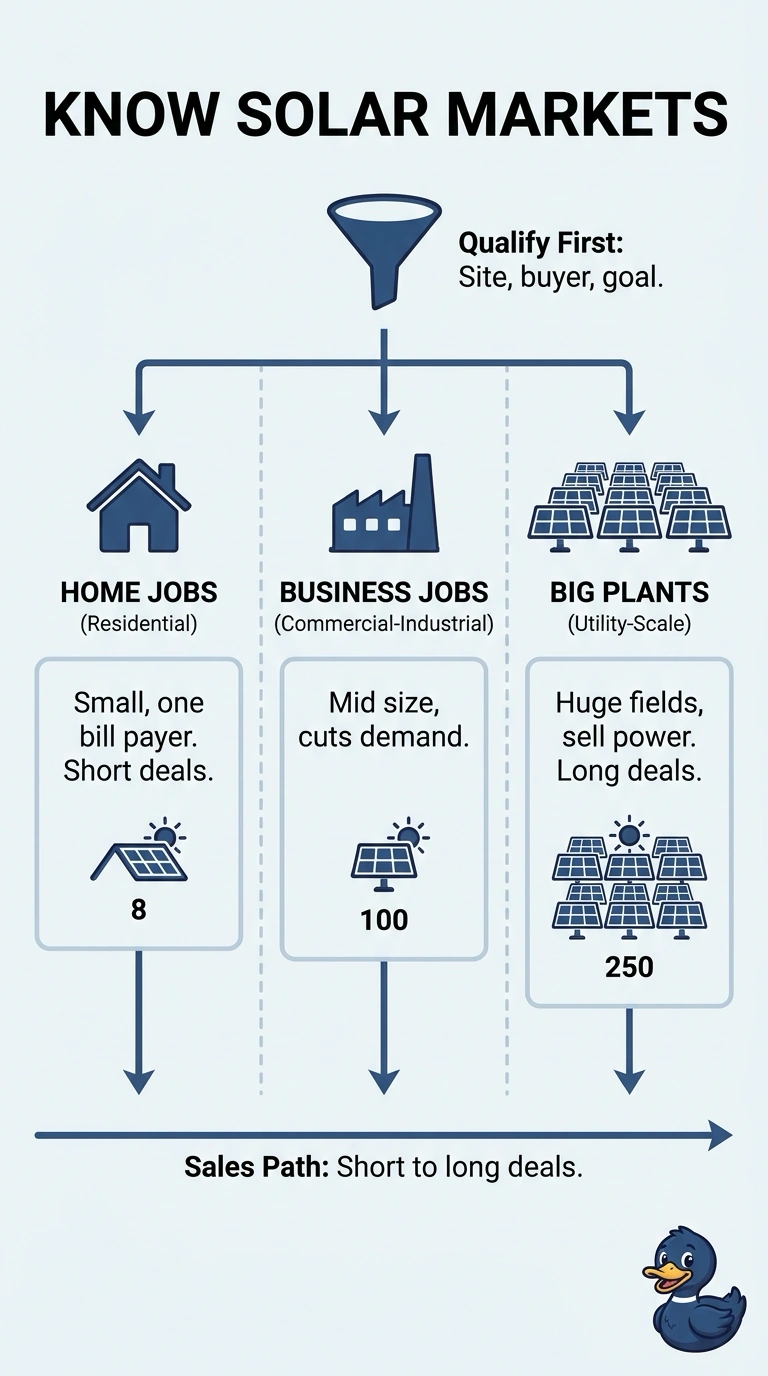
A sales trainee must qualify three leads: a 8-kW home with net billing, a 250-kW warehouse with demand charges, and a 100-MW field with a power purchase contract. The trainee mixes up approval paths and sales cycles. Which market-segment distinction best organizes these PV opportunities?
Select an answer to reveal the explanation.
Short Explanation
You are sorting leads like a seasoned seller — size points to buyer. Buyer scale shapes the whole deal, like small, mid, and bulk orders need varied checkout lanes.
Full Explanation
The correct distinction organizes the leads around the market segments that shape both project scale and how a sale proceeds. An 8-kW home is residential, typically involving a homeowner, net-billing rules, and a comparatively short approval and sales process. A 250-kW warehouse is commercial-industrial, where demand charges, business decision-makers, and more involved engineering and approvals matter. A 100-MW contracted field is utility-scale, with large project development, contract negotiations, and lengthy review and procurement cycles. Grouping by customer type and tariff can be useful for proposal design and timing, but it does not account for system scale, which is an explicit basis for distinguishing these opportunities. Grouping by capacity and interconnection pathway helps anticipate technical and permitting work, but it omits who the buyer is, a key factor in organizing sales activity. Grouping by capacity and customer class can guide design and identify likely buyers, but it overlooks sales-cycle differences, which are central to the scenario. Exam caveat: segment boundaries and approval steps vary by jurisdiction, utility, and project structure, so capacity alone does not determine a project’s market segment. Practical check: confirm the customer and contracting party, system capacity, tariff or offtake arrangement, and applicable interconnection and approval process before assigning the lead.