
A new installer asks why a silicon module makes DC power with no moving parts during a toolbox talk in Denver. The crew works with crystalline modules rated near 40 Voc and wants the physics, not sales terms. Which statement correctly explains the photovoltaic effect for this entry-level crew?
Select an answer to reveal the explanation.
Short Explanation
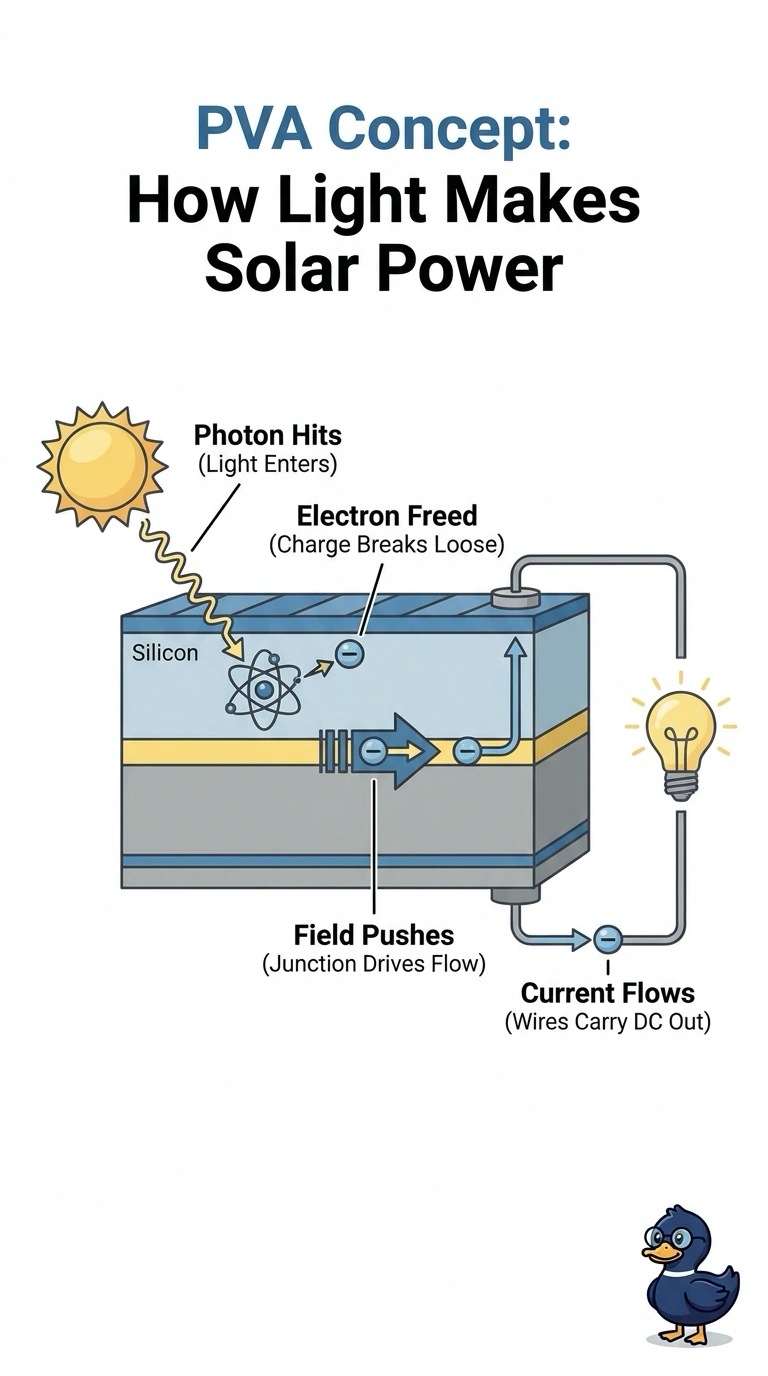
When light photons reach silicon, they free electrons, and the junction field guides the separated charges into directed current. You get DC power without moving parts or a heat engine.
Full Explanation
In a crystalline-silicon photovoltaic cell, absorbed photons create mobile electron-hole pairs, and the built-in electric field at the junction separates the charges. Their separation establishes a voltage, and a connected circuit carries direct current; no moving parts are needed. A sunlight-heated thermoelectric junction can produce DC from a temperature difference, but that is not how a silicon photovoltaic module generates its output. In a silicon photodetector, illumination can increase carrier density while an externally applied bias drives current; that describes a sensing arrangement, not a module generating power through its photovoltaic junction. An external battery bias likewise is not what drives current from an illuminated module: the cell’s built-in junction field separates carriers, rather than a battery supplying the driving bias. Exam caveat: the junction field separates carriers, but photons supply the energy that creates them. Practical check: in light, measure a module’s polarity and open-circuit voltage, then compare its current under a safe load; follow site procedures and use appropriately rated instruments.