
A designer compares two 10-kW bids in a hot, dusty valley with rare rain, nearby almond harvest dust, and 105°F summer peaks. Both use the same modules and tilt. Which design adjustment best accounts for weather and soiling effects on performance?
Select an answer to reveal the explanation.
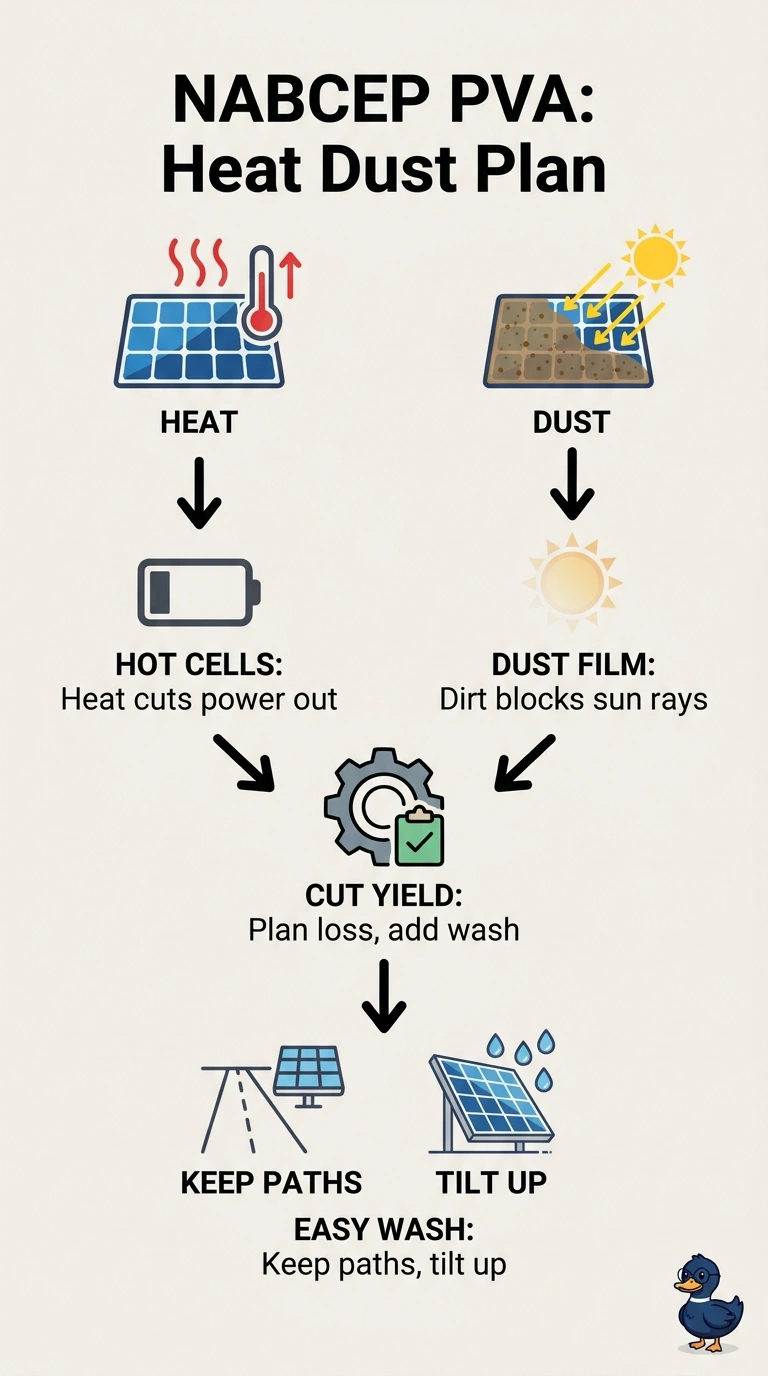
Short Explanation
Dust and heat can quietly steal power during hot weeks, so you’ll want to model cell-temperature losses and include a soiling derate with a cleaning plan. Like packing extra water for a desert hike, build in room for those real-world losses—and favor tilt and access that make washing easier.
Full Explanation
The design that models high cell-temperature losses, adds a soiling derate with a cleaning plan, and favors tilt and access that ease washing accounts for both major environmental losses. High cell temperatures reduce module output during hot summer peaks, while almond dust can accumulate when rain is rare. A soiling derate makes expected energy loss visible in the bid comparison, and suitable tilt and access make the planned cleaning practical. Using annual irradiance and site-specific soiling with planned cleaning, but retaining standard module-temperature assumptions, misses the stated 105°F summer conditions and can overstate annual yield. Modeling hot-cell losses and providing wash access, but applying a generic low-soiling factor, fails to reflect the unusually dusty harvest setting, so the loss estimate may be too small. Modeling hot-cell losses and a valley-specific soiling derate with scheduled cleaning, but prioritizing a compact low-tilt layout, makes washing less convenient; a cleaning plan alone cannot ensure the array is readily washable. Exam caveat: a soiling allowance should reflect local evidence and assumed cleaning frequency, not be treated as a universal fixed percentage. Practical check: compare the modeled temperature and soiling assumptions with local weather and dust data, then confirm row spacing, tilt, and cleaning access on the site plan.