
A homeowner in a zoned city wants a 7-kW rooftop system that will export power. The city requires a building and electrical permit, the utility requires an interconnection application, and power cannot flow until final sign-off. Which AHJ permitting, utility, and inspection sequence meets requirements?
Select an answer to reveal the explanation.
Short Explanation
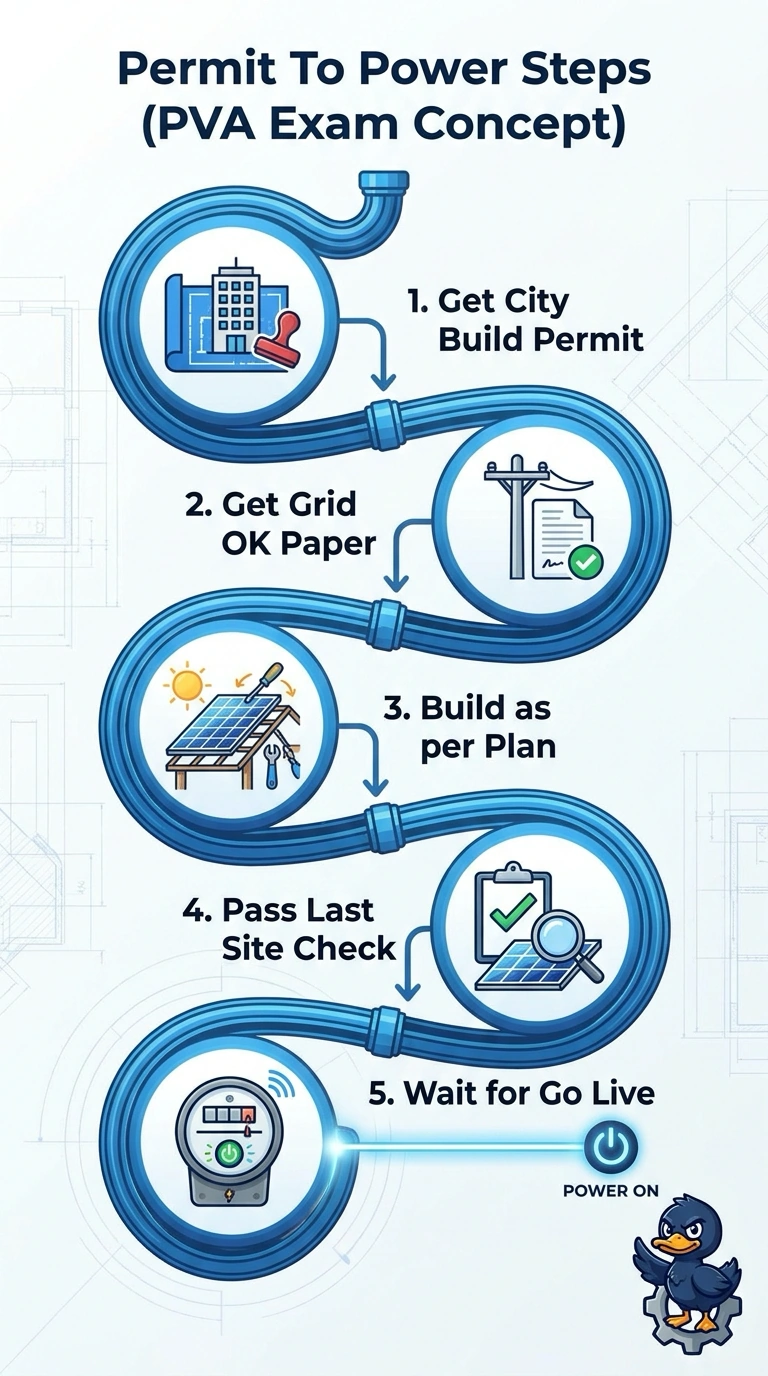
You’ve got this—you need both the city and the utility to clear their steps. Sequence is your traffic light: wait for utility approval before building, then for final sign-off and permission to operate before power flows.
Full Explanation
The compliant sequence secures both required city permits and utility interconnection approval before construction, then completes the installation, passes final inspection, and awaits permission to operate before power can flow. Interconnection approval and permission to operate are distinct milestones: approval establishes the utility’s acceptance of the proposed system or its conditions, while permission to operate authorizes energization and export. A sequence that energizes as soon as interconnection approval is issued fails because approval is not permission to operate. A sequence that obtains only the building permit and waits for written permission to operate omits the required electrical permit. A sequence that files the utility application but builds while it is under review fails because utility approval must come before construction. An exam caveat: utilities and jurisdictions may coordinate reviews or allow some work in parallel, but that does not override an explicit sequencing condition in the question. In practice, verify both issued city permits, utility interconnection approval, the final inspection record, and written permission to operate before energizing or exporting.