
A nursing facility purchases a new commercial dishwashing system for $60,000 with an estimated useful life of 10 years and zero salvage value. Under accrual-basis GAAP accounting, how should the finance director record this equipment's cost on the income statement?
Select an answer to reveal the explanation.
Short Explanation
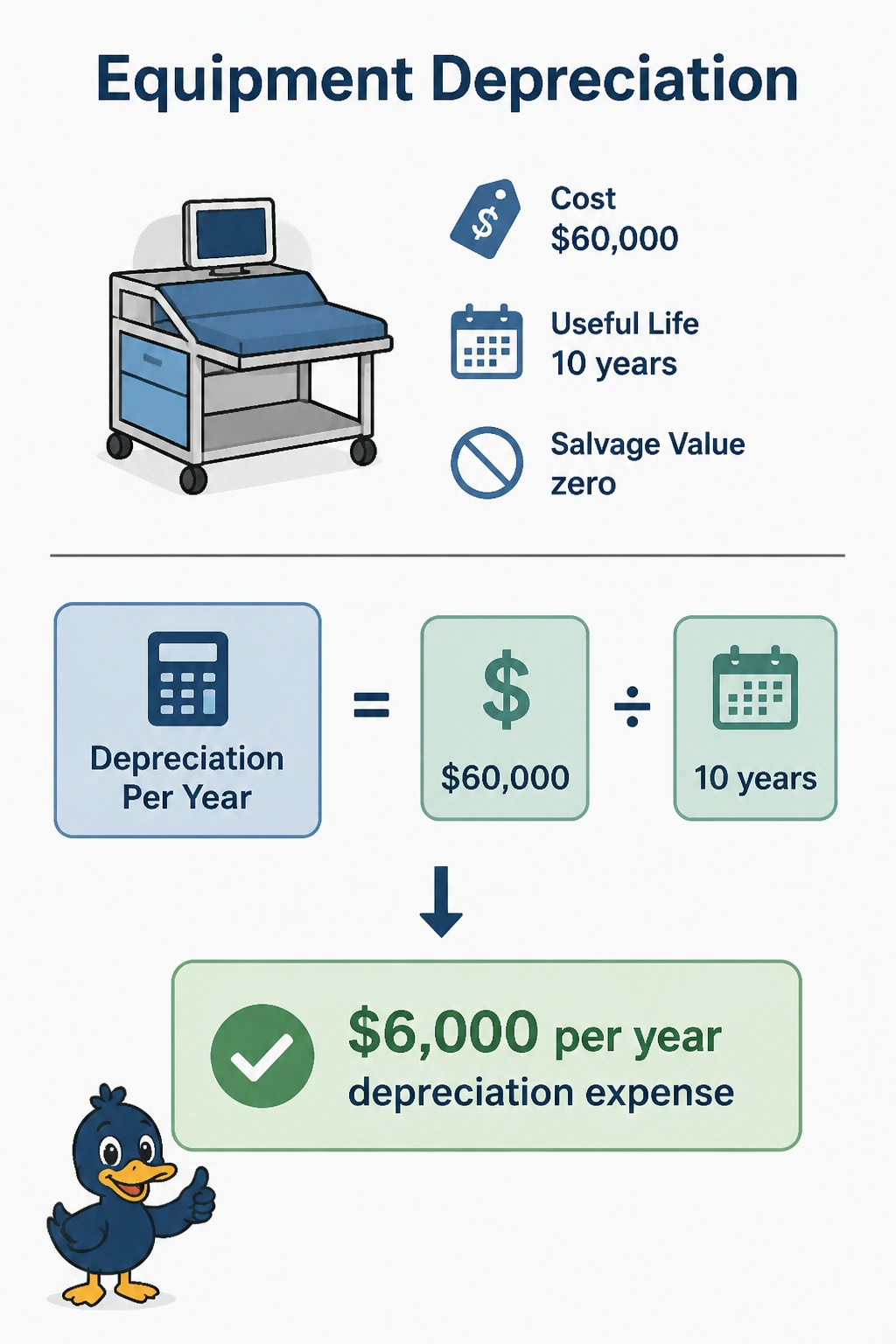
Buying a commercial dishwasher that lasts a decade shouldn't make one month's food-service budget look like a financial disaster. Under accrual accounting, you spread that capital asset's cost across the years it actually serves the building through depreciation—here, $6,000 per year. The trap is expensing the entire $60,000 upfront like disposable supplies.
Full Explanation
Under Generally Accepted Accounting Principles (GAAP) matching rules, a long-lived capital asset is capitalized on the balance sheet and its cost is systematically expensed over its useful life; using straight-line depreciation ($60,000 divided by 10 years), the finance director must Allocate $6,000 per year as depreciation expense over the 10-year life. Choosing to Expense the full $60,000 purchase price in the month of installation violates the matching principle by distorting current-period operating expenses for an asset that generates value for a decade. Selecting to Record the $60,000 as a current liability until the vendor invoice clears confuses accounts payable (how the purchase is owed) with income statement expense recognition. Opting to Leave the $60,000 unrecorded until the dishwasher is eventually replaced understates ongoing operating costs and overstates net income throughout the asset's service life. Exam caveat: depreciation is a non-cash expense that reduces net income without reducing cash flow in subsequent years. Depreciation is still reported on the Medicare cost report, but under SNF PPS it does not set the Part A per diem. As an operational check, reconcile the fixed-asset register to the general ledger depreciation schedule at each monthly close.
Prefer to study offline? Printable PDF study book + test engine ($7.50, unofficial). These questions stay free here.