
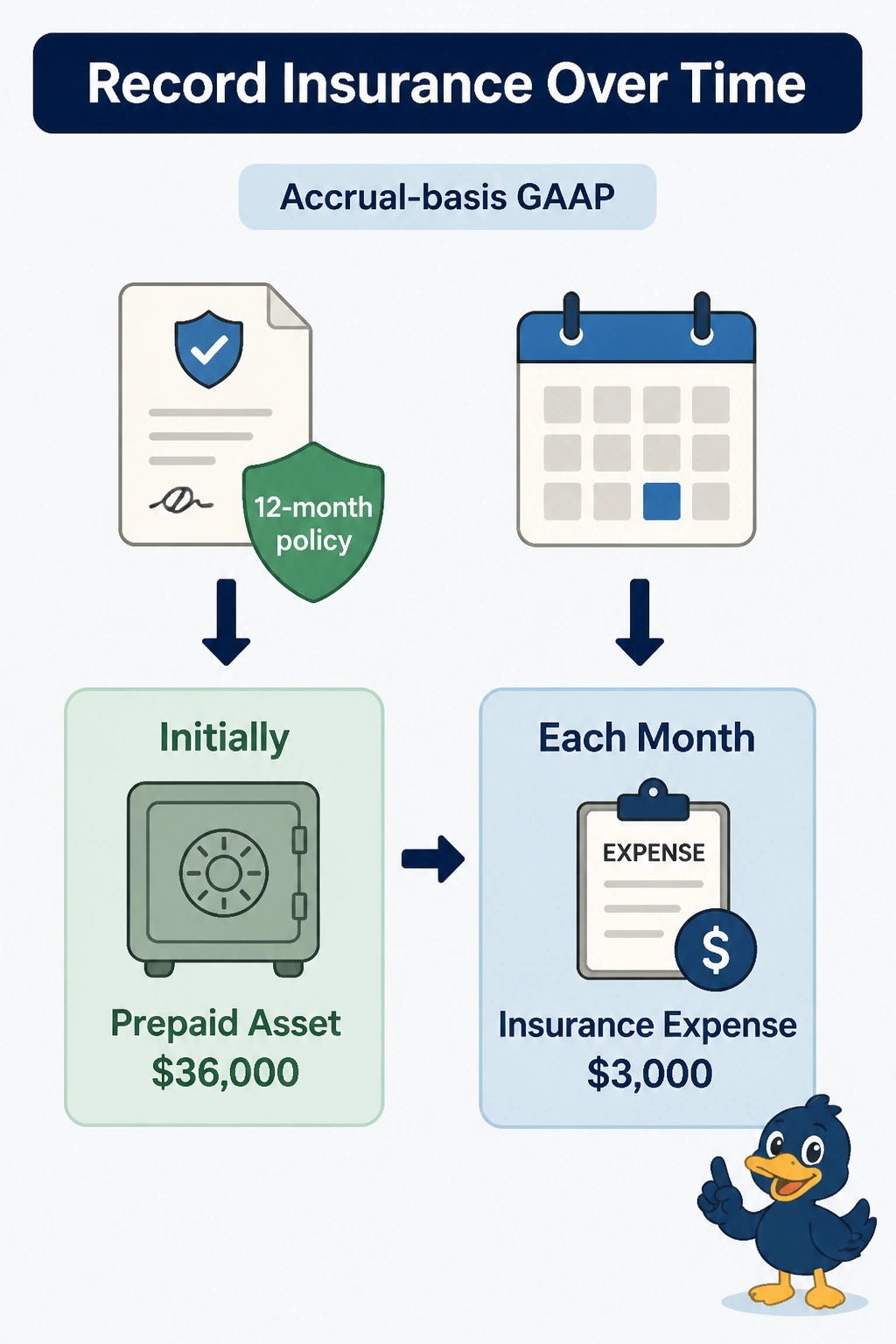
At the start of the fiscal year, a nursing facility pays $36,000 upfront for a 12-month property and liability insurance policy. Under accrual-basis GAAP accounting, how should the finance director record this transaction?
Select an answer to reveal the explanation.
Short Explanation
Paying a full year of insurance upfront does not mean your facility used a full year of coverage on day one. The trap is expensing the whole check when cash leaves the bank—under accrual accounting, you spread that cost evenly across the twelve months of protection.
Full Explanation
Under accrual-basis GAAP matching principles, expenses must be recognized in the accounting periods in which the related economic benefit is consumed, so the finance director should record the $36,000 as a prepaid asset initially and recognize $3,000 of insurance expense each month. Because the policy provides twelve equal months of coverage, each monthly income statement reflects its fair $3,000 share while the prepaid insurance asset decreases by $3,000 until it reaches zero at year-end. Choosing to expense the entire $36,000 in the first month because cash left the operating bank account immediately follows cash-basis accounting rather than GAAP accrual rules and artificially distorts month-one operating margin. Choosing to capitalize the $36,000 as a long-term fixed asset and depreciate it over the facility building's useful life misclassifies a 12-month current prepaid expense as property, plant, and equipment. Choosing to defer recording any insurance expense until the end of the twelfth month when the policy term expires understates operating expenses for eleven months and creates an inaccurate year-end spike. As an exam caveat, only short-term benefits consumed within twelve months belong in current prepaid assets rather than long-term assets. Operationally, maintain a monthly prepaid-amortization schedule and reconcile the remaining balance to active policy terms at each month-end close.
Prefer to study offline? Printable PDF study book + test engine ($7.50, unofficial). These questions stay free here.