
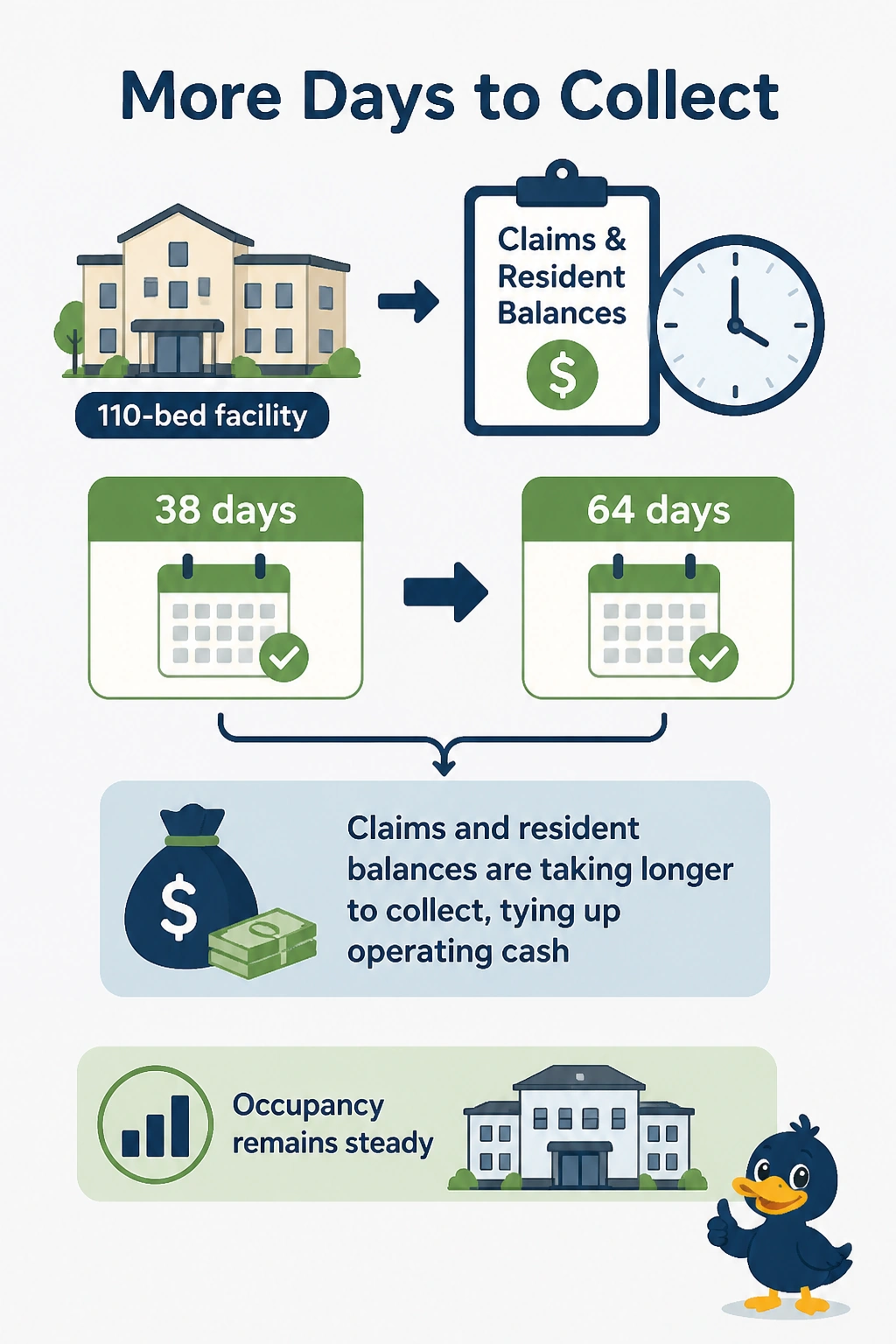
A 110-bed skilled nursing facility's Days in Accounts Receivable increases from 38 days to 64 days over two quarters while occupancy remains steady. What does this financial metric indicate to the administrator?
Select an answer to reveal the explanation.
Short Explanation
Think of Days in Accounts Receivable as the time it takes for earned revenue to actually land in your bank account. When that number jumps from 38 to 64 days, your claims are stalling and cash is getting trapped in unpaid bills. The trap is confusing rising receivables with stronger liquidity—more uncollected money means less cash on hand.
Full Explanation
Days in Accounts Receivable measures the average number of days required to collect patient service revenue, calculated by dividing net accounts receivable by average daily net patient revenue. When the metric climbs from 38 to 64 days while occupancy stays flat, it signals that Claims and resident balances are taking longer to collect, tying up operating cash due to billing delays, payer denials, or pending Medicaid eligibility applications. Choosing The facility has reduced its fixed operating expenses and improved short-term cash liquidity gets the relationship backward because slower collections reduce available cash even when accrual revenue looks healthy. Choosing The facility's occupancy rate has grown faster than its budgeted staffing capacity contradicts the scenario's steady occupancy and misinterprets a revenue-cycle metric as a staffing ratio. Choosing All Medicaid and Medicare claims have been written off as uncollectible bad debt is incorrect because writing off receivables reduces net accounts receivable and lowers Days in AR rather than raising it. Caveat: A temporary spike in Days in AR can also occur after a payer portal transition or rate-update hold, so leadership must pair the metric with an aging schedule by payer. Operational check: Review the payer-specific AR aging report weekly with the business office manager to target claims exceeding 60 days.
Prefer to study offline? Printable PDF study book + test engine ($7.50, unofficial). These questions stay free here.