
After experiencing minor supply thefts near a rear service hallway, a nursing facility's maintenance supervisor installs a keyed deadbolt on an exterior exit door so that staff must use a physical key to open it from the inside. Why does this modification violate federal Life Safety Code standards?
Select an answer to reveal the explanation.
Short Explanation
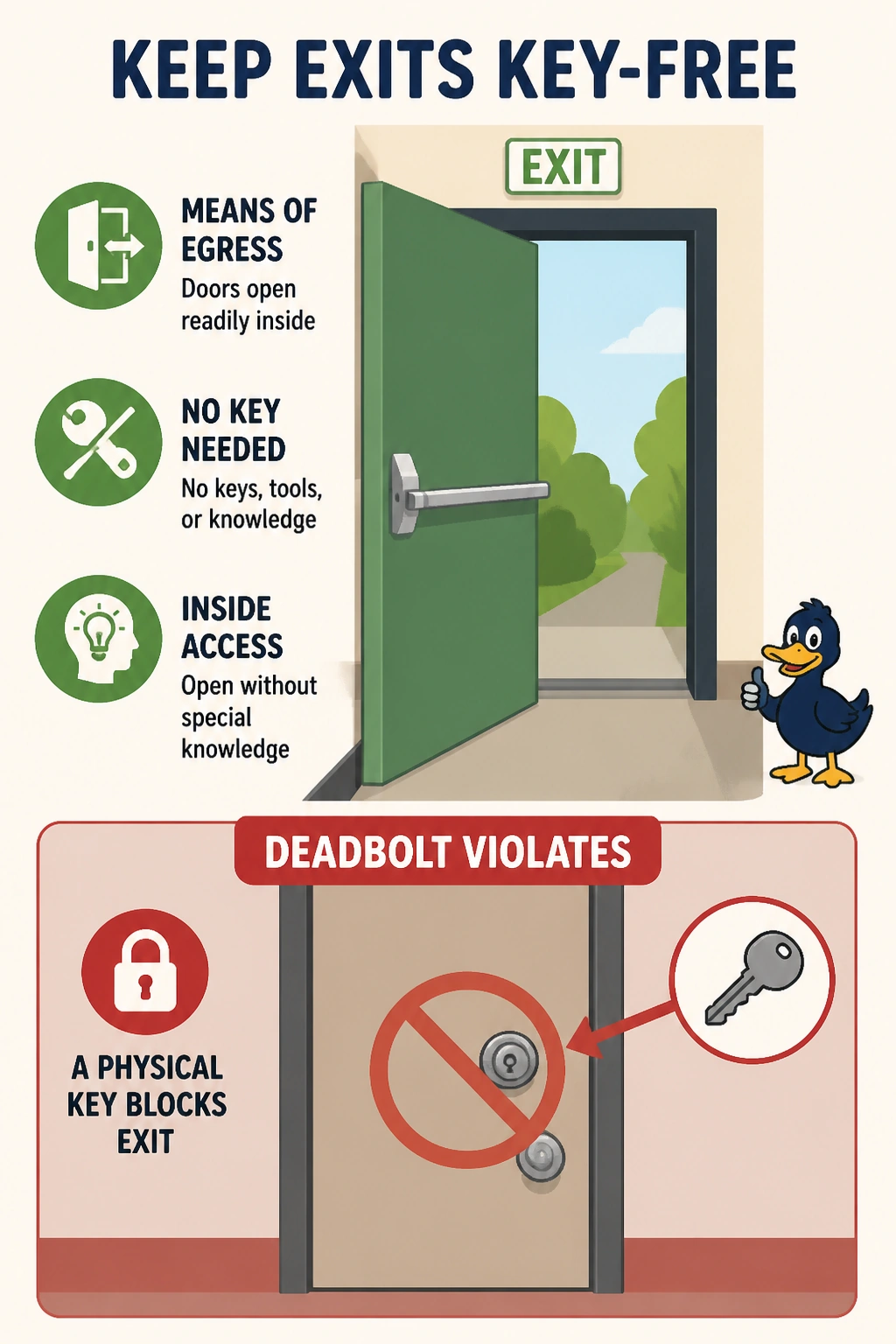
You’re right to focus on whether staff can get out immediately in an emergency: a key-operated deadbolt can turn an exit into a trap. The Life Safety Code requires egress doors to open from the inside without keys, tools, or special knowledge, even when security is a concern.
Full Explanation
NFPA 101 Life Safety Code rules require occupants to evacuate quickly without searching for a key or figuring out complex hardware. Means of egress doors must open readily from the inside without keys, tools, or special knowledge, so an interior keyed deadbolt creates a serious life-safety hazard. Requiring biometric scanners approved by the local fire marshal is not the standard; where security is needed, compliant hardware or delayed-egress systems may be used instead. Keeping service hallway exit doors propped open with wedges during daytime shifts is also wrong because it compromises fire-barrier integrity: doors must remain closed and latched when not in use. Illuminated exit signs do not make a keyed deadbolt acceptable, because signage cannot excuse a locked egress path. As an exam caveat, specialized delayed-egress or controlled-egress locks are permitted only when installed in full compliance with Life Safety Code requirements, including automatic release and fire-alarm integration. As a practical check, remove the keyed deadbolt and confirm that the door opens from inside without a key, tool, or special knowledge; use compliant panic hardware or a monitored alarm for security instead.
Prefer to study offline? Printable PDF study book + test engine ($7.50, unofficial). These questions stay free here.