
While auditing maintenance records, an administrator discovers that the facility's diesel emergency generator has been started monthly for the past six months, but only under no-load conditions. Why does this testing practice create both a compliance deficiency and an operational hazard?
Select an answer to reveal the explanation.
Short Explanation
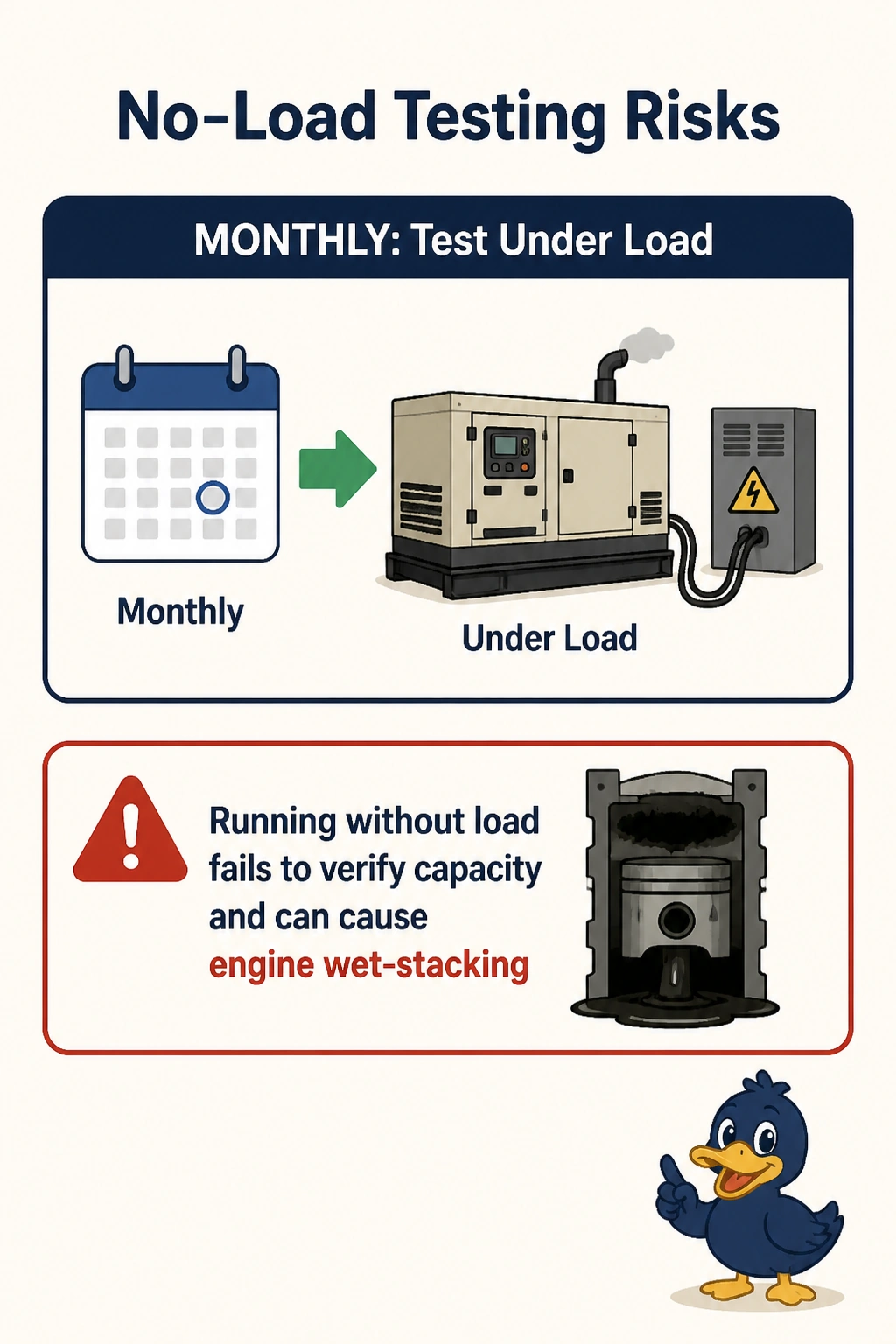
Idling a diesel generator without a load is like revving a car in neutral—it tells you nothing about whether it can climb a hill. The trap is thinking a monthly engine start checks the compliance box, when unloaded runs actually foul the engine and leave transfer capacity untested.
Full Explanation
Under CMS emergency preparedness and Life Safety Code standards referencing NFPA 99 and NFPA 110, emergency power systems must be tested regularly under load to confirm they can carry critical life-safety and clinical circuits during an outage. The practice fails because Running without load fails to verify capacity and can cause engine wet-stacking, a buildup of unburned fuel and carbon deposits in diesel exhaust systems that degrades performance and risks engine failure when real demand hits. Choosing No-load testing automatically voids the facility's commercial property insurance policy misstates standard insurance contract terms rather than identifying the technical and regulatory defect. Choosing Monthly generator tests are prohibited unless a municipal power outage is actively occurring reverses actual NFPA rules, which mandate routine scheduled testing. Choosing A monthly no-load start meets NFPA 110 if staff log oil pressure and coolant temperature during the run misstates NFPA 110, which requires a monthly loaded run at about 30 percent of nameplate kW or the manufacturer's exhaust-gas temperature, so logging vitals without load does not prove capacity. As a caveat, if a generator cannot reach required load thresholds during monthly runs, annual load-bank testing is required to burn off deposits and verify full output. Operational check: inspect monthly generator logs to verify transfer-switch activation, load percentages, and running temperatures.
Prefer to study offline? Printable PDF study book + test engine ($7.50, unofficial). These questions stay free here.