
A long-stay resident with advanced dementia eats slowly and requires frequent verbal cueing during meals, and a family member asks whether a feeding tube should be inserted to speed up intake. How must the interdisciplinary team approach nutrition support under federal guidelines?
Select an answer to reveal the explanation.
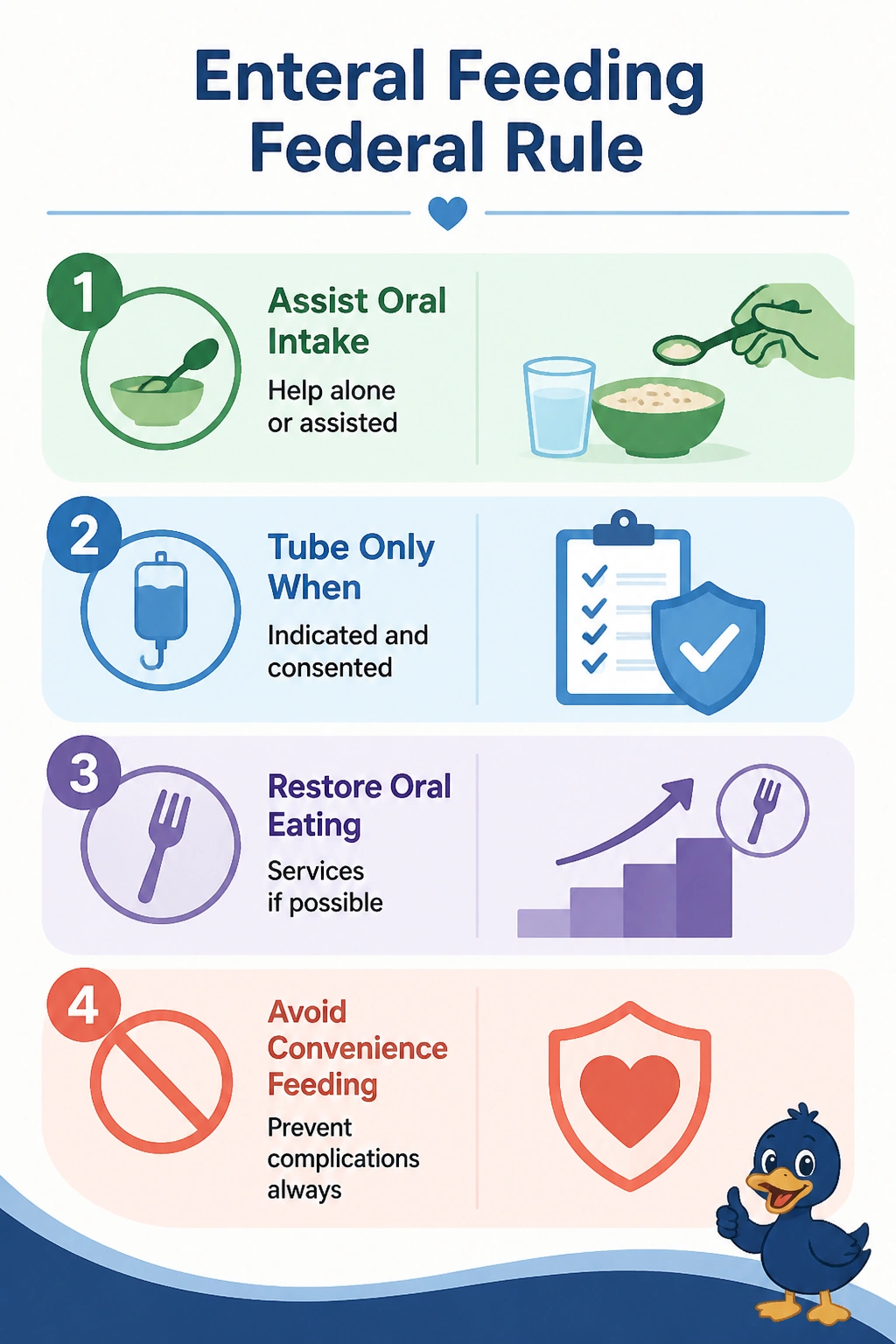
Short Explanation
For residents with advanced dementia, you preserve comfort and dignity by sharing an unhurried, hand-assisted meal rather than rushing to a tube. Remember the trap: tubes do not prevent aspiration, and federal rules require assisted oral feeding unless enteral feeding is clinically indicated and consented to.
Full Explanation
Under 42 CFR 483.25(g)(4), a resident who can eat enough alone or with assistance is not fed by enteral methods unless enteral feeding is clinically indicated and the resident has consented; (g)(5) requires services to restore oral eating if possible and to prevent complications. Prioritizing assisted hand-feeding with individualized dining support, cueing, positioning, and unhurried pacing honors that standard and preserves dignity for advanced dementia. Scheduling immediate gastrostomy to prevent aspiration is incorrect because tubes do not eliminate aspiration risk and expose the resident to procedural harms without indication or consent. Discontinuing oral meals for overnight enteral nutrition to save time is incorrect because federal standards forbid substituting staff convenience for needed eating assistance. Requiring tray completion within twenty minutes before supplements is incorrect because it ignores slowed chewing, cueing needs, and person-centered pacing and risks inadequate intake. Caveat: if reversible dysphagia or acute illness arises, involve speech-language pathology and document informed discussion with the representative. Operational check: audit mealtime staffing and cueing weekly.
Prefer to study offline? Printable PDF study book + test engine ($7.50, unofficial). These questions stay free here.