
A resident is admitted from an acute hospital with a transfer summary indicating full resuscitation status, while the resident's healthcare proxy presents a signed, valid advance directive requesting no cardiopulmonary resuscitation. How should the admitting team resolve this conflict?
Select an answer to reveal the explanation.
Short Explanation
Conflicting code-status paperwork at admission is a red flag you have to clear up right away, not file away for later. The trap is assuming either the hospital transfer sheet or a family member's comment stands alone without a verified physician order.
Full Explanation
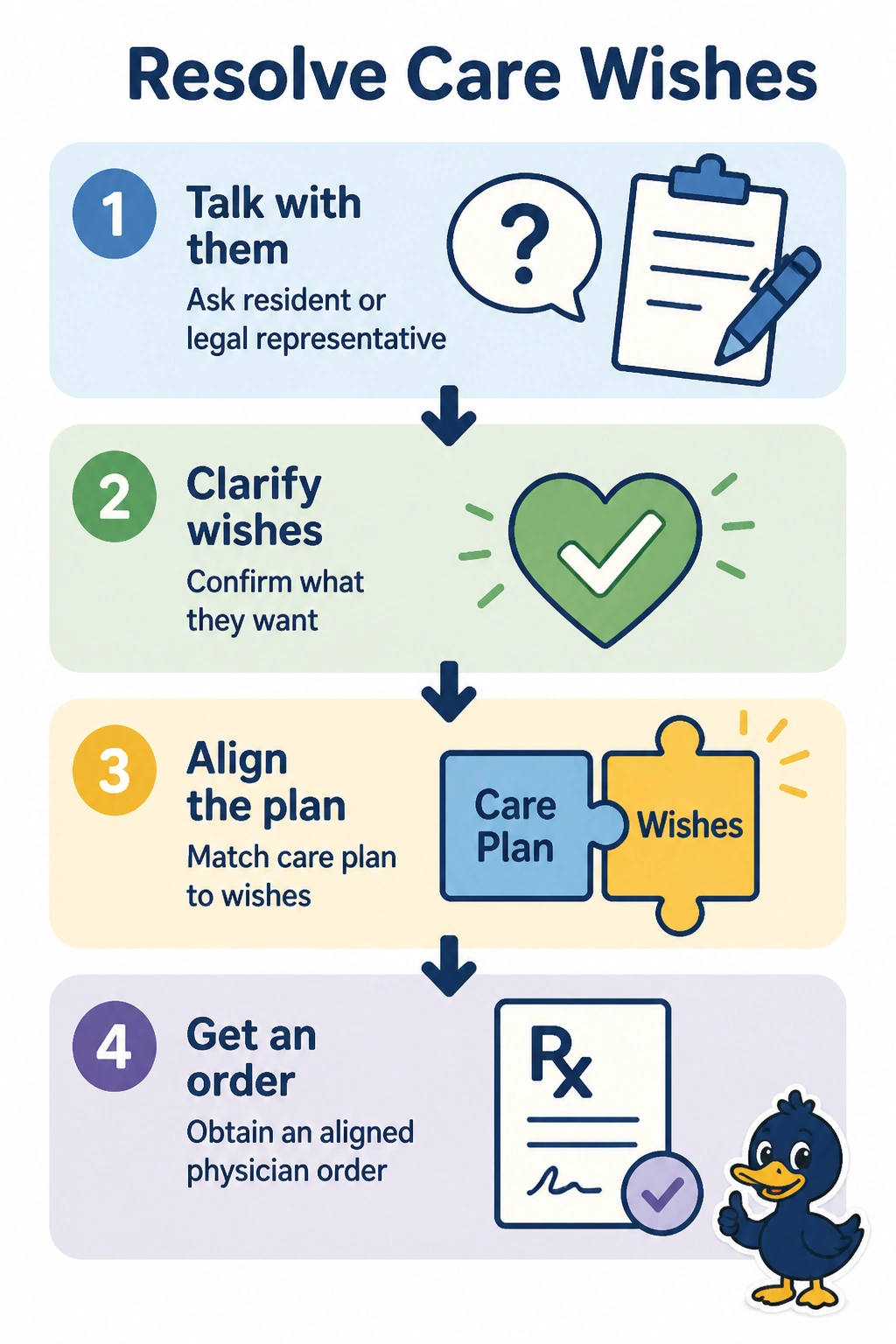
Under 42 CFR 483.10(g)(12), facilities must respect advance directives and ensure physician orders accurately reflect the resident's current wishes. The admitting nurse and medical team must Clarify wishes with the resident or legal representative and obtain an aligned physician order promptly upon admission so emergency responders have unambiguous instructions. Choosing to Follow the hospital transfer summary indefinitely because acute-care orders supersede family documents risks performing unwanted resuscitation against a valid advance directive. Choosing to Enter a Do Not Resuscitate order immediately based solely on the family's verbal statement at admission bypasses required verification of the resident's capacity, legal authority, and a valid physician order. Choosing to Wait until the resident's first quarterly care conference to ask the attending physician about code status leaves a dangerous gap during the highest-risk post-hospitalization window. As a caveat, until a conflicting directive is clarified with the physician, facilities follow established emergency protocols while expediting provider contact. Operational check: audit admission checklists weekly to confirm code-status orders match signed advance directives in the chart.
Prefer to study offline? Printable PDF study book + test engine ($7.50, unofficial). These questions stay free here.