
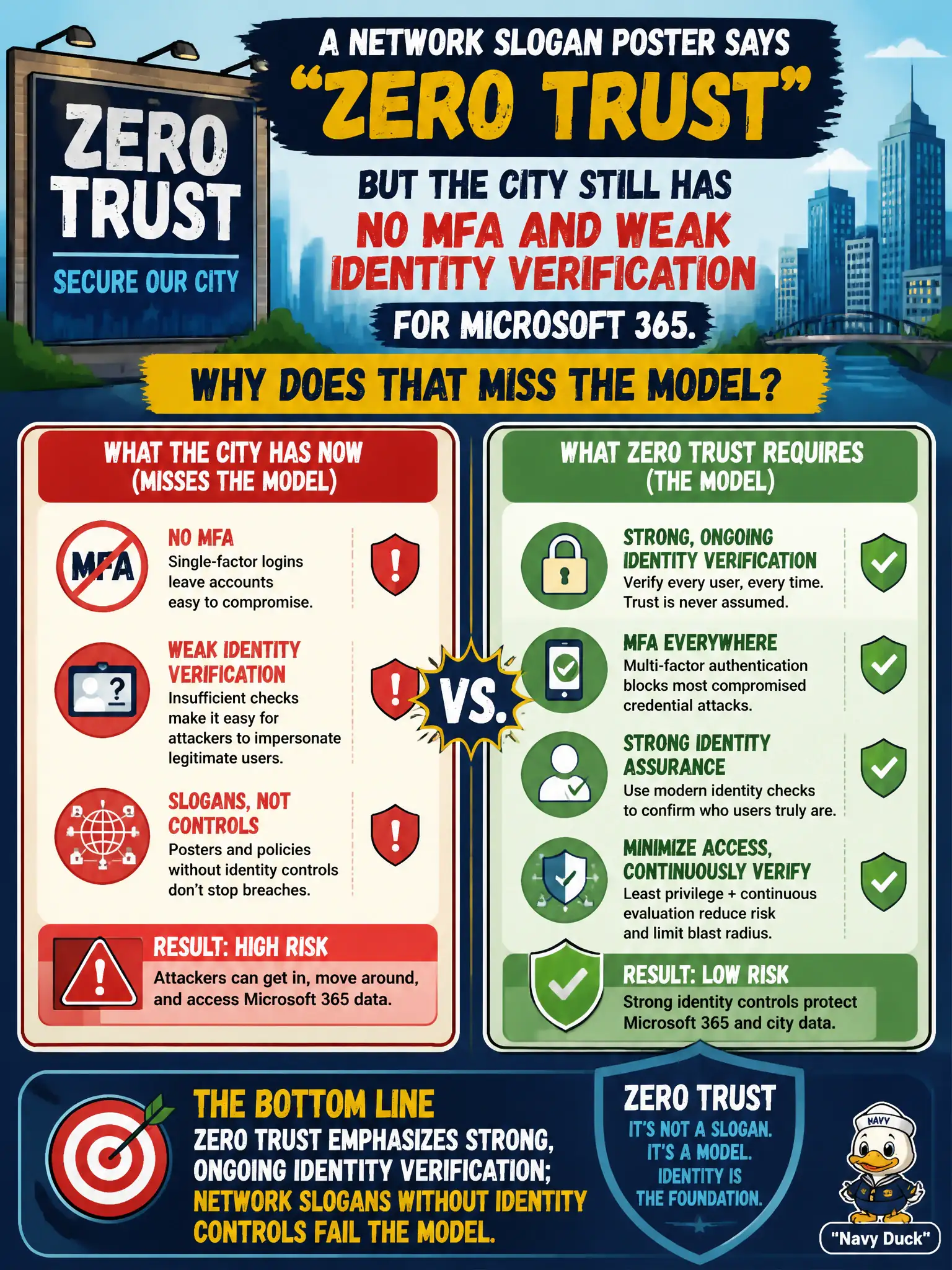
A network slogan poster says Zero Trust, but the city still has no MFA and weak identity verification for Microsoft 365. Why does that miss the model?
Select an answer to reveal the explanation.
Short Explanation
Zero Trust starts with proving who is asking—every time. Fancy network posters without MFA and solid identity checks are costume jewelry. Identity is a core pillar.
Full Explanation
Zero Trust emphasizes strong, ongoing identity verification. A network slogan poster that says Zero Trust while the city still has no MFA and weak identity verification fails the model because identity is a core pillar—continuous verification of who is requesting access, not decorative perimeter language. Municipal programs must implement MFA and related Entra controls to align with Zero Trust in practice.
Zero Trust does not only apply to printer firmware updates. It does not forbid all cloud services by definition; Microsoft 365 is commonly secured with Zero Trust principles. Buying more Ethernet switches alone does not complete Zero Trust, which is not a cabling or hardware-refresh project.
Exam caveat: device health, least privilege, and data protection also matter, but identity weakness is a clear model failure even when network posters look polished. Operational check: measure MFA registration and Conditional Access coverage for city Microsoft 365 users, remediate privileged accounts first, and replace trusted-network exceptions that skip identity checks without compensating controls. For municipal MS-900 scenarios, keep the product-to-purpose mapping explicit so distractors about unrelated UX, networking, or licensing features do not displace the correct compliance or security control.