
A residency policy requires certain citizen records to remain stored in a specific geography. How does Microsoft support that requirement at fundamentals depth?
Select an answer to reveal the explanation.
Short Explanation
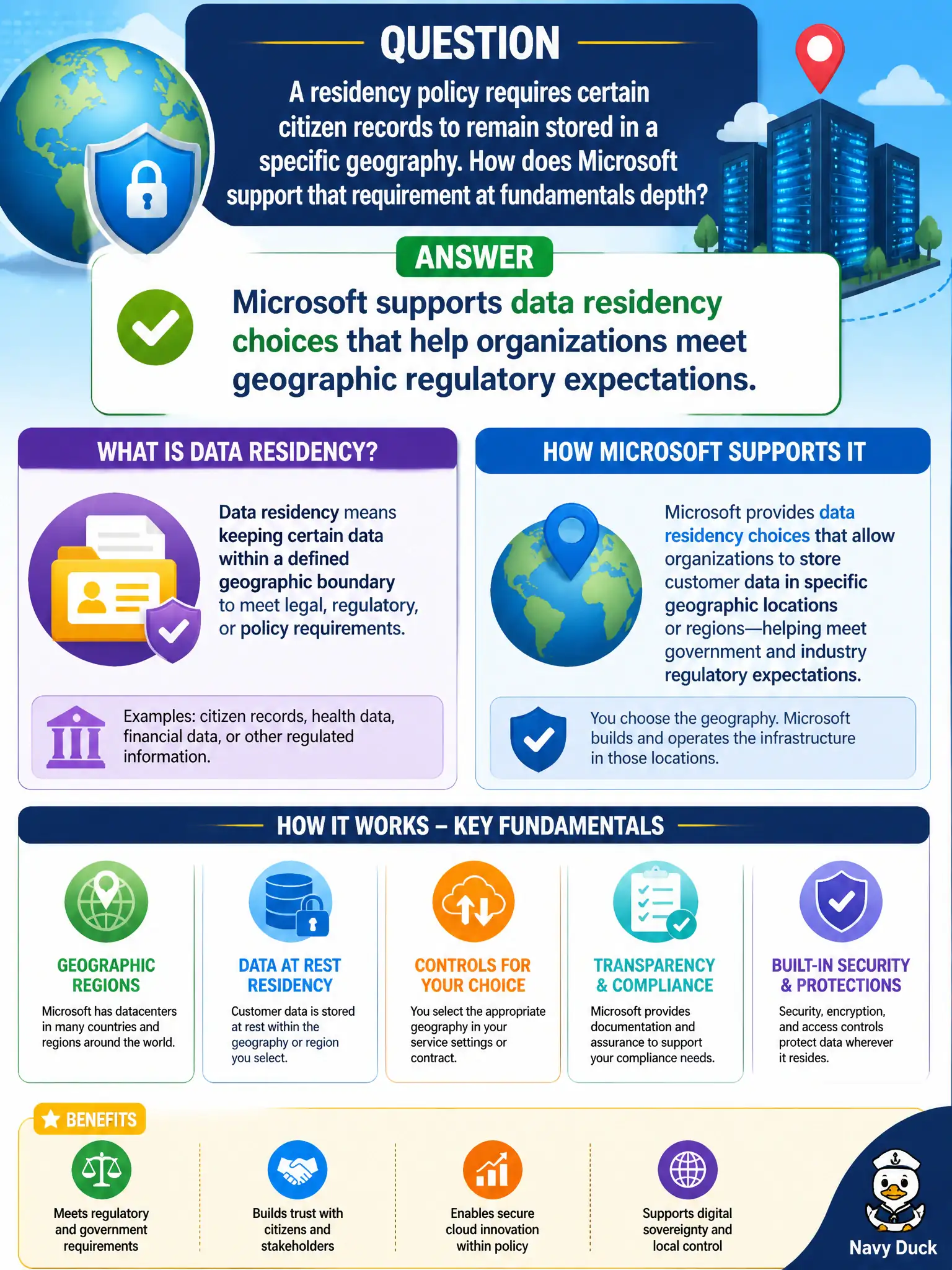
Residency is about where the data lives at rest—geography for the regulators. Microsoft offers residency options to help with those rules. Renaming a Teams channel does nothing for that requirement.
Full Explanation
Microsoft supports data residency choices that help organizations meet geographic regulatory expectations for where customer data is stored at rest. A residency policy requiring certain citizen records to remain in a specific geography maps to that trust topic at MS-900 fundamentals depth—not to renaming collaboration artifacts or deleting logs.
Data residency does not mean every city must host its own Exchange servers on-site forever; cloud residency options exist within Microsoft’s geography commitments. Renaming Teams channels does not achieve residency. Deleting all audit logs weekly is unrelated and harmful to accountability; it is not a residency control for citizen records.
Exam caveat: residency concerns location at rest; it is related to but not identical to customer-managed keys, sovereignty programs, or encryption topics—read the question for geography versus key control. Operational check: review the tenant’s Preferred Data Location and Microsoft 365 residency commitments for the city’s region, document which workloads are in scope for citizen records, and align records retention locations with legal’s geographic requirements. For municipal MS-900 scenarios, keep the product-to-purpose mapping explicit so distractors about unrelated UX, networking, or licensing features do not displace the correct compliance or security control.