
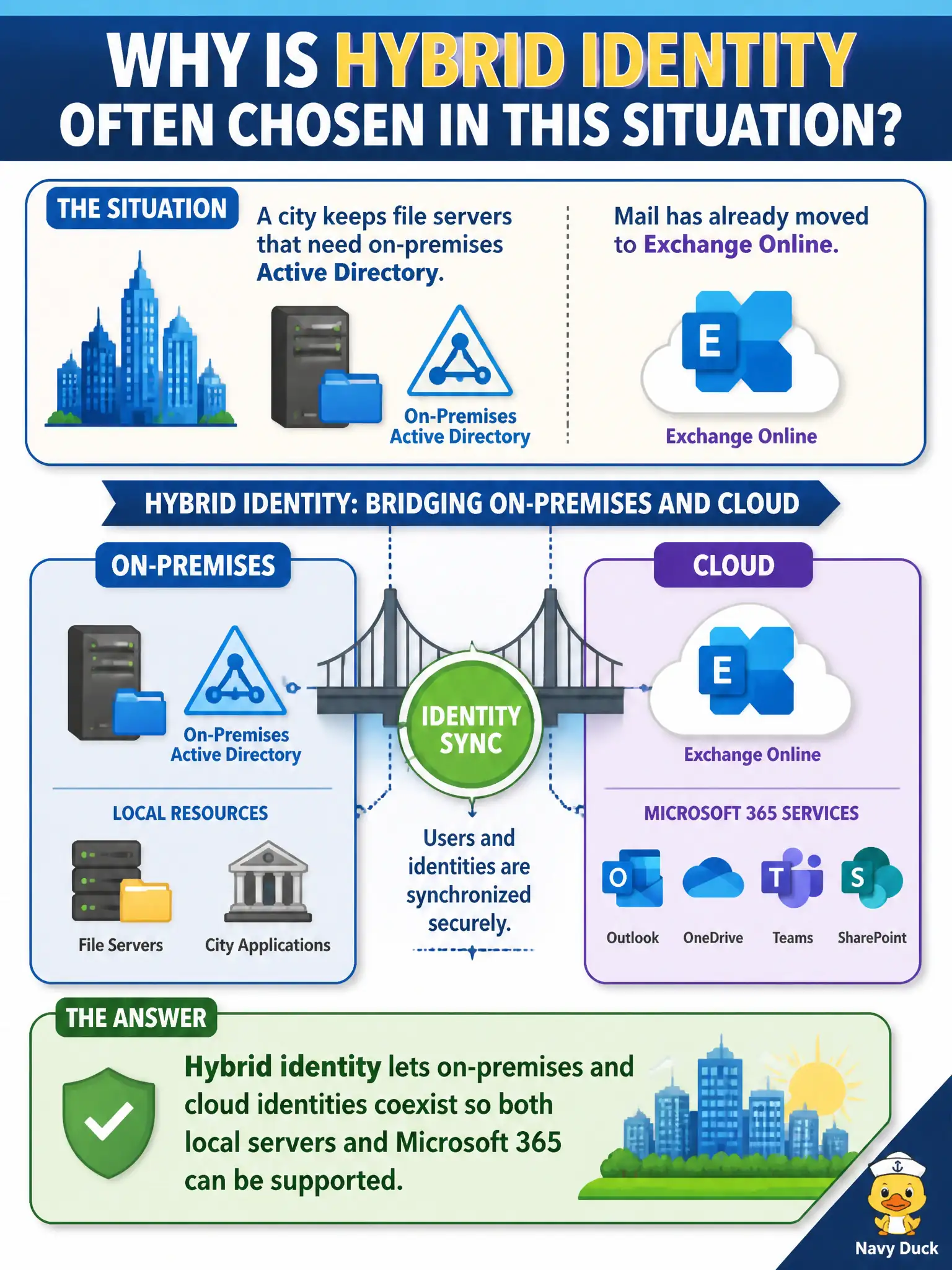
A city keeps file servers that need on-premises Active Directory while mail has already moved to Exchange Online. Why is hybrid identity often chosen in that situation?
Select an answer to reveal the explanation.
Short Explanation
File servers still speak local AD; Exchange Online speaks Entra ID. Hybrid identity is the bridge so staff are not living two unrelated lives. Keep both worlds until everything is ready to move.
Full Explanation
Hybrid identity lets on-premises and cloud identities coexist so both local servers and Microsoft 365 can be supported, which is why cities often choose it when file servers still need on-premises Active Directory while mail has already moved to Exchange Online. Municipal estates rarely flip every dependency overnight; hybrid identity keeps one synchronized identity fabric across the remaining AD DS-backed servers and cloud productivity apps. That coexistence story is central to MS-900 identity models.
Hybrid identity does not permanently delete on-premises Active Directory the day Exchange Online is enabled. It is not required only for Microsoft Whiteboard and never for Exchange Online. It does not replace Conditional Access and MFA; those controls remain important in hybrid tenants.
An exam caveat is that hybrid identity adds sync health, attribute flow, and lifecycle operations that cloud-only tenants avoid—choose it for coexistence needs, not by default superstition. Operationally, confirm Entra Connect or cloud sync is healthy after Exchange Online migration, verify file-server ACLs still resolve on-premises identities correctly, and test that the same municipal users can access both local file shares and Exchange Online with the hybrid identity design.