
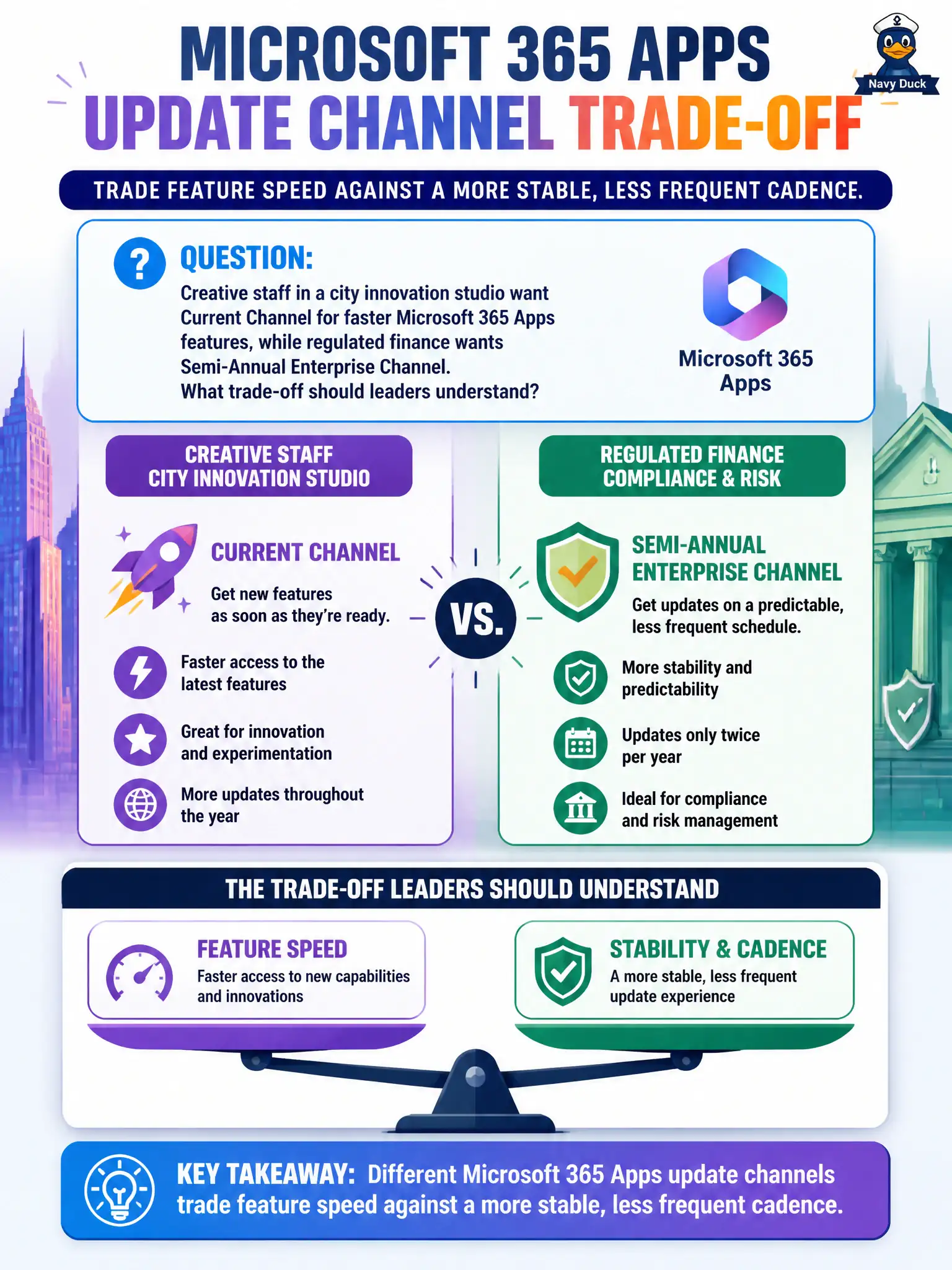
Creative staff in a city innovation studio want Current Channel for faster Microsoft 365 Apps features, while regulated finance wants Semi-Annual Enterprise Channel. What trade-off should leaders understand?
Select an answer to reveal the explanation.
Short Explanation
Channels are speed dials for Office features: Current races ahead; Semi-Annual hits the brakes for stability. Finance and the design studio can honestly want different dials—names aren’t just stickers.
Full Explanation
Creative staff in a city innovation studio wanting Current Channel for faster Microsoft 365 Apps features—while regulated finance wants Semi-Annual Enterprise Channel—illustrates that different Microsoft 365 Apps update channels trade feature speed against a more stable, less frequent cadence. Leaders should allow different channels for different risk appetites rather than forcing one timing on every role. Innovation can absorb UI change; finance and regulated offices often cannot.
Claiming all channels deliver identical feature timing fails because cadence differences are real, not cosmetic branding. Claiming Semi-Annual Enterprise Channel always installs experimental Insider builds before Current Channel reverses the stability intent of Semi-Annual. Claiming Current Channel removes Word and Excel while only Semi-Annual includes core apps is false—core apps remain; timing differs.
Exam caveat: channel choice is a speed-versus-stability trade-off across cohorts. Names are not interchangeable labels and do not remove Word/Excel.
Operational check: assign Current Channel to innovation studios that accept change, assign Semi-Annual Enterprise to regulated finance for stability, document exceptions, test critical add-ins per channel, and educate leaders that channel names reflect cadence—not missing productivity apps.