
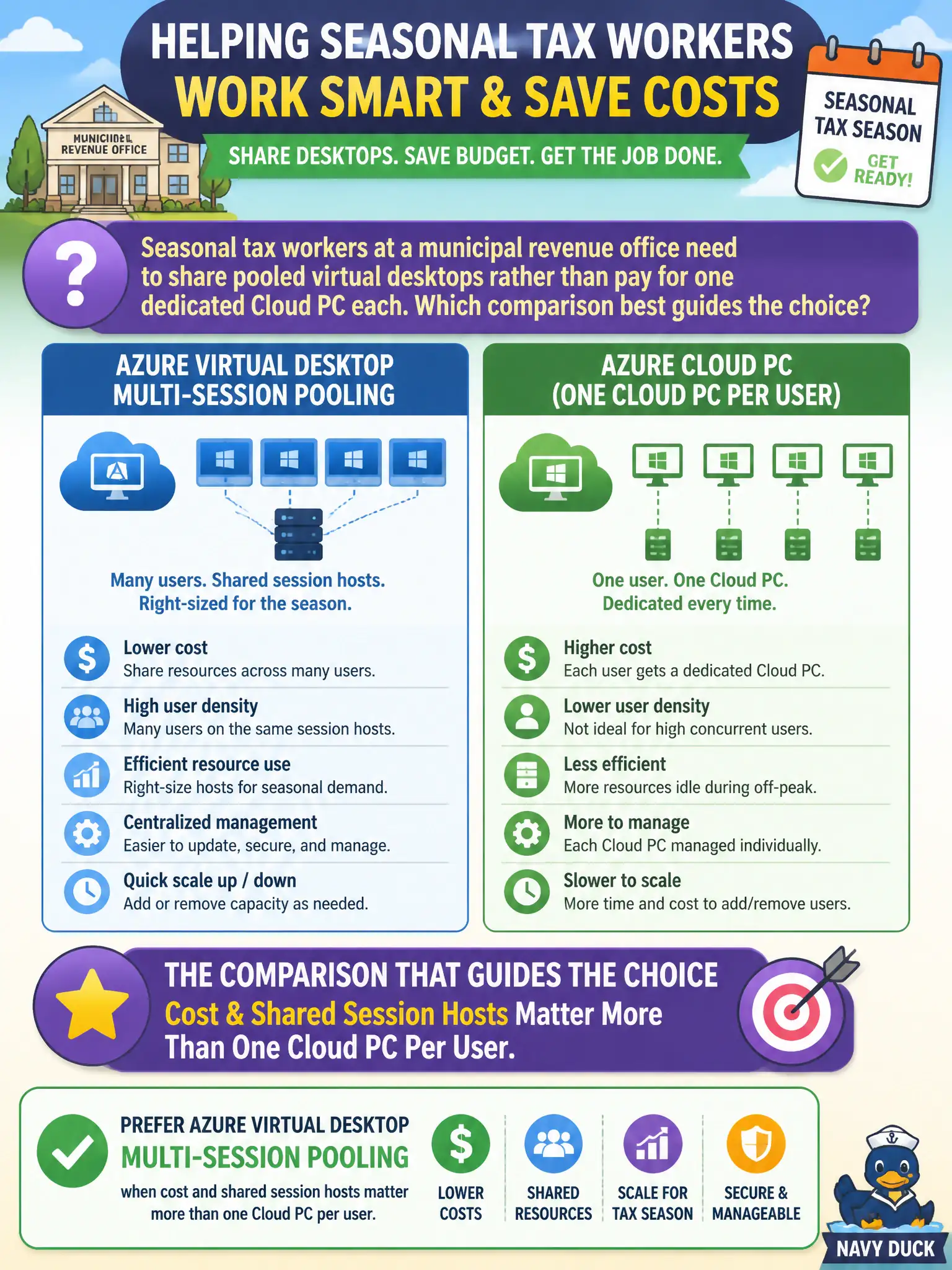
Seasonal tax workers at a municipal revenue office need to share pooled virtual desktops rather than pay for one dedicated Cloud PC each. Which comparison best guides the choice?
Select an answer to reveal the explanation.
Short Explanation
One Cloud PC each is a private office; AVD multi-session is the shared cubicle farm for tax season. When pooling and cost matter, AVD is the compare-level answer—not To Do or Viva Goals.
Full Explanation
Seasonal tax workers at a municipal revenue office who need to share pooled virtual desktops—rather than pay for one dedicated Cloud PC each—should prefer Azure Virtual Desktop multi-session pooling when cost and shared session hosts matter more than one Cloud PC per user. AVD’s flexible host-pool and multi-session model fits bursty seasonal density: many workers share session-host capacity during peak filing weeks, then the pool shrinks when the season ends. That compare-level choice protects budgets without denying desktop access.
Preferring Windows 365 personal Cloud PCs only fails when the requirement is pooled sharing; claiming Azure Virtual Desktop cannot host multi-session scenarios is incorrect and reverses the flexibility comparison. Preferring Microsoft To Do task lists fails because personal tasks do not replace virtual desktop platforms. Preferring Microsoft Viva Goals alone fails because goals tracking does not provision pooled desktops for seasonal staff.
Exam caveat: Windows 365 emphasizes personalized Cloud PCs; AVD emphasizes flexible multi-session virtualization. Seasonal pooling and shared session hosts → AVD.
Operational check: size AVD host pools for peak filing weeks, define user assignment and profile strategy, compare cost against per-user Windows 365 seats, brief finance on why pooling fits seasonal tax staff, and keep To Do/Viva Goals out of the VDI decision.