
A CIO asks for the simple fundamentals difference between Windows 365 and Azure Virtual Desktop. Which comparison is accurate?
Select an answer to reveal the explanation.
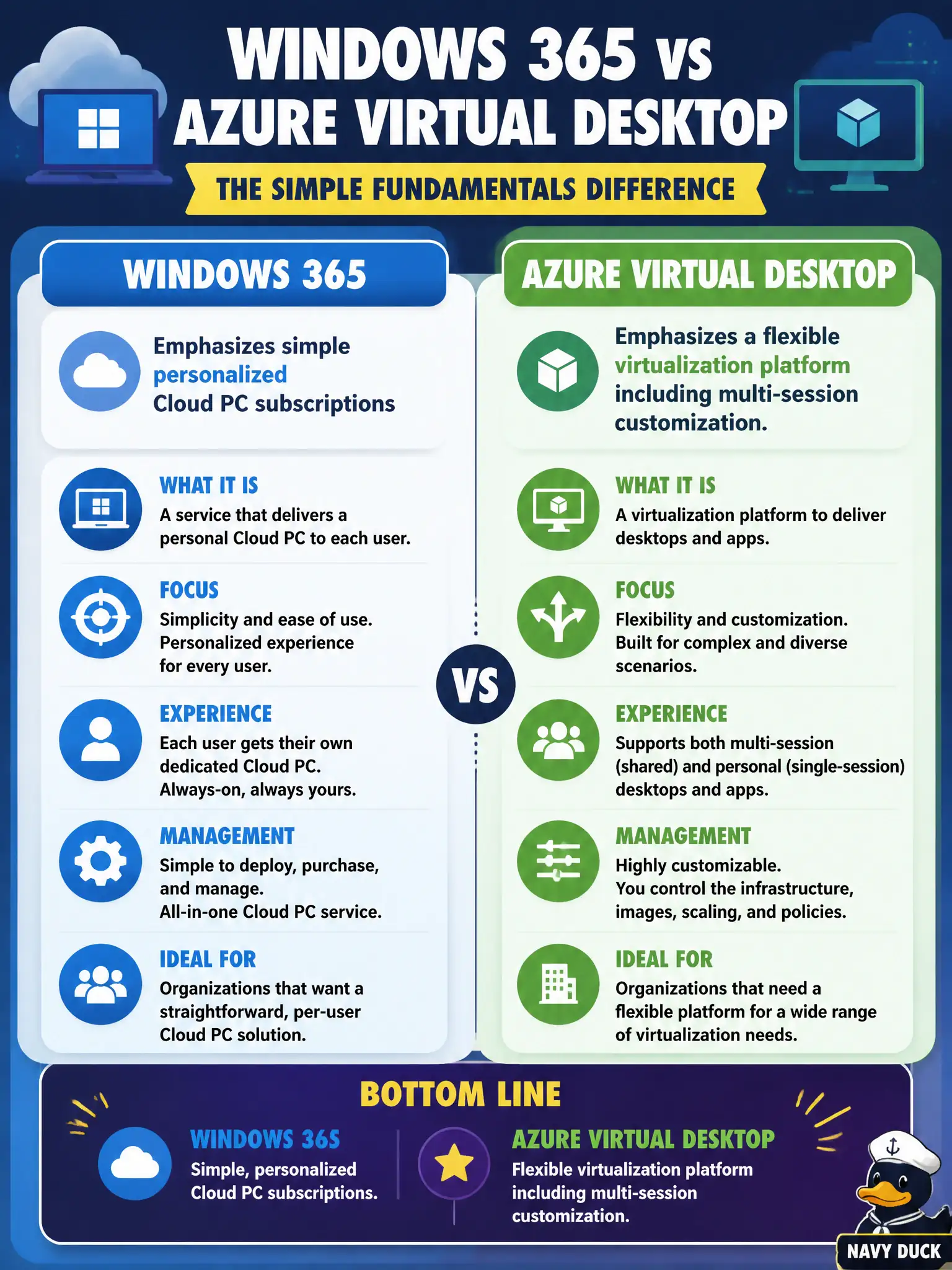
Short Explanation
Windows 365 is the easy reserved Cloud PC subscription; AVD is the flexible virtualization workshop with more pooling and customization knobs. Same neighborhood, different product shapes. That's the CIO one-liner.
Full Explanation
When a CIO asks for the simple fundamentals difference between Windows 365 and Azure Virtual Desktop, the accurate comparison is that Windows 365 emphasizes simple personalized Cloud PC subscriptions while AVD emphasizes a flexible virtualization platform including multi-session customization. One is turnkey personal desktop-as-a-subscription; the other is a broader virtualization platform you shape with host pools and multi-session options.
Claiming both are identical SKUs with no differences fails the compare objective. Claiming Windows 365 is only an email add-in and AVD only a SharePoint theme is nonsense. Claiming AVD can only run on-premises Hyper-V without any Azure cloud option misstates AVD’s cloud virtualization model.
Exam caveat: memorize the personalization-versus-flexibility contrast. Details of every SKU metering nuance are beyond typical MS-900 depth, but the conceptual difference is required.
Operational check: for each municipal persona, choose Windows 365 when you want simple personal Cloud PCs and AVD when you need flexible multi-session or customized host-pool designs; document the decision criteria for future projects; reject identical-SKU myths in architecture reviews.