
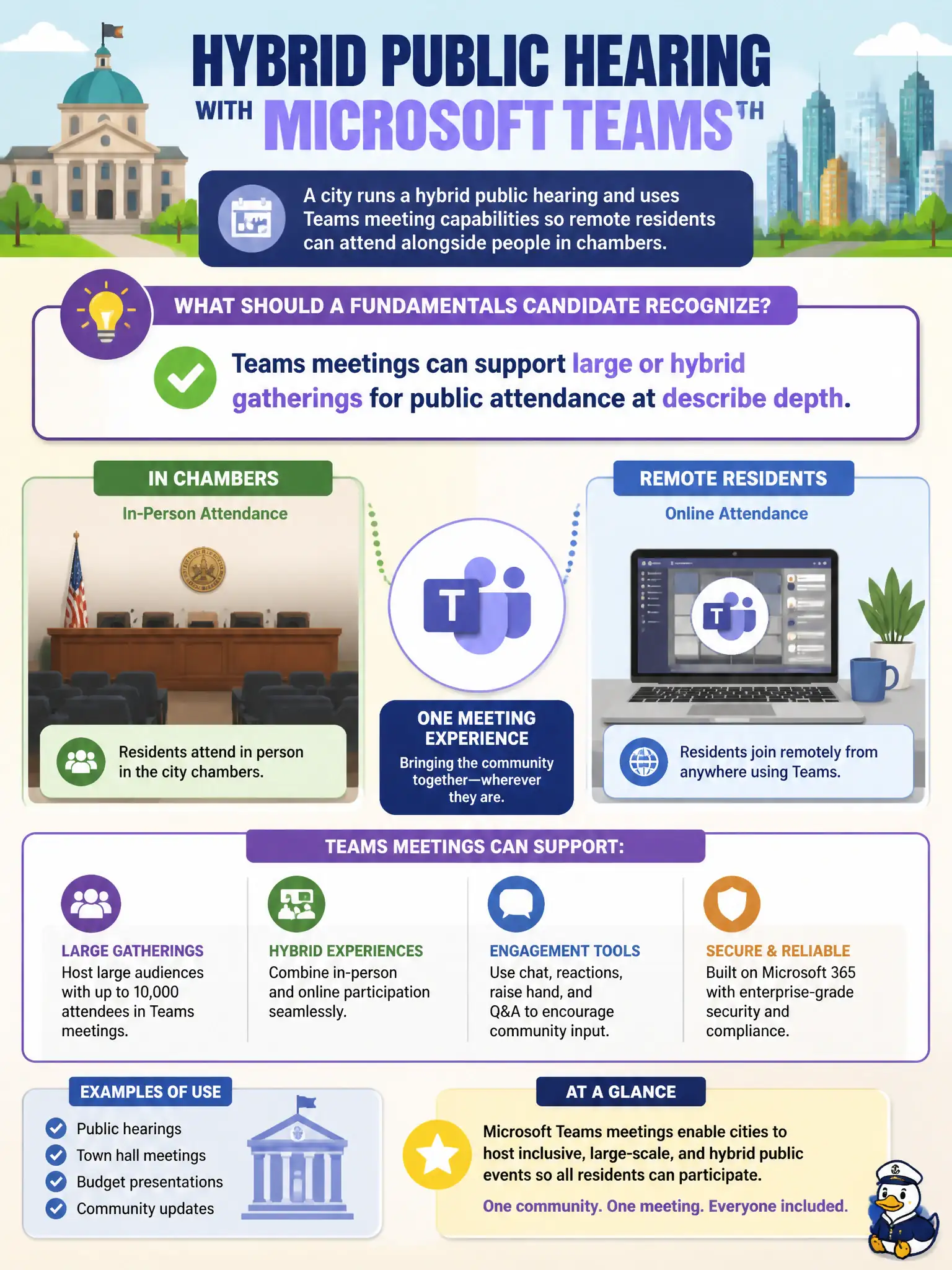
A city runs a hybrid public hearing and uses Teams meeting capabilities so remote residents can attend alongside people in chambers. What should a fundamentals candidate recognize?
Select an answer to reveal the explanation.
Short Explanation
Chambers plus living-room laptops is the modern town hall. Teams meetings bring remote residents into the same session without inventing a separate AI platform or patch ring. Call it meeting capability storytelling—not MS-700 policy labs.
Full Explanation
A city running a hybrid public hearing with Teams meeting capabilities so remote residents can attend alongside people in chambers should recognize that Teams meetings can support large or hybrid gatherings for public attendance at describe depth. The meeting surface provides video, audio, and shared content so civic participation is not limited to physical seats alone—subject to the city’s policy and capacity planning.
Claiming Teams meetings cannot support hybrid attendance and only work for one-to-one chat fails because meetings are explicitly multi-party collaboration sessions. Requiring Azure AI Foundry models before any meeting can start fails because AI platform services are not a meeting prerequisite. Configuring hybrid civic meetings only through Windows Autopatch quality-update rings fails because update rings service Windows; they do not configure public hearings.
Exam caveat: “at describe depth” means recognizing Teams meetings for hybrid gatherings conceptually. Real cities still handle ADA, records, moderation, and capacity—those operational details do not change the MS-900 product mapping.
Operational check: schedule the hearing as a Teams meeting, validate lobby/moderation settings per policy, test hybrid AV in chambers, publish dial-in or join instructions to residents, and keep AI Foundry and Autopatch out of the hearing runbook.