
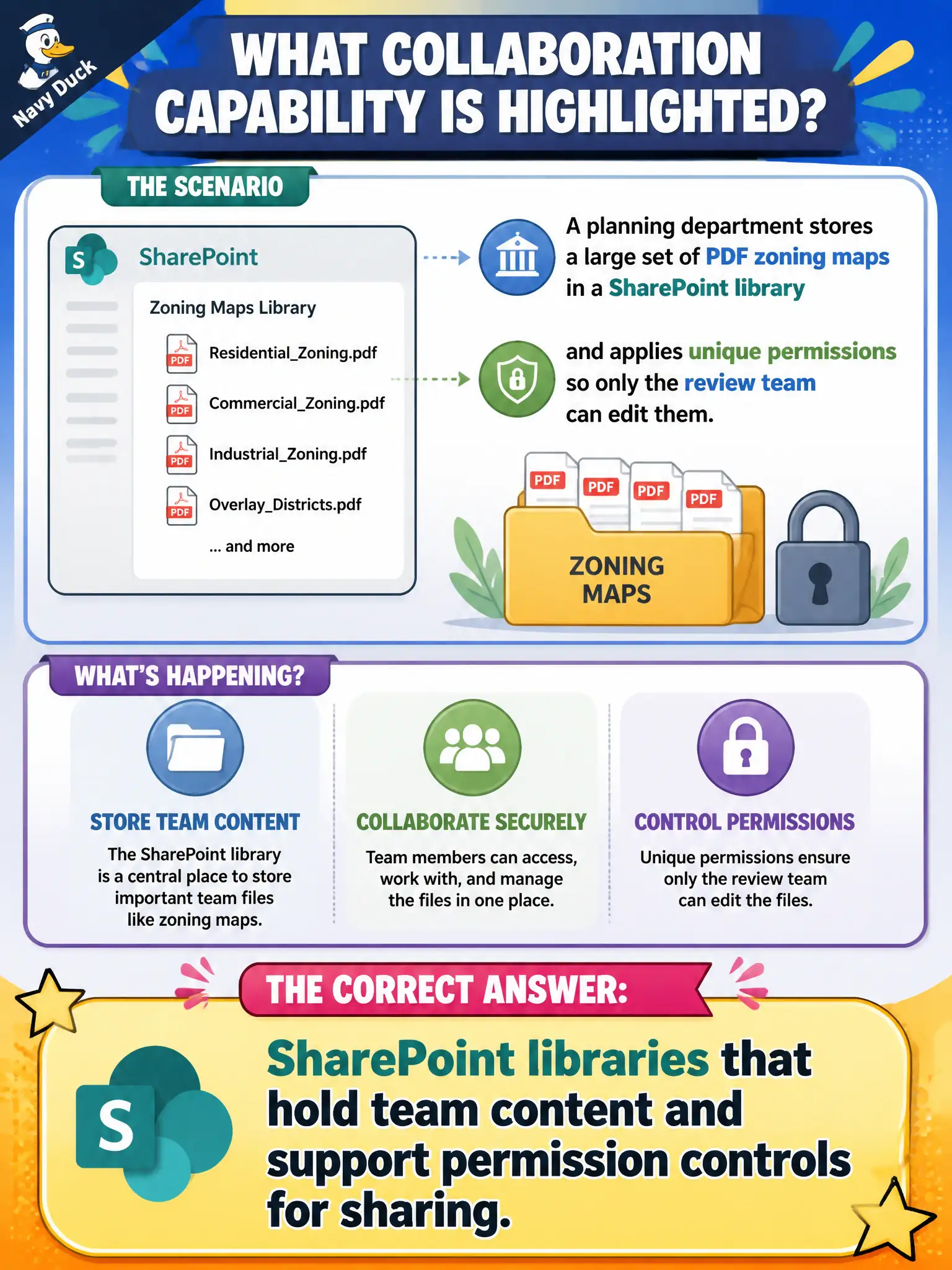
A planning department stores a large set of PDF zoning maps in a SharePoint library and applies unique permissions so only the review team can edit them. What collaboration capability does that highlight?
Select an answer to reveal the explanation.
Short Explanation
Maps belong in a shared cabinet with labeled keys—not in everyone's desk drawer. SharePoint libraries give departments a place for PDFs and other files with permissions that fit who should edit versus who should only read. That's SharePoint content sharing at fundamentals depth.
Full Explanation
A planning department storing PDF zoning maps in a SharePoint library and applying unique permissions so only the review team can edit them highlights SharePoint libraries that hold team content and support permission controls for sharing. SharePoint is the team and organization content backbone: libraries, permissions, and governed sharing for departmental records—not softphones or virtual desktop pools pretending to be document libraries.
Teams Phone softphone licensing fails as the primary way to store map PDFs because telephony licensing is unrelated to document libraries. Azure Virtual Desktop host pools fail as the only supported document library because session hosts deliver desktops; they are not the SharePoint content service. Claiming OneDrive personal links cannot be used for any departmental content overstates personal-versus-team boundaries incorrectly; the correct teaching point is that departmental libraries with unique permissions are a SharePoint strength.
Exam caveat: unique permissions are powerful but should be used deliberately; MS-900 still expects you to recognize SharePoint libraries plus permission controls as the collaboration capability in this stem.
Operational check: place zoning maps in a SharePoint library, break inheritance only where justified, grant edit to the review team and read to broader planners as needed, document the permission model, and avoid storing the department’s system-of-record maps only in unmanaged personal locations.