
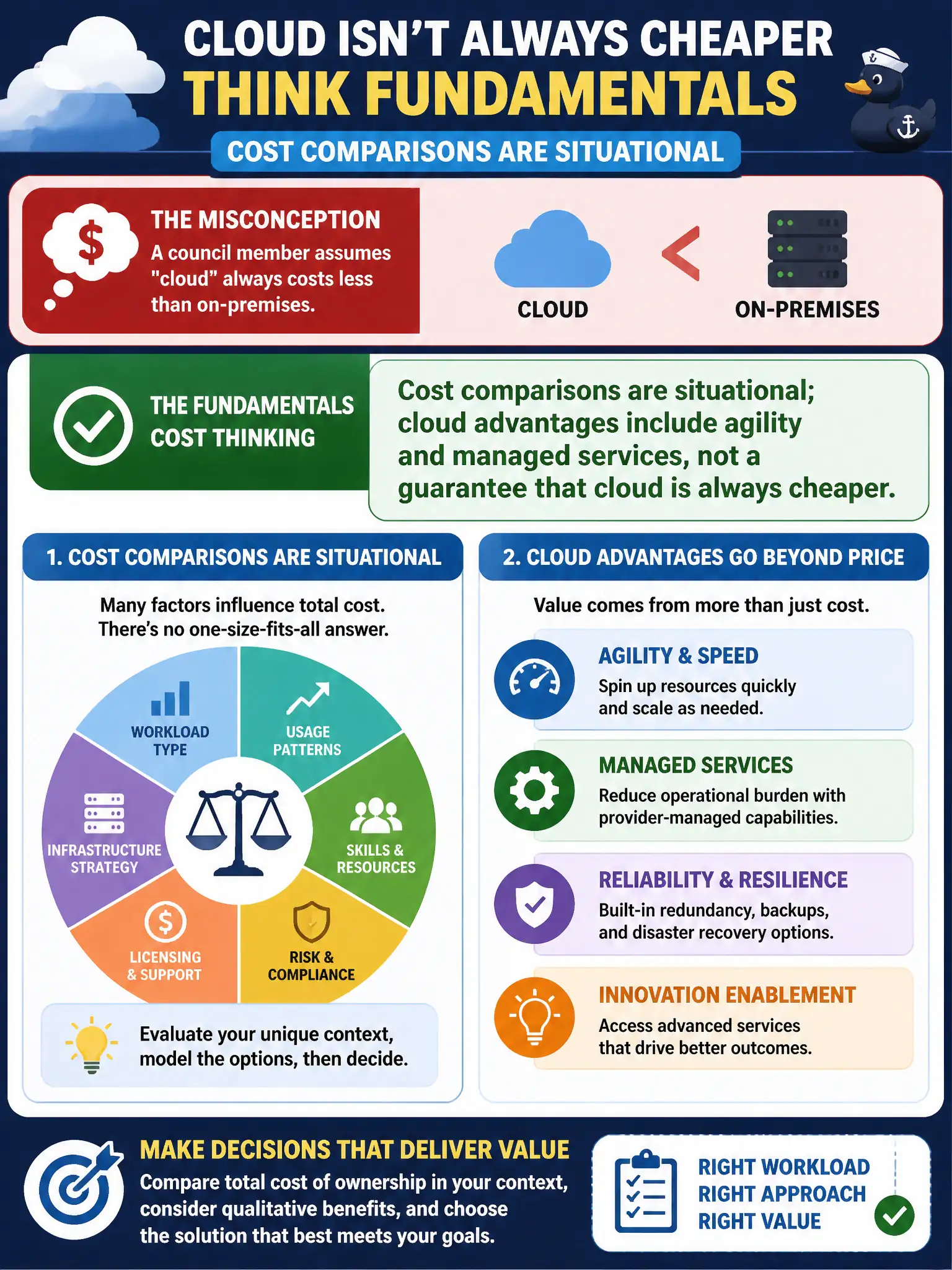
A council member assumes "cloud" always costs less than on-premises. Which statement best reflects fundamentals cost thinking?
Select an answer to reveal the explanation.
Short Explanation
"Cloud is always cheaper" is a bumper sticker, not a budget analysis. Sometimes it wins on agility and managed services; sometimes a quiet on-prem workload still pencils out. Compare thoughtfully.
Full Explanation
Fundamentals cost thinking treats cloud versus on-premises comparisons as situational. Cloud can offer agility, managed services, and elastic capacity for municipal workloads, but those advantages are not a universal guarantee that cloud is always cheaper in every city for every system. A council member who assumes “cloud always costs less” needs that nuanced comparison framing before budget votes.
Claiming cloud is universally the cheapest option for every municipality and every workload fails because total cost depends on licenses, integration, exit costs, and staffing. Claiming on-premises is always free fails because hardware still needs power, cooling, refresh cycles, facilities, and administrators. Saying Microsoft 365 pricing eliminates any need to compare total cost of ownership fails public-finance decision hygiene for elected oversight.
Exam caveat: exam items often punish absolute “always cheaper” language even when cloud is attractive for a given scenario. Operational check: build a simple TCO worksheet for the contested workload covering licenses, admin time, refresh, and risk; review it with finance before the council vote; and revisit cost assumptions annually as usage changes.