
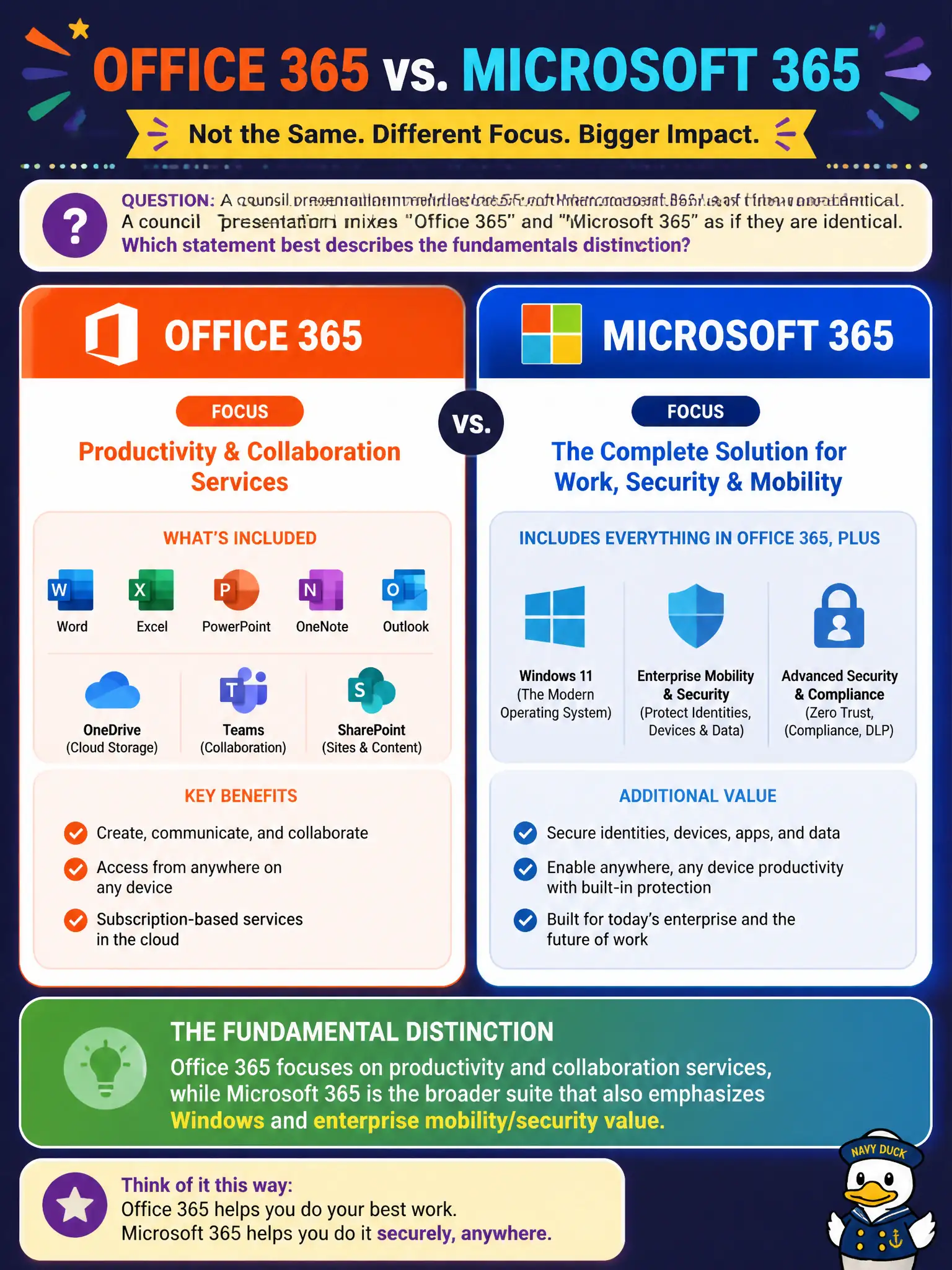
A council presentation mixes "Office 365" and "Microsoft 365" as if they are identical. Which statement best describes the fundamentals distinction?
Select an answer to reveal the explanation.
Short Explanation
Think "Office 365" as the productivity core, and "Microsoft 365" as that core plus more OS, device, and security storytelling. Same family, not perfect synonyms—Microsoft 365 is the wider umbrella at fundamentals depth.
Full Explanation
At Microsoft 365 fundamentals depth, Office 365 focuses on productivity and collaboration services, while Microsoft 365 is the broader suite that also emphasizes Windows and enterprise mobility or security value alongside those productivity services. When a council presentation treats the names as identical, the candidate should teach that related-but-broader Microsoft 365 scope rather than collapsing the brands into perfect synonyms.
Saying Office 365 and Microsoft 365 are unrelated products that never share productivity apps fails because they are closely related offerings with shared Office-centric DNA. Claiming Microsoft 365 is only a new Windows logo and never includes Office productivity services fails the suite definition. Claiming Microsoft 365 removes Word and Excel while only Office 365 includes those apps fails because Word and Excel remain core Microsoft 365 productivity applications for municipal staff.
Exam caveat: marketing names and SKU bundles evolve; exam items reward the “productivity core versus broader Windows, device, and security suite” distinction more than memorizing every add-on name. Operational check: in RFPs, budget memos, and council decks, explicitly state whether the city needs productivity collaboration alone or the fuller Microsoft 365 endpoint management and security story so purchasing and licensing match civic intent.